

Not sure what to eat on a ketogenic diet? Here’s a quick food list for you to reference.
Below you’ll find a brief overview of what you can eat. Scroll further down to see more details on each section.
Being on a diet isn’t the easiest thing in the world, especially when you don’t know what you should eat. We’ve put together this ketogenic diet food list to help people out there make decisions on what they are eating and shopping for.
Below you can find a quick visual guide to what to eat on a ketogenic diet. Let’s go over some of the commonly identifiable items that people use on keto:
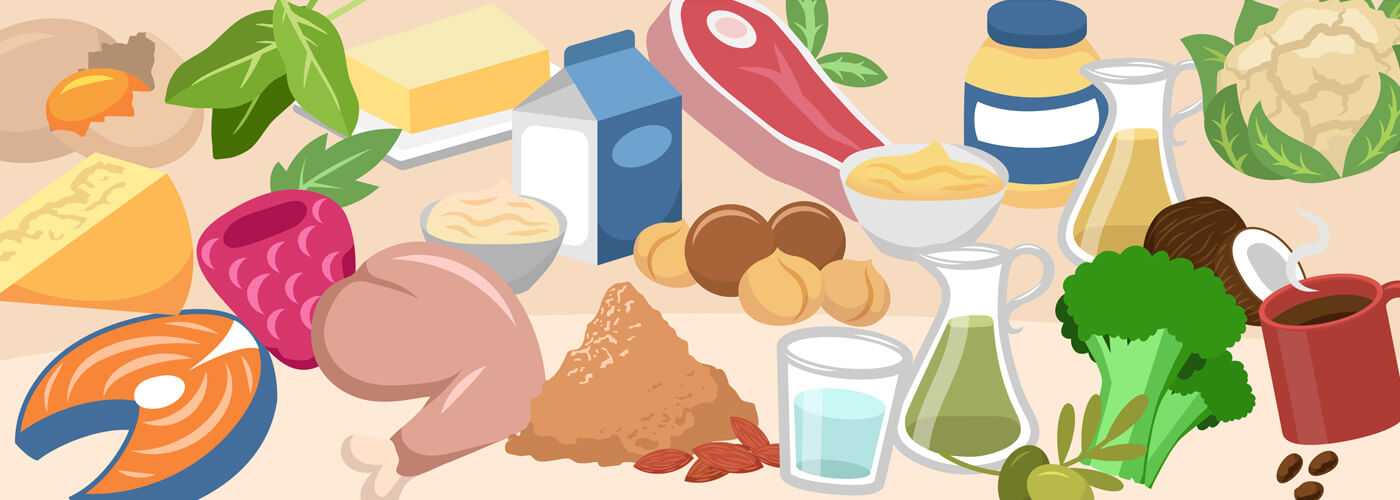
All of the food above sticks to the strict 5% carbohydrate allowance that we use on keto. In general, you can eat from the following food groups:
- Fats & Oils. Try to get your fat from natural sources like meat and nuts. Supplement with saturated and monounsaturated fats like coconut oil, butter, and olive oil.
- Protein. Try to stick with organic, pasture-raised and grass-fed meat where possible. Most meats don’t have added sugar in them, so they can be consumed in moderate quantity. Remember that too much protein on a ketogenic diet is not a good thing.
- Vegetables. Fresh or frozen doesn’t matter. Stick with above ground vegetables, leaning toward leafy/green items.
- Dairy. Most dairy is fine, but make sure to buy full-fat dairy items. Harder cheeses typically have fewer carbs.
- Nuts and Seeds. In moderation, nuts and seeds can be used to create some fantastic textures. Try to use fattier nuts like macadamias and almonds.
- Beverages. Stay simple and stick to mostly water. You can flavor it if needed with stevia-based flavorings or lemon/lime juice.
Here’s an overview video that quickly goes over our keto food list. If you scroll down, you can see in-depth breakdowns of each section along with some ideas on what types of food to eat! If you’re not much of the planning type and would rather follow along to get meal ideas, take a look at our Keto Academy Program >
Fats and Oils
Fats will be the majority of your daily calorie intake when you are on a ketogenic diet, so choices should be made with your likes and dislikes in mind. They can be combined in many different ways to add to your meals – sauces, dressings, or just simply topping off a piece of meat with butter.
Fats are vital to our bodies, but they can also be dangerous if you are consuming too much of the wrong types of fats. There are a few different types of fat that are involved in a ketogenic diet. Different foods usually have various combinations of fats, but the unhealthy fats are easy to avoid. Here’s a brief overview:
- Saturated Fats. Eat these. Some examples of these are butter, ghee, coconut oil, and lard.
- Monounsaturated Fats. Eat these. Some examples of these are olive, avocado, and macadamia nut oils.
- Polyunsaturated Fats. Know the difference. Naturally occurring polyunsaturated fats in animal protein and fatty fish are great for you, and you should eat these. Processed polyunsaturated fats in “heart healthy” margarine spreads are bad for you.
- Trans Fats. Completely avoid. These are processed fats that are chemically altered (hydrogenated) to improve shelf life. Avoid all hydrogenated fats, such as margarine, as they’re linked to heart disease.
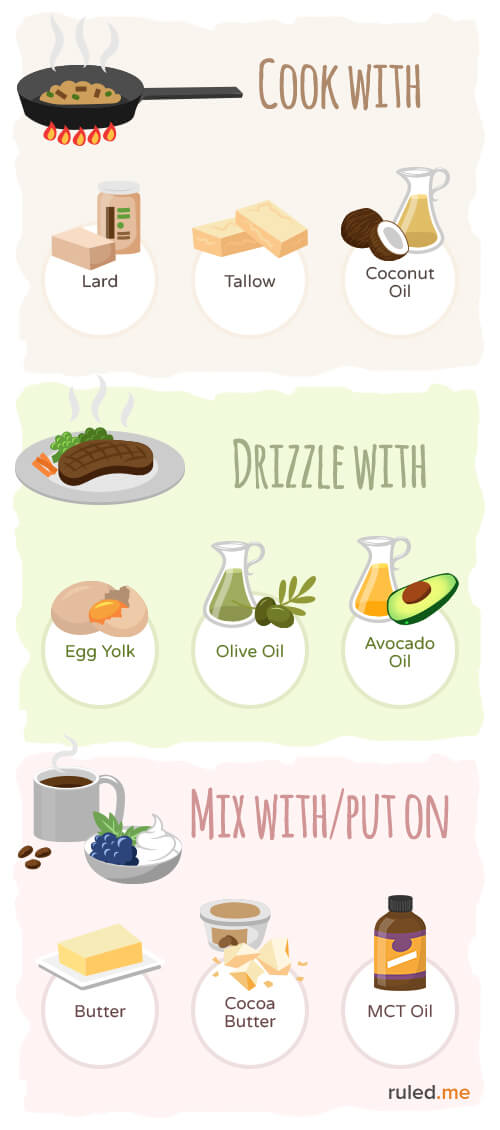
Saturated and monounsaturated fats such as butter, macadamia nuts, avocado, egg yolks, and coconut oil are more chemically stable and less inflammatory to most people, so they are preferred. Below, you can see some common ways to increase the amounts of fat you eat on a ketogenic diet.
You also want to have a balance between your omega 3’s and omega 6’s, so eating things like wild salmon, tuna, trout, and shellfish can help provide a balanced diet of Omega-3’s. If you don’t like fish, or just prefer not to eat it, we suggest taking a small fish oil supplement. You can also take krill oil for omega 3’s if you are allergic.
Keep an eye on your intake for nut or seed based foods, as they can be quite high in inflammatory omega 6’s. These include items like almonds, walnuts, pine nuts, sunflower oil and corn oil. Eating fatty fish and animal meat, keeping snacking to a minimum, and not over-indulging in dessert items that are dense in almond flour is usually enough to keep your omega’s at normal ranges.
Essential fatty acids (the omegas) provide core functions to the human body, but they are often times out of balance when on a standard diet. On keto, with a little bit of preparation, your omega fatty acids are easily manageable. If you want to know more about essential fatty acids, omegas, and how they interact with our body on a ketogenic diet, you can read more here >
Some ketogenic diet foods that are ideal for fats and oils (organic and grass-fed sources are preferred):
- Fatty Fish
- Animal Fat (non-hydrogenated)
- Lard
- Tallow
- Avocados
- Egg Yolks
- Macadamia/Brazil Nuts
- Butter/Ghee
- Mayonnaise
- Coconut Butter
- Cocoa Butter
- Olive Oil
- Coconut Oil
- Avocado Oil
- Macadamia Oil
- MCT Oil
If you’re using vegetable oils (olive, soybean, flax, or safflower) choose the “cold pressed” options if they are available.
If you tend to fry things up, try to go after non-hydrogenated lards, beef tallow, ghee, or coconut oil since they have higher smoke points than other oils. This allows less oxidization of the oils, which means you get more of the essential fatty acids.
Protein
Below, you’ll find a visual list of proteins that are commonly consumed on a ketogenic diet. Note that the higher the amount of protein, the less you will want to consume.
Your best bet when it comes to protein is choosing pasture-raised and grass-fed. This will minimize your bacteria and steroid hormone intake. Try to choose the darker meat where possible with poultry, as it is much fattier than white meat. Eating fatty fish is a great way to get omega 3’s in as well.
When it comes to red meat, there’s not too much to avoid. Cured meats and sausages can sometimes have added sugars and added processed ingredients. If you eat steak, try to choose fattier cuts like ribeye. If you like hamburger meat (ground beef), try to choose fattier ratios like 85/15 or 80/20 in some cases.
One thing you do need to be careful of when dealing with meat is your protein intake. Too much protein on a ketogenic diet can lead to lower levels of ketone production and increased production of glucose. You want to aim for nutritional ketosis, so you must not over-consume on protein.
Try to balance out the protein in your meals with fattier side dishes and sauces. If you choose to eat lean beef, you have to be especially careful with the portioning of protein. Jerky and other beef snacks can add up in protein very fast, so make sure to pair it with something fatty – like cheese!
Note: If you don’t eat pork or beef, you can always substitute lamb in its place since it is very fatty. Replace cuts of meat like bacon with similar, leaner items. Add extra fat if needed.
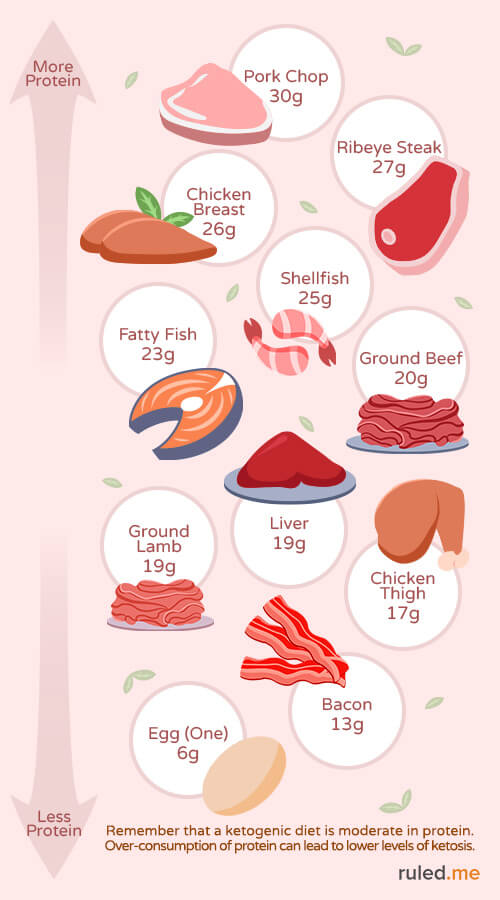
Some examples of how to get your protein in on a ketogenic diet are below:
- Fish. Preferably eating anything that is caught wild like catfish, cod, flounder, halibut, mackerel, mahi-mahi, salmon, snapper, trout, and tuna. Fattier fish is better.
- Shellfish. Clams, oysters, lobster, crab, scallops, mussels, and squid.
- Whole Eggs. Try to get them free-range from the local market if possible. You can prepare them in many different ways like fried, deviled, boiled, poached, and scrambled.
- Beef. Ground beef, steak, roasts, and stew meat. Stick with fattier cuts where possible.
- Pork. Ground pork, pork loin, pork chops, tenderloin, and ham. Watch out for added sugars and try to stick with fattier cuts.
- Poultry. Chicken, duck, quail, pheasant and other wild game.
- Offal/Organ. Heart, liver, kidney, and tongue. Offal is one of the best sources of vitamins/nutrients.
- Other Meat. Veal, Goat, Lamb, Turkey and other wild game. Stick with fattier cuts where possible.
- Bacon and Sausage. Check labels for anything cured in sugar, or if it contains extra fillers. Don’t be overly concerned with nitrates.
- Nut Butter. Go for natural, unsweetened nuts and try to stick with fattier versions like almond butter and macadamia nut butter. Legumes (peanuts) are high in omega 6’s so be careful about over-consumption.
Here’s a nutritional list of some of the most commonly consumed proteins on keto and their respective nutritional profile. Keep in mind that you still need to balance your protein intake with fat.
| Keto Protein Source | Calories | Fats (g) | Net Carbs (g) | Protein (g) |
| Ground beef (4 oz., 80/20) | 280 | 23 | 0 | 20 |
| Ribeye steak (4 oz.) | 330 | 25 | 0 | 27 |
| Bacon (4 oz.) | 519 | 51 | 0 | 13 |
| Pork chop (4 oz.) | 286 | 18 | 0 | 30 |
| Chicken thigh (4 oz.) | 250 | 20 | 0 | 17 |
| Chicken breast (4 oz.) | 125 | 1 | 0 | 26 |
| Salmon (4 oz.) | 236 | 15 | 0 | 23 |
| Ground lamb (4 oz.) | 319 | 27 | 0 | 19 |
| Liver (4 oz.) | 135 | 5 | 0 | 19 |
| Egg (1 large) | 70 | 5 | 0.5 | 6 |
| Almond butter (2 tbsp.) | 180 | 16 | 4 | 6 |
Remember that protein is always to be consumed in moderation. If you need help knowing how much protein to eat, we recommend visiting the Keto Calculator >
Vegetables and Fruit
Below, you’ll find a visual list of fruit and veggies that are commonly consumed on a ketogenic diet. Note that the higher the amount of carbs, the less you will want to consume.
Vegetables are a paramount part of a healthy keto diet, but sometimes we’re stuck with decisions we might regret later. Some vegetables are high in sugar and don’t cut it nutritionally – so we need to weed them out.
The best type of vegetables for a ketogenic diet are high in nutrients and low in carbohydrates. These, as most of you can guess, are dark and leafy. Anything that resembles spinach or kale will fall into this category and will be the best thing to include in anything you can.
Try to go after cruciferous vegetables that are grown above ground, leafy, and green. If you can opt for organic as there are fewer pesticide residues, but if you can’t then don’t worry. Studies show that organic and non-organic vegetables still have the same nutritional qualities. Both frozen and fresh vegetables are good to eat.
Note: Vegetables that grow below ground can still be consumed in moderation – you just have to be careful about the number of carbs that they have. Usually, underground vegetables can be used for flavor (like half an onion for an entire pot of soup) and easily moderated.
In general, there’s no fitting rule that works perfectly. Try to choose your vegetables with carbohydrates in mind and portion them based on their carb counts.
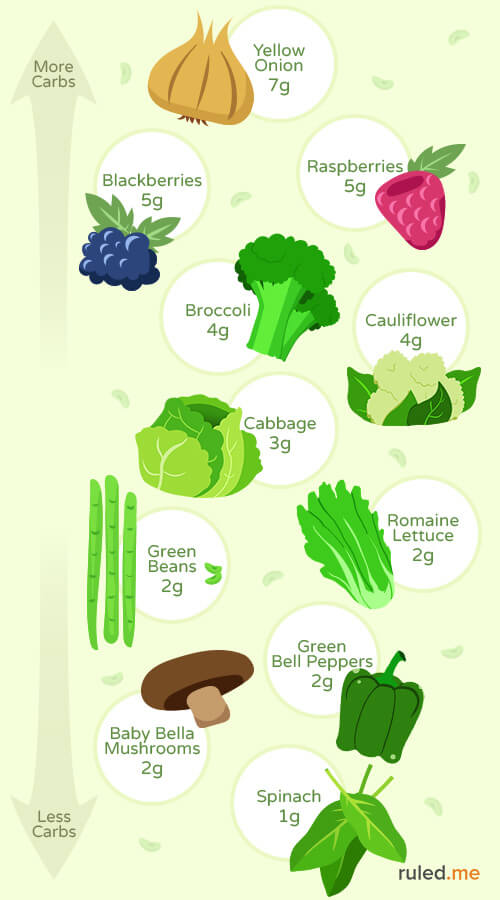
Be careful and monitor the vegetables (and their respective carb counts) you add to any of your meals. Especially try to limit your intake of:
- Higher carb vegetables. This includes onion, parsnip, garlic, mushrooms, and squash.
- Nightshades. This includes tomato, eggplant, and peppers.
- Berries. This includes raspberries, blackberries, and blueberries.
- Citrus. This includes lemon, lime, and orange juice (or zest) in water and in recipes.
- Completely avoid starchy vegetables and large fruits like potatoes and bananas.
Here’s a nutritional list of some of the more commonly consumed vegetables on keto. Keep in mind that the weights are the same of everything listed so that it will impact the skew of the carb counts. For example, in a meal you may have 6 oz. of broccoli in the side, but you would not have 6 oz. worth of berries in the morning. You may mix 6 oz. of berries into a pudding with 4 servings.
| Keto Veggie/Fruit Source | Calories | Fats (g) | Net Carbs (g) | Protein (g) |
| Cabbage (6 oz.) | 43 | 0 | 6 | 2 |
| Cauliflower (6 oz.) | 40 | 0 | 6 | 5 |
| Broccoli (6 oz.) | 58 | 1 | 7 | 5 |
| Spinach (6 oz.) | 24 | 0 | 1 | 3 |
| Romaine Lettuce (6 oz.) | 29 | 1 | 2 | 2 |
| Green Bell Pepper (6 oz.) | 33 | 0 | 5 | 1 |
| Baby Bella Mushrooms (6 oz.) | 40 | 0 | 4 | 6 |
| Green Beans (6 oz.) | 26 | 0 | 4 | 2 |
| Yellow Onion (6 oz.) | 68 | 0 | 12 | 2 |
| Blackberries (6 oz.) | 73 | 1 | 8 | 2 |
| Raspberries (6 oz.) | 88 | 1 | 8 | 2 |
You may notice that fruits and vegetables that grow underground tend to have higher carb counts, so they must be monitored and limited. To see a full list of low carb vegetables, take a look at the best low-carb vegetables list >
Dairy Products
Below, you’ll find a visual list of dairy that is commonly consumed on a ketogenic diet. Note that the higher the amount of carbs, the less you will want to consume.
Dairy is commonly consumed in tandem with meals on keto. Try to keep your dairy consumption to a moderate level. Most of your meals should be coming from protein, vegetables, and added fats/cooking oils.
Raw and organic dairy products are preferred here, if available. Highly processed dairy normally has 2-5x the number of carbohydrates as raw/organic dairy so it does add up over time. Make sure to choose full fat products over fat-free or low-fat as they will have significantly more carbs and less “filling” effects.
If you have lactose sensitivities, stick with very hard and long-aged dairy products as they contain much less lactose. Some examples of dairy you can eat on keto are:
- Greek yogurt
- Heavy whipping cream
- Spreadables including cottage cheese, cream cheese, sour cream, mascarpone, creme fraiche, etc.
- Soft Cheese including mozzarella, brie, blue, colby, monterey jack, etc.
- Hard Cheese including aged cheddar, parmesan, feta, swiss, etc.
- Mayonnaise and mayo alternatives that include dairy.
Dairy is a great way to add extra fats into meals by creating sauces or fatty side dishes like creamed spinach, but always remember that it does have protein in it as well. You should always take this into account when pairing dairy with protein-heavy dishes.
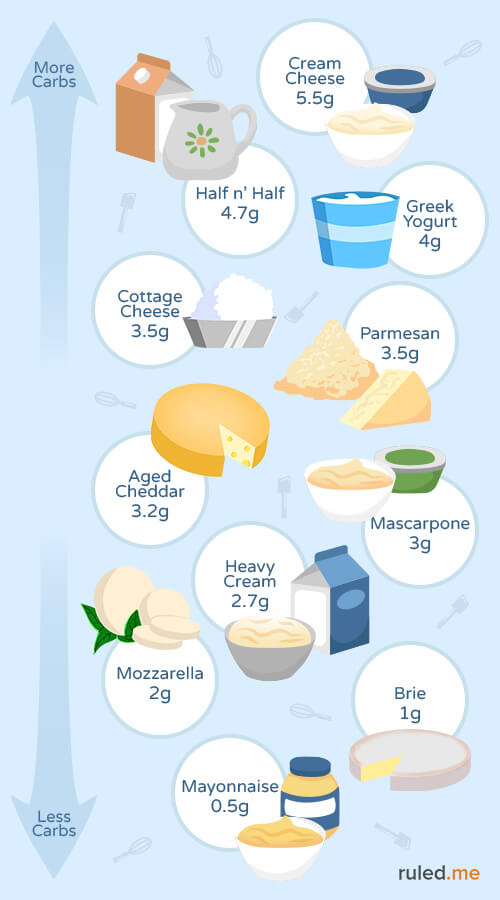
Below you’ll find a nutritional list of the most commonly consumed dairy items on keto. By far the most common dairy items used are heavy cream (for tea/coffee) and cheese (for added fats in meals). Note that the nutrition values in the table are based on 1 oz. servings while the visual guide is based on 100g servings (~1/2 cup).
| Keto Dairy Source | Calories | Fats (g) | Net Carbs (g) | Protein (g) |
| Heavy cream (1 oz.) | 100 | 12 | 0 | 0 |
| Greek yogurt (1 oz.) | 28 | 1 | 1 | 3 |
| Mayonnaise (1 oz.) | 180 | 20 | 0 | 0 |
| Half n’ half (1 oz.) | 40 | 4 | 1 | 1 |
| Cottage cheese (1 oz.) | 25 | 1 | 1 | 4 |
| Cream Cheese (1 oz.) | 94 | 9 | 1 | 2 |
| Mascarpone (1 oz.) | 120 | 13 | 0 | 2 |
| Mozzarella (1 oz.) | 70 | 5 | 1 | 5 |
| Brie (1 oz.) | 95 | 8 | 0 | 6 |
| Aged Cheddar (1 oz.) | 110 | 9 | 0 | 7 |
| Parmesan (1 oz.) | 110 | 7 | 1 | 10 |
Some people experience slower weight loss when over-consuming cheese. If you notice that you have hit a plateau or slowed down in weight loss, you may want to consider reducing the amount of dairy you eat. To see a full list of low carb dairy products, take a look at the best keto dairy list >
Nuts and Seeds
Below, you’ll find a visual list of nuts that are commonly consumed on a ketogenic diet. Note that the higher the amount of carbs, the less you will want to consume.
Nuts and seeds are best when they are roasted to remove any anti-nutrients. Try to avoid peanuts if possible, as they are legumes which are not highly permitted in the ketogenic diet food list.
Typically raw nuts can be used to add flavorings or texture to meals. Some people choose to consume them as snacks – which can be rewarding but may work against weight loss goals. Snacking, in general, will raise insulin levels and lead to slower weight loss in the long term.
Nuts can be a great source of fats, but you always have to remember that they do have carbohydrate counts that can add up quickly. It’s also particularly important to note that they do contain protein as well. Nut flours especially can add up in protein rather fast – so be wary of the amount you use.
Nuts can also be high in omega 6 fatty acids, so it’s good to be careful with the amount you consume. For typical eating, you want to stick with fattier and lower carbohydrate nuts.
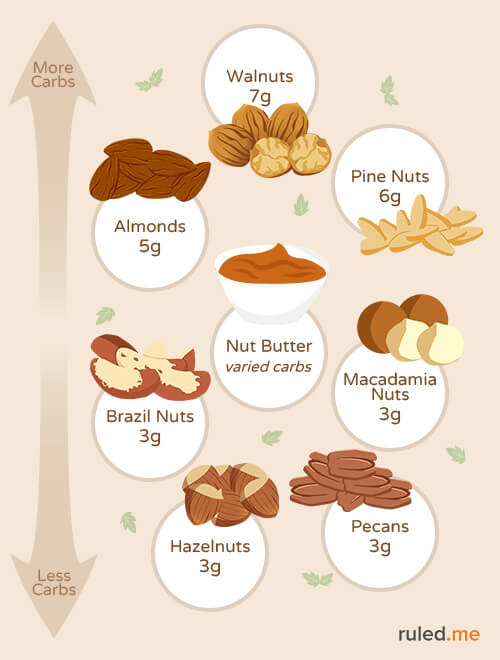
Next time you’re thinking about opening a new bag of nuts to eat, consider what’s better for you on keto from the following:
- Fatty, low carbohydrate nuts. Macadamia nuts, brazil nuts, and pecans can be consumed with meals to supplement fat.
- Fatty, moderate carbohydrate nuts. Walnuts, almonds, hazelnuts, peanuts, and pine nuts can be used in moderation to supplement for texture or flavor.
- Higher carbohydrate nuts. Pistachios and cashews should rarely be eaten or avoided as they’re very high in carbohydrates (2 handfuls of cashews is almost a full day’s allowance of carbs).
Note: If you have a nut allergy, a common substitution for almond flour is sunflower seed flour. Just keep in mind that this has higher levels of omega 6 fatty acids.
Below you’ll see a nutritional list of some examples of the most commonly consumed nuts on keto. Remember that snacking will slow down weight loss:
| Keto Nut Source | Calories | Fats (g) | Net Carbs (g) | Protein (g) |
| Macadamia Nuts (2 oz.) | 407 | 43 | 3 | 4 |
| Brazil Nuts (2 oz.) | 373 | 37 | 3 | 8 |
| Pecans (2 oz.) | 392 | 41 | 3 | 5 |
| Almonds (2 oz.) | 328 | 28 | 5 | 12 |
| Hazelnuts (2 oz.) | 356 | 36 | 3 | 9 |
Below, you’ll find a visual list of nut and seed flours that are commonly consumed on a ketogenic diet. Note that the higher the amount of carbs, the less you will want to consume.
Nut and seed flours are great to substitute for regular flour. Commonly consumed on keto, seeds and nuts are frequently seen in baked recipes and dessert recipes. We often see the use of nuts (in almond flour) and seeds (in flaxseed meal) but should be eaten in moderation.
You can usually use a mix of multiple flours to get a realistic texture in baking recipes. Combining flours and experimenting with your baking can lead to much lower net carb counts in recipes. We think these lemon poppyseed muffins (a mix of almond flour and flaxseed meal) make a great texture when combined with the fats from the heavy cream and butter.
Remember that different flours act in different ways as well. For example, you would only need about half the amount of coconut flour as you would almond flour. Coconut flour is much more absorptive and generally, requires more liquid.
Besides baking, you can also use these flours as a breading when frying foods or even as a pizza base!
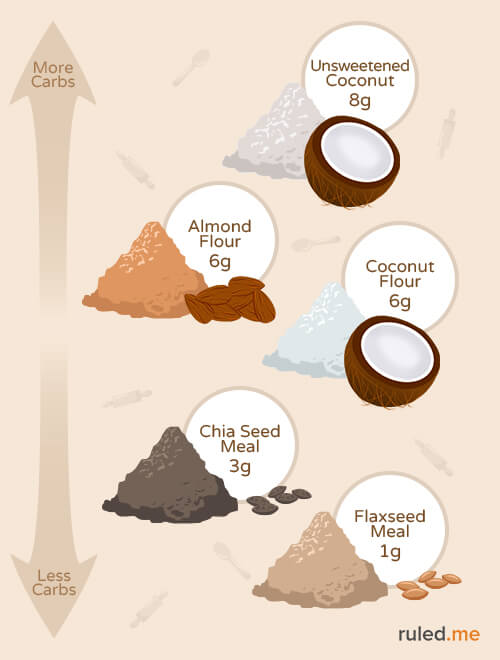
When you get creative enough, there’s always a way to make a low-carb version of an old favorite. If you need some ideas, check out our keto cheat sheet >
You can see a nutritional list of some examples of commonly consumed keto nut/seed items below:
| Keto Nut/Seed Baking Source | Calories | Fats (g) | Net Carbs (g) | Protein (g) |
| Almond Flour (2 oz.) | 324 | 28 | 6 | 12 |
| Coconut Flour (2 oz.) | 120 | 4 | 6 | 4 |
| Chia Seed Meal (2 oz.) | 265 | 17 | 3 | 8 |
| Flaxseed Meal (2 oz.) | 224 | 18 | 1 | 8 |
| Unsweetened Coconut (2 oz.) | 445 | 40 | 8 | 4 |
Water and Beverages
Below, you’ll find a visual list of beverages that are commonly consumed on a ketogenic diet. Note that the more restricted they are, the less you will want to consume.
The ketogenic diet has a natural diuretic effect, so dehydration is common for most people starting out. If you’re prone to urinary tract infections or bladder pain, you have to be especially prepared.
The eight glasses of water we’re recommended to drink? Drink those, and then some more. Considering we’re made up of about two-thirds water, hydration plays a substantial role in our everyday life. We recommend that you try to drink as close to a gallon of water a day as possible.
Many people choose ketoproof coffee or tea in the morning to ramp up energy with added fats. While it is a great thing, it’s also important to consume flavored beverages in moderation. This is amplified when it comes to caffeine as too much will lead to weight loss stalls; try to limit yourself to a maximum of 2 cups of caffeinated beverages a day.
Note: Many people experience the Keto Flu when transitioning to keto due to dehydration and lack of electrolytes. Make sure that you replenish your electrolytes and drink plenty of fluids. An easy way to do this is by drinking bone broth or sports drinks sweetened with sucralose or stevia.
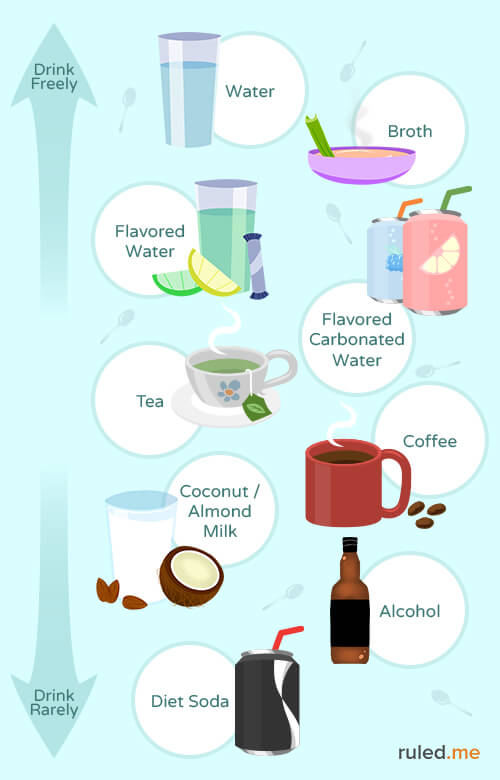
Some examples of commonly consumed beverages on keto are below:
- Water. This will be your staple, go-to source for hydration. You can drink still or sparkling water.
- Broth. Loaded with vitamins and nutrients. More importantly, it will kickstart your energy by replenishing your electrolytes.
- Coffee. Improves mental focus and has some added weight loss benefits.
- Tea. Has the same effects as coffee, but many don’t enjoy tea. Try to stick with black or green.
- Coconut/Almond milk. You can use the unsweetened versions in the carton from the store to replace your favorite dairy beverage.
- Diet soda. Try to severely reduce or completely stop drinking this. It can lead to sugar cravings and sometimes insulin spikes in the long run.
- Flavoring. The small packets that are flavored with sucralose or stevia are fine. You can alternatively add a squeeze of lemon, lime, or orange to your water bottle.
- Alcohol. Choose hard liquor. More beer and wine will be too high carb to consume. Frequent consumption of alcohol will slow weight loss down. Read more here >
Many people enjoy keeping themselves accountable by creating challenges for themselves. We use a 32 oz. water bottle and put four hair ties around it. Each time we finish a bottle, we take away a hair tie. Keep drinking until there’s no more!
Spices and Cooking
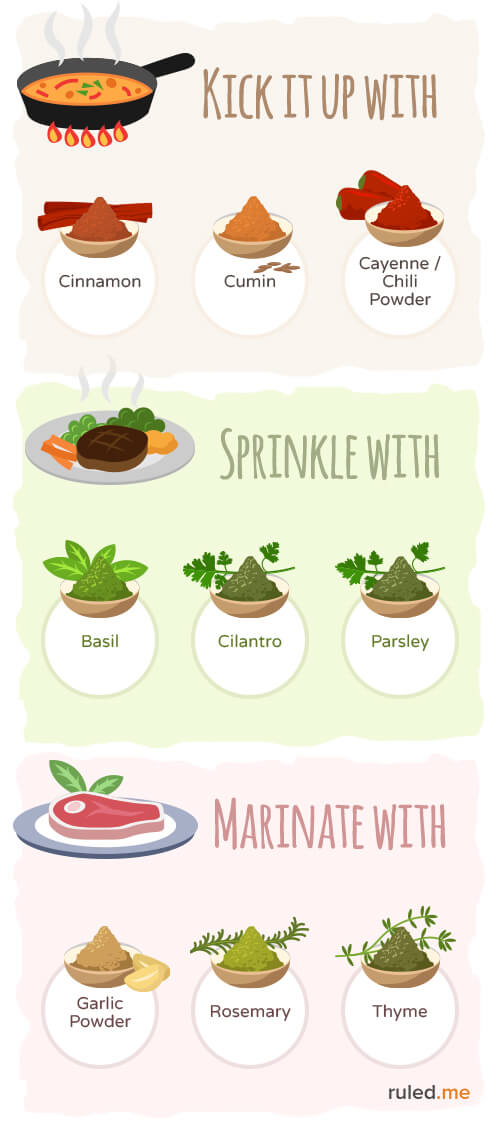
Below, you’ll find a visual idea of spices that are commonly consumed on a ketogenic diet. Even small ingredients can add up in carbs; make sure to monitor spices and condiments that you add to your meals.
Seasonings and sauces are a tricky part of ketogenic diet foods, but people use them on a regular basis to add flavor to their meals. The easiest way to remain strict here is to avoid processed foods. There are many low carb condiments and products on the market, and there’s no way to list them all. A handful of them are great, but the majority use high glycemic index sweeteners – which you want to avoid.
Spices have carbs in them, so make sure you are adding them to your counts. Sea salt is preferred over table salt, as it is usually mixed with powdered dextrose. Most pre-made spice mixes will have sugars added to them, so make sure you read the nutrition label beforehand to make sure you know what’s inside. If you have the choice, never include added sugar into your spice blends or food.
Below you’ll find some common herbs and spices that people use on a ketogenic diet. Always remember that spices do have carbs in them, so you should make sure to adjust your nutrition based on this.
- Cayenne Pepper
- Chili Powder
- Cinnamon
- Cumin
- Oregano
- Basil
- Cilantro
- Parsley
- Rosemary
- Thyme
Both salt and pepper can be used for seasoning without worrying about the nutritional information.
Typically speaking, the number of carbs in spices is minimal, so you don’t have to drive yourself crazy with measuring and recording. When using a lot of spices in a recipe, carbs can add up quickly.
If you want to see some examples of recipes where we use spices, feel free to look at our ever-growing library of keto recipes >
Condiments and Sauces
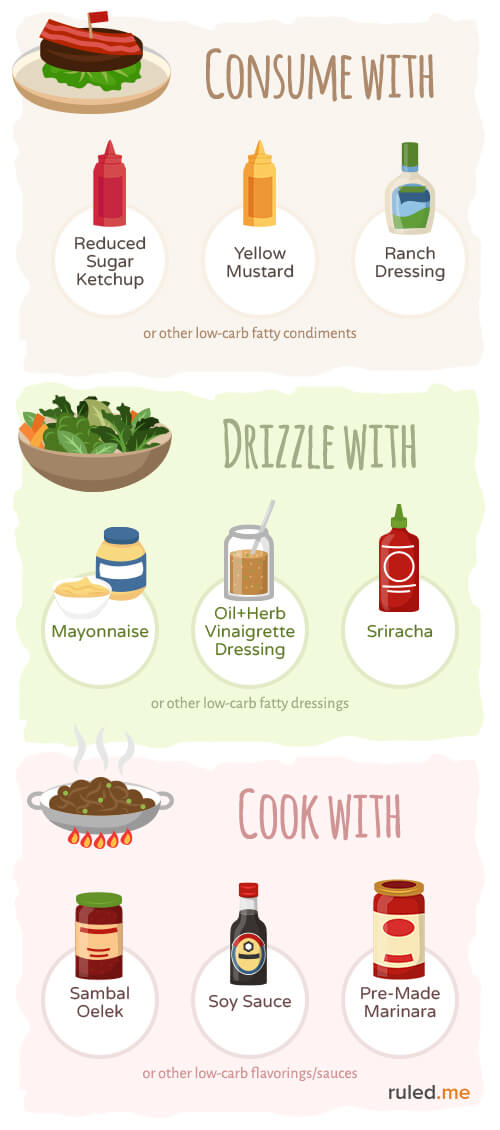
Below, you’ll find a visual idea of condiments that are commonly consumed on a ketogenic diet. Sometimes there is a lot of added sugar in just a teaspoon of sauce; double check nutrition labels to make sure it fits into your macros.
Sauces, gravies, and condiments, on the whole, have a lot of a gray area on keto. Generally, if you want to be strict, you should avoid all pre-made sauces and condiments unless listed below. They can have added sugars or use sweeteners that aren’t friendly on the ketogenic diet.
If you choose to make your sauces and gravies, you should consider investing in guar or xanthan gum. It’s a thickener that’s well known in modern cooking techniques and lends a hand to low carb by thickening otherwise watery sauces. Luckily there are many sauces to choose from that are high fat and low carb. If you’re in need of a sauce then consider making a beurre blanc, hollandaise or simply brown butter to top meats with.
Although great in health and theory, you may be like many others and not have the schedule to be able to make everything from scratch. Although it varies from brand to brand (make sure to read the ingredients), standard pre-made condiments for keto include:
- Ketchup (choose low, or no sugar added)
- Mustard
- Hot Sauce
- Mayonnaise (choose cage-free and avocado oil where possible)
- Sauerkraut (choose low, or no sugar added)
- Relish (choose low, or no sugar added)
- Horseradish
- Worcestershire Sauce
- Salad Dressings (choose fattier dressings like ranch, caesar, and unsweetened vinaigrettes)
- Flavored Syrups (choose acceptable sweeteners)
Try to err on the side of caution when it comes to keto condiments that are pre-made. Make your sauces and gravies using thickeners, and try to make your own condiments where applicable. Always double check the nutrition and ingredient list on your food to make sure that it fits in with your dietary requirements.
If you need some more ideas on how to use sauces and condiments in recipes, consider reading our keto cheat sheet >
Sweeteners
Below, you’ll find a visual list of sweeteners that are commonly consumed on a ketogenic diet. Note that the less accepted they are, the less you will want to consume.
Staying away from anything sweet tasting is the best bet – it will help curb your cravings to a minimal level, which essentially promotes success on the ketogenic diet. If you have to have something sweet, though, there are some options available to choose from.
When searching for sweeteners, try to go after liquid versions as they don’t have added binders (such as maltodextrin and dextrose). These are commonly found in blends like Splenda and can add up in carbs very, very quickly. For keto, you want to try to stick with lower glycemic index sweeteners.
Please note that this is just a small list of sweeteners that people use on keto. There’s tons of different brands and blends out there – we frequently use a mixture of stevia and erythritol in our dessert recipes. You may find something that suits your tastes better, though, just make sure that it is on the acceptable sweetener list.
Typically you want to stay away from any brands that use filler ingredients like maltodextrin and dextrose, or high glycemic sweeteners like maltitol. Many low-carb products that claim low net carbs usually use these sugar alcohols. Many candies that are “sugar-free” also use these sweeteners. Avoid them where possible. These specific sweeteners respond in our body in a similar way sugar does.
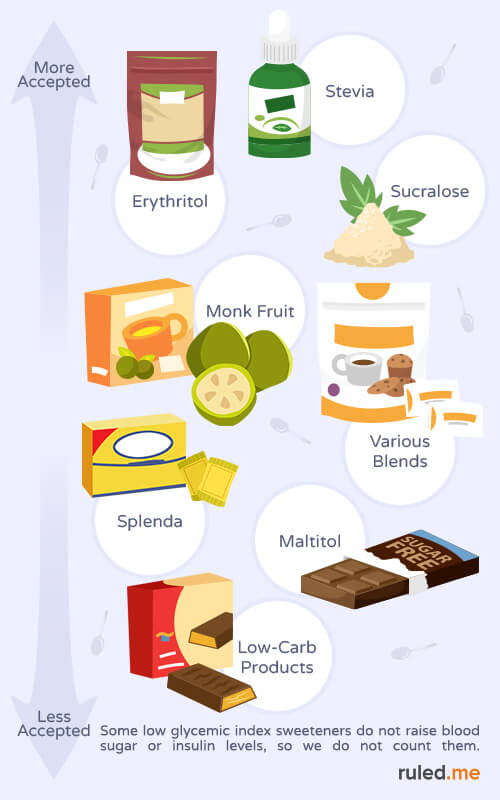
When a sweetener has a low glycemic impact (or a low glycemic index), it has little effect on blood sugar. The higher the glycemic index is, the higher your blood sugar will spike during consumption. Here’s our recommended list of 0 GI sweeteners:
- Stevia. One of the most common sugar substitutions used on the market today. Incredibly sweet with no glycemic impact. The liquid form is preferred.
- Sucralose. A very easy, but very sweet substitution to sugar that has a lot of misinformation around it. Many people confuse this with Splenda, but sucralose is the pure sweetener. Liquid versions are preferred.
- Erythritol. This is a great sugar substitution that has 0 glycemic impact. It’s special because it passes through our bodies undigested, and is excreted without absorbing the carbs.
- Monk fruit. This is a less common sweetener and usually used in combination with others. While somewhat rare, if you can find it, it makes a great balanced sweetener.
- Various blends. There are numerous brands on the market that combine these sweeteners in their ratios. Be careful and read the ingredients.
For those looking for something just a little closer to real sugar, you can use Xylitol. It cooks and tastes very similar to sugar, but it has a slight glycemic impact (13 vs. 100 for sugar). It is great, but please keep in mind that it is very toxic to animals and it will raise insulin levels slightly. These are the two most cited reasons for not using Xylitol.
If you want a more detailed list of the best and worst sweeteners to use on keto, click here >
Cravings and Sugar Addiction
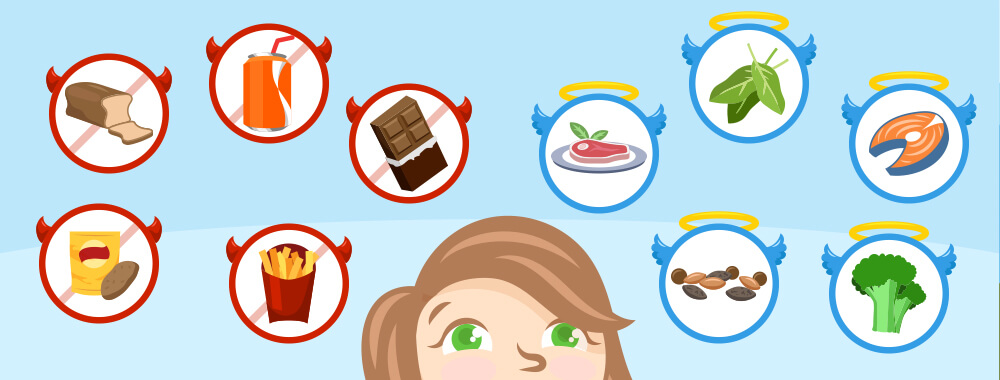
Most of the cravings that we get are caused by sugar. Sugar, at the end of the day, is an industry that’s run on addiction. There have been numerous studies showing that sugar stimulates the reward centers of the brain.
When we constantly consume sugar, we release dopamine in our brain – creating an addiction and an increased tolerance. Over time you will have to eat larger and larger amounts of sugar to continue the dopamine secretion. Once our body is dependent on a chemical reaction in the brain, we can find that we’re craving things even when we’re not hungry.
When trying to shift from a high carb diet to a ketogenic diet, cravings can definitely get strong. It’s always best to try to clean house before you start so that you don’t have food around you that can lead to cravings. We recommend that when switching to keto, you restrict using sweeteners completely for the first 30 days. It normally leads to breaking sugar addiction and ultimately not having cravings.
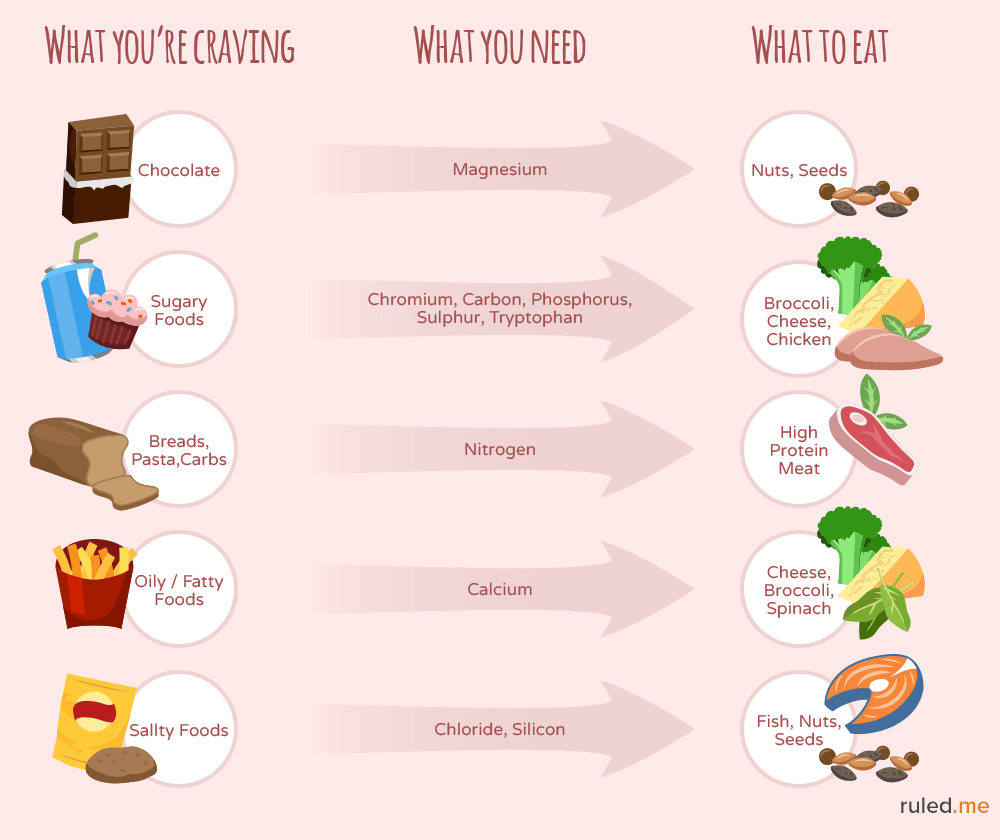
Besides sugar, sometimes our bodies crave food because of lack of nutrients. The craving usually goes away if you fulfill your nutrient intake in a different way. Below you’ll see a few ways to get rid of pesky cravings that hit.
Hidden Carbs and Nutrition Labels
Going on a ketogenic diet can be very difficult in the very beginning. Knowing what to eat and what not to eat takes some time to get used to, so if you make some mistakes in the beginning don’t be too hard on yourself. It’s better to make a mistake and learn from it than to make a mistake and not realize it was in error.
There’s always going to be foods that are bad for us when it comes to eating. Some foods are particularly sneaky at hiding carbohydrates from us. Here’s a small list of common items that sometimes have hidden carbs:
- Low-carb products. There’s a lot of choices when it comes to bars, snacks, and foods. It’s better to stay away from these, but if you have no choice make sure to read the label. Many use high glycemic index sweeteners in their products.
- Spices. As mentioned above, spices do have carbs – but certain ones have more carbs than others. These include onion powder, cinnamon, garlic powder, allspice, and ginger. Always read labels and make sure no added sugar are in your spice blends.
- Fruit and berries. Most fruits are not allowed to be consumed due to the high sugar content. Many people still eat berries, but you have to control your portioning with these. Be careful blueberries and cranberries as they add up in carbohydrates fast.
- Tomato-based products. Lots of people use tomato sauces and canned diced tomatoes. Make sure to read the nutrition labels – food companies are infamous for messing with serving sizes to make their foods seem “healthier.” Make sure that there are no added sugars.
- Condiments. It’s almost tradition to add sauce to a meal – but be careful about your favorites. Sometimes condiments and sauces can show minuscule serving sizes which skew the actual carbs that are inside. Make sure you read the nutrition and ingredient lists well.
- Peppers and chiles. Be very careful when you use small peppers as sometimes they can be incredibly sweet inside. There can sometimes be 3-4g carbs in a tiny chili pepper. When using bell peppers, try to opt for green as red/yellow bell peppers will have slightly more carbs.
- Diet soda. You can drink diet soda, but it’s recommended to cut it out completely. Some people report being knocked out of ketosis after a large consumption of artificial sweeteners. Studies also show a link between sugar cravings and artificial sweeteners – cutting the soda out will help curb your cravings.
- Chocolate. You can eat chocolate on keto, but you have to be very cautious with the serving sizes. You want to stick to very dark chocolate (90% or higher), as this will have much fewer carbs.
- Medicine. Cold medications, cough syrups, and flu remedies often contain lots of sugar. Some of the generic over the counter cough medicines contain 20g of carbs per serving, so be very careful when sick. There are usually sugar-free or diabetic alternatives.
There are so many food items out there that contain hidden sugars and carbs. Always be careful about what you’re purchasing and try to make as much from scratch as you can from home.
Foods to Avoid
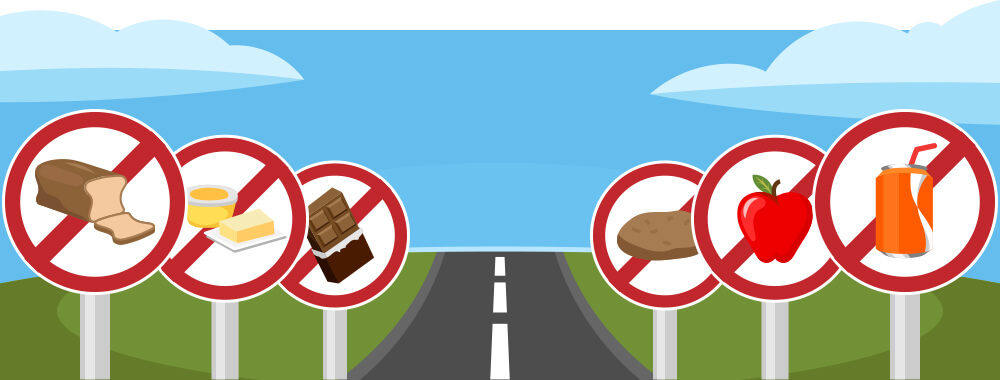
By now, you should have a pretty good idea of what to eat on a ketogenic diet. Make sure that you read and re-read through the list of acceptable foods to build a mental image around what type of meals you will want to eat.
If you’re still unsure about any products or food items that might not be keto friendly, don’t worry too much. Below, you’ll find a list of things that you should always be on the look out for.
- Sugar. It’s typically found in soda, juice, sports drinks, candy, chocolate, and ice cream. Anything that’s processed and sweet you can think of most likely contains sugar. Avoid sugar at all costs.
- Grains. Any wheat products (bread or buns), pasta, cereal, cakes, pastries, rice, corn, and beer should be avoided. This includes whole grains like wheat, rye, barley, buckwheat, and quinoa.
- Starch. Avoid vegetables (like potatoes and yams) and other things like oats, muesli, etc. Some root vegetables are okay in moderation – be sure to read the section on vegetables.
- Trans Fats. Margarine or any other spreadable replacement butter should be avoided as they contain hydrogenated fats (bad for us).
- Fruit. Avoid any large fruits (apples, oranges, bananas) as they’re extremely high in sugar. Some berries can be consumed in moderation – be sure to read the section on fruits.
- Low-fat foods. These tend to be much higher in carbs and sugar than full-fat versions. Make sure you read the package to make sure a mistake isn’t made.
In general, the more “real” the food, the better it is for you. While some processed foods are acceptable, many are not. Make sure that you read through the ingredients and nutrition information to make sure that it can fit within your diet. If you want to take things further and skip label-reading altogether, we put together a list of the strictest zero-carb options that fit keto without any counting.
I have a friend doing the ketogenic diet as a part of his brain cancer treatment. He is having fantastic success and his tumors are reducing in size, dramatically. There are versions of the ketogenic diet that are tailored especially for cancer patients. If you’re interested in more information I can do some digging for you. It will be hard not to loose weight though on the diet, it is definitely a side effect, a pleasant on for most of us, but a side effect all the same.
On another note, Craig, I am having fantastic success with the diet and love your site for information and ideas. Wonderful thanks.
Stefan.
I’m always interested in reading more info. If you come across anything just shoot me an e-mail at [email protected] 🙂
i have a fish and seafood allergy (no fish at all) yet this plan suggests several servings of these. i also cannot take any of the omega 3 supplements that are fish or krill based.
You could use an omega that’s flax based if you want. For seafood, you can skip it. Most of my recipes don’t include seafood.
Do you have Keto diet plan for people that do not eat meat (fish is okay), just not animal meat? Pescatarian
I don’t have one personally available, but you can easily create your own 🙂
Hey Craig,
I think you need to correct madadamia to Macadamia 😀
Your website is awesome!
Oops – you’re right. Sorry about that, and thank you!
For those using the ketogenic diet for fighting cancer, in conjunction with chemo and radiation, is there anything different you would recommend?
Stay away from sugar as much as possible and stay as strict as you can with keto.
So how do you calculate how much fat/protein/carbs each day you should have?
We have a handy calculator here on the website!
Try it out here:
http://www.ruled.me/keto-ca…
Hello Craig, I was wondering if you know anything about endurance sport on a Ketogenic diet. I am a pretty avid cyclist in spring/summer/fall what is about 200 miles/per week. It is common for me to be on my bike on the weekend for 70+ miles/5,000ft elevation gain on 1 day. And I need to consume a fair amount of carbs to sustain. Now, in winter it is just 120miles/per week. I still have one training day with 60miles/3000 feet elevation gain. I am not sure how to eat on those days! Since low carb makes me really, really slow on such rides. Any suggestions? Thanks in advance.
It normally takes 6-8 weeks to become fully “fat adapted” (your body changes on a molecular level to efficiently handle the fat). Studies show that endurance exercise and keto go very well together and after your body becomes fat adapted you should not see any sluggishness. Just keep with it 🙂
I just don,t get it If I have two chicken legs and a few pieces of broccoli now what ?Dump half a bottle of olive oil on my plate.Not trying to be smart just do not understand.Why add fat when I have enough fat on my body to be eaten away
You can eat at a deficit so that your body uses some of the body fat as energy as well. Chicken legs with skin generally have a lot of fat in already (usually equal amount fat to protein) so you wouldn’t need to add much more fat to make a nice meal. You could make a small dipping sauce for the broccoli, and have a bit of avocado on the side if you needed to up the fat content.
Craig,
I was looking for a Crab Cake recipe and noticed you do not have one. I bet your wildly creative mind would come up with a great alternative.
Hey Debra – check out the tuna/avocado balls that I did a while back. Crab cakes should be relatively easy. A mix of mayo/seasoning/crab. You can use egg as a binder if you can’t get them to stick together (along with a bit of flaxseed meal), but you’ll have to cook them longer if you add egg. Once you can form patties, just do a quick egg wash then dip in almond flour/flaxseed meal (and parmesan/spices if you want), then fry.
More a “presentation” question… how can you get reds or yellows in a recipe? I may use red bell peppers or tomatoes in a recipe but flavor is not the main reason. Any keto-friendly substitutes?
Spices like chili powder and paprika for reds. Turmeric or curry blends for yellows.
Sauces like: all sorts of hot sauces, chili pastes, no sugar added tomato sauces like Rao’s, etc.
Plants like red or yellow bell peppers, moderate number of raspberries.
Could also top things with nice yellow cheese!
Can you eat egg noodles on the ketogenic diet? I’m also assuming pickles are a no-go?
You can’t have egg noodles, but pickles are okay as long as they’re unsweetened. Everything in moderation!
Egg noodles no, dill pickles yes
My calories are always between 1200-1800, usually on the lower end. My macros are 75% fat, 20% protein and 5% carbs. My total carbs rarely go over 20 per day, so I know the net carbs is waaaay less. It has been 6 days this time and no weight loss. Last time I went 2 weeks then caved in and pigged out since I wasn’t losing anyhow. I do feel better eating this way but would like to see the scale go down. Any suggestions?
Track what you’re eating to a tee. Be consistent with it and use the data to see where things are going wrong. Generally if you’re not tracking and not seeing results – something will become apparent once you do 🙂
I started the Keto diet in response to a rising cholesterol problem. When it first became an issue I followed all the standard recommendations; lowered my intake of red meat and animal fats, ate more high fiber items like beans, ate nuts and brown rice, and lived on chicken breast. When I went back a few months later, my overall cholesterol levels had doubled, and all the beneficial/deleterious markers had gone the absolute wrong way.
In my investigation of the problem, I discovered the divergent philosophies of the low fat vs. low carb camps. Since the low fat road obviously did not work, I thought I would try the low carb route.
I am 49, male, work out 3-5 times a week, and was in good shape. I lost 6 pounds in the first 2 weeks and have plateued at about 12 pounds under my starting weight after about 3 months. I have not looked this good since high school. I eat a lot of red meat and broccoli, I supplement or replace meals with protein drinks made with half and half ( I add ground flax, cinnamon, pure chocolate powder, and green tea powder to my shakes.)
The effects on my body have been stupendous. I no longer have any effects of acid reflux, I used to wake up every morning with terrible hunger pangs, stiff, sore joints, and a few other bothersome items, all of which have disappeared. I am very surprised at the missing acid reflux because it had always been associated with eating fatty and acidic things like pasta with meat sauce. But now I can eat all the fat, chilli, chilli burgers (no bun) , anything I want with no effect.
Bottom line is that I look better than I ever have, I have built muscle (that is not hidden under a layer of fat), and I feel fantastic! The only odd thing is that I have dreams about bingeing on pizza or cake. No, like really dreams about crashing weddings and sneaking off with the wedding cake, or going shopping and eating all the bakery items before I get to the register.
I get my blood test results back today, and will post if the Keto diet has helped me with my cholesterol problem.
Hi Mitchell, I am so glad to hear that you’ve found success! I hope that your blood test went really well for you. 😀
I got my lipid panel back. The normal triglyceride baseline is 149, mine was 467 in November. Today it is 165 and all the rest of the cholesterol numbers are well within healthy range. 3 months of Keto diet, Ruled Me is my Keto Bible. Whenever a questionable food comes up or I need to expand my menu, I come here. Thanks you guys for perhaps saving my life!
Mitchell – Your dreams made me laugh so hard! Thank you!! I was wondering if anyone ever had sugar cravings like I do….or did. I’m on day 17 of Keto and, as of today, I’ve lost 7 pounds. My sugar cravings have certainly lessened, but I still dream – and daydream – about desserts. 🙂
Hi Erik, you can do keto if you are lactose intolerant. I know because I am intolerant as well. I find that being on keto allows me to eat some dairy with no ill effects, but if you are especially sensitive you can of course omit cheese and heavy creams. It will make it more difficult to find recipes for things like pizza or sweets, since many keto dough’s are cheese and nut flour based.
What are the risks for type 1 diabetics with this diet?
There’s no outright risks but you need to keep an eye on your insulin levels. Your needs of insulin may change on a ketogenic diet.
Yesterday, my naturopath recommended the ketogenic diet as I am going through my second round of chemo for a very rare form of lymphoma. So, here I am in the hospital (for a 5-day overnight stay/infusion) researching ketosis/the ketogenic diet and feeling really empowered that I don’t have to just let chemo destroy EVERYTHING, there’s a way that I can have it destroy cancer cells even better while allowing my body to protect my healthy cells. I’m so thankful that there are brilliant people in the world that know about the way that our cells work and the way that they can and cannot adapt to different energy sources. Thank you for this easy guide!!
Hi Kari. I’m really sorry to hear about your illness. I hope that keto and your treatments are able to help you. I hate cancer, cancer sucks!
My daughter is 16 and has lost 7lbs on this in a week. But irt is hard when they go to school. I notice you told someone not to really snack and actually she is doing great . But for lunch we do lunche meat pep , cheese etc… Carrots But it is hard with this age group. She is extremly active She has Volleyball 3 days a week and does Crossfit 2 to 3 days a week. So any additional suggestions oneasy packable (highschool) lunch?
Hi Susan! Try some of our soups in a thermos. You can also make a batch of our coconut flour tortillas and then use to make easy sandwiches. If you can pack her lunch with some ice then try our pizza fat bombs. They are so good! At my high school I would miss the pizza (I was doing Atkins back in the day hahah), so I think some slices of keto pizza might be welcome sometimes too.
ok I will look into those two items. I don’t think I saw those recipes.
Oh noooo! You might be more sensitive then I am, which sucks! Here’s some recipes you might enjoy:
http://www.ruled.me/blackbe…
http://www.ruled.me/low-car…
http://www.ruled.me/keto-cr…
http://www.ruled.me/simple-…
http://www.ruled.me/thai-st…
http://www.ruled.me/cinnamo…
http://www.ruled.me/mini-pu… (Just leave the cream cheese off.)
Unfortunately a lot of the fake crusts or pastry type recipes might not work for you. (Especially low carb pizzas…almost always have cheese.) You may need to up your daily fats in other ways.
Thanks for the compliment 😀
I am curious…as of 4pm today I am shy 80 of my 122-150 in fats…How do I make this up??
Curious how you calculate how much fat you should be consuming? Thanks
You can get your individual numbers using our keto calculator:
https://www.ruled.me/keto-c…
I have been seeing Detox teas and didn’t know if they would be okay to drink while eating the Keto way?
Just check the ingredients/nutrition for sugar/carbs. If they don’t have any then there shouldn’t be a problem.
I’m in law enforcement an rotate shifts every 28 days. will this diet still work? I get up during the day an I’m hungry so I grab a couple pieces of bacon.then back to sleep again a few hours later back up get ready for a 12 hour shift at work all night.
I think so! You will probably want to do a lot of batch cooking so you can take food with you, and get familiar with low carb options at restaurants if you eat out a lot. 🙂
I will say; Keto diet is successful, period. Research all the benefits as stated by Dr. Mercola. You do need to be disciplined but if you stick with it, the results are amazing.
I agree! 🙂
I use stevia 0 cal ones in my coffee and 0 cal creamer in my coffee called walden farms . Will that effect my ketosis?
Hi Keisha, stevia is great. Some people have issues losing when using products like the creamer – but not everyone does.
Check out this article on sweeteners, I think you will find it informative!
https://www.ruled.me/keto-d…
Is there a link to a site with recipes and whatnot ?
Hi Aaron, we have a lot of recipes here!
https://www.ruled.me/keto-r…
Like everything I’ve seen so far, and I’ve even tried a couple of the recipes. One thing, on the weekly shopping lists, it would be very helpful if there was an amount needed for each item, IE:
Ground beef vs. 2 lbs Ground Beef
Just something I would find helpful, thanks.
Thank you Patrick!
I’m confused about Tomatoes, are they good on a Keto diet or not? Different sources say they are okay and others not so much. Also, I really wish I could find a good daily menu plan for the Keto diet. I mean one that has realistic food combinations that work and not necessarily recipes with things I either do not have or are “too complex”. Simple, easy and tasty. Any ideas?
You can have some but they do have carbs, so you have to be careful with portion sizes and limit your intake. You might like our 30 day meal plan, a lot of the recipes are fairly simply (but not all, there are some treats included.)
What if you typically don’t eat beef? Any substitutions? I really only eat chicken, turkey, and bacon, but i’m willing to expand my protein choices to reach my goals. Guess I need to say bye bye to black bean burgers!
You can still eat those things if that’s what you want to do. 🙂 There are even vegans who do keto.
What’s the difference between this and the Paleo Diet?
How does Shakeology add up to this diet?
It really depends on how many carbs the shakeology product has and how many net carbs and total carbs you are allowing yourself to eat in a day.
According to the chocolate Shakeology product images on amazon.com, it has 17 grams of carbs and 11 net carbs per scoop. Looks like it is relatively low-carb, so if it fits well into your daily carb and net carb limit and your daily macros after you consider all the other food you’ll be eating for the day, then it can definitely be a part of your keto diet.
Question: I don’t see asparagus listed? Is it an approved veggie? Also, what about sugar free coffee creamer? I’m considering starting this eating plan…
Hi Hope! Asparagus is about .3 net carbs per spear, you can certainly eat it. Sugar-free coffee creamers are a personal choice (are you OK with thickeners, sweeteners they use, etc.) Some of them have corn syrup, and most are still 1-2 carbs per tablespoon. You might get more mileage out of switching to something like unsweetened almond milk (my fav because it’s less than 1 carb per cup), unsweetened coconut cream, or something similar.
Hello. I am overweight and have high uric acid. Doctors have advised me to avoid red meats, nuts, and mushrooms. However it seems that these 3 food types seem to appear often as recommended choices in a keto diet. Moreover, I cannot take anything cold — I will get stomach upsets and menstrual cramps (so cold juices and salads are bad for me in the long run).
I’d love to try keto for weight loss but I’m worried that my current condition would significantly limit my food choices.
Ah, that sounds like a struggle! You can do keto eating fish or chicken as well. You won’t be able to do a lot of the baked treats, but that just means you would lose weight faster than someone who eats a lot of almond flour treats. (You can still have some treats – fat bombs are wonderful.) There are even vegans who do keto, you just have to be a little creative sometimes. 🙂
I have been doing a STRICT Keto diet and initially lost 7 pounds. Over the last two weeks I have gained back 5 pounds!!!!!! NO CHEATING!! What’s UP?????
Hi Diann, this article might help you out:
https://www.ruled.me/ketoge…
can you eat sunflower seeds?
Yes, Aaron, you can eat sunflower seeds, but have them in moderation because sunflower seeds do contain some net carbs.
To figure out exactly what moderation means for you:
1. Check how many grams of carbs and fiber are in the sunflower seed product you are eating.
2. Subtract the fiber from the total carbs, and you’ll end up with the net carb count per serving.
3. If that net carb count fits in with your keto diet macros for the day, then they’ll be a great keto food for you.
Is there an issue with having an Atkins bar here and there? I can’t get into the Keto Bombs or any of the Keto deserts…I’m really struggling with the sweet tooth side of this and the Atkins bars seem to really take the edge off.
Hi Sara, if you can fit the bars in your macros then ultimately it’s up to you. A lot of people don’t like their ingredients, but if they don’t cause you problems then it’s really your call. 🙂
Hello, I am pescatarian, and mostly dairy free. I am very interested in the Ketogeninc diet. The article above does have great suggestions. I am looking for a bit more guidance and food ideas for my particular scenario. Will I be able to get help in any of your books? Can you suggest any resources? Thanks in advance!!
Hi Oscar, our stuff is mostly geared towards people who eat both dairy and all types of meat. You can absolutely do keto as a pescatarian (there are even some vegans who do keto). We have some seafood, and vegetarian, based recipes on this website -but most use chicken or red meat. We have a Facebook group called Ketogenic Living, you might be able to find some other keto pescetarians in there to get advice from.
Thank you. I will join today!
Stevia and Splenda have aspartame in them, which is bad for you. Also Diet soda is FAR worse for you than regular soda, it has more sugar added to it because they took out most of the fat, that’s the lies of the sugar industry for ya’. Other than that i can see this as being a pretty healthy diet choice. 8D
Stevia and Splenda do not have aspartame in them, they are completely different ingredients.
can we eat cucumbers?
You can, you just need to track carefully.
I am vegetarian and would like to know does the KetoAcademy have enough options for Vegetarian recipes.
Hi Bharath! Many of the recipes are not vegetarian unfortunately. I hope we will be able to come out with a vegetarian meal plan in the future. 🙂
Today I took the Keto plunge and will be starting my 30-day plan this weekend. I am excited, yet a little scared. I have tried to cut carbs out of my diet before and I have always been REALLY hungry. I know it takes time for your body to adjust, and this is much different than anything I’ve ever tried, so I’m hoping for the best!
Good luck Nicole!
Hello,
This is my first post. I am a huge fan of grass fed meat but no knowledge of the ketogenic diet. Would it be appropriate to eat grass fed meat two times per day on a daily basis? I am considering 4 ounces of grass fed lamb and 4 ounces of grass fed hamburger. I also like eggs. Thank you for taking your time to answer my questions.
Hey Joel,
Great question! I am a huge fan of grass fed meat. Grass fed meat is the healthiest meat you can have on keto (other than organ meats like liver), and you can definitely eat two 4oz portions of it and eggs on a daily basis. However, I recommend adjusting your meal sizes and meat portions based on your macronutrient needs for best results.
To find out how much you should eat to meet your goals, I recommend using our Keto Calculator:
https://www.ruled.me/keto-calculator/
It will tell you exactly how much of each macronutrient you should eat. Once you know this, you can adapt your serving sizes of grass fed meat and eggs so that they help you meet your fat and protein needs for the day.
Is there a one time fee for the Keto Academy or is it monthly?
It’s a one time fee. There are a series of PDF books included, and once you purchase it you keep them. 🙂
Vermont Cabot Cheddar and Mozzarella have zero lactose. The longer the cheese is aged the less lactose it has. I’m severely lactose intolerant and I can eat these all day. I still take a lactose enzyme pill just in case, but the packages clearly state 0g lactose and lactose free.
Thank you! I’m going to look for these!
I work for a brewery and really enjoy what I do. It’s virtually impossible for me to avoid drinking beer but I do try to limit it to 1 or 2 beers a day. Is there a source that has information on how many carbs a specific beer has?
Hey Leo,
We actually have a guide that has a lot of good beer suggestions with their carb content:
https://www.ruled.me/ketoge…
If our charts don’t have the beer you are looking for, then your best bet is to do a quick google search for its nutrition info.
Muscle Milk light has only 2 carbs.
Do you have this list in a printable format? Or maybe a condensed version to put on the fridge? Great list! Thank you!
Hey Manuel,
Here is a sample food list for you:
https://www.ruled.me/faq/sa…
We are currently working on an extended version of this shopping list in a much more aesthetically pleasing and printable format.
Thank You for this information I find it very helpful.
I have just started the Keto diet yesterday. This summer I am going to Europe and am wondering what I will be eating then?? Eating out all the time. Italy has wonderful pasta and risotto. This will be the end of May for 2 wks. Any suggetions??Thank you.
Also I read on a different Keto diet site that they say No to cream and No the cheese. What are your ideas on this? I say that cheese will save me!
Hey Kristen,
Great question!
We actually have an article on how to travel on keto that you can find here:
https://www.ruled.me/travel…
In general, feel free to enjoy those delicious foods in moderation, and eat keto whenever possible. As long as you are able to keep the portions small (so you can be in a calorie deficit), you will lose weight (or at least you won’t gain weight).
Regarding cream and cheese on keto: As long as you have no problems digesting it, you feel good eating it, and you get the highest fat and lowest carb varieties, they should be a staple in your keto diet!
What about cucumbers? I eat those in my salad instead of lettuce. Also, those little packets you add to water of Sugar free Hawaiian Punch? Thanks!
Hey Rhonda,
Cucumbers are great for keto. Just make sure you are mindful of how many net carbs you are getting from them (1/2 cup of cucumber slices has ~1.5 net carbs).
Sugar-free Hawaiian Punch powder is keto-friendly as well, but each serving has 1 gram of carbs (from maltodextrin) and artificial sweeteners that can increase insulin levels, so it is best to drink it in moderation. It is possible that drinking this throughout the day can keep you from getting into deeper levels of ketosis, but it won’t keep you from losing weight unless you have an unreasonable amount.
If you have any other questions, please let me know. 🙂
I have stage 3 kidney disease. Is this hard on kidneys.
Hey Carol,
Keto typically isn’t hard on the kidneys. However, you may need to limit your phosphate and protein intake with your current condition. I recommend asking your doctor what he or she thinks you should do.
If his or her suggestions don’t fit with Keto, don’t get discouraged. You can still lose weight and improve health by maintaining a calorie deficit and eating healthier foods. One of the simplest ways to do this is by eating more fruits and vegetables and cutting out the heavily processed foods.
Does that make sense? If you have any questions, please let me know.
Hi, can you please let me know about the impact of the red wine vinegar? is it even allowed ?
Hey Olivia,
Yes, most kinds of vinegar are allowed including red wine vinegar. One tablespoon typically has about one net carb, so keep that in mind when you are trying to meet a specific carb limit.
However, if the vinegar has added sugars, then it is best to avoid it or at least consume it in moderation so you do not go over your carb limit for the day.
Thanks for the question!