Vegetables are an essential part of a healthy low-carb diet, but sometimes we’re stuck with decisions we might regret later. Some vegetables are high in sugar and don’t cut it nutritionally – so we need to weed them out. Make sure to be careful when eating vegetables as their carb counts do add up quickly.
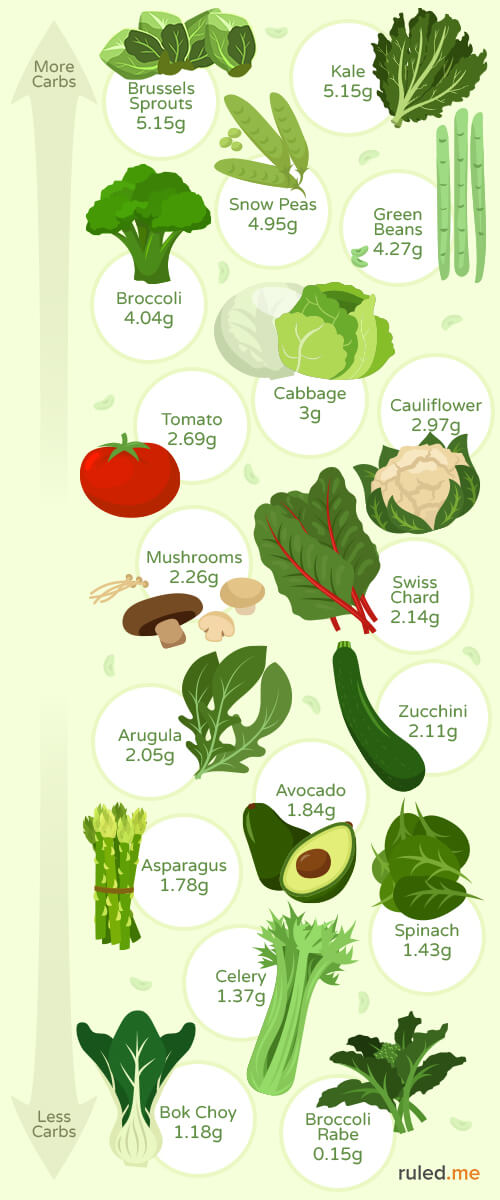
Below you’ll find a quick visual guide on the best (and worst) low-carb vegetables for keto. Keep scrolling down to see a complete list of the most commonly consumed vegetables. At the bottom of this page, you’ll find a list of the top 10 vegetables to consume based on scientific facts.
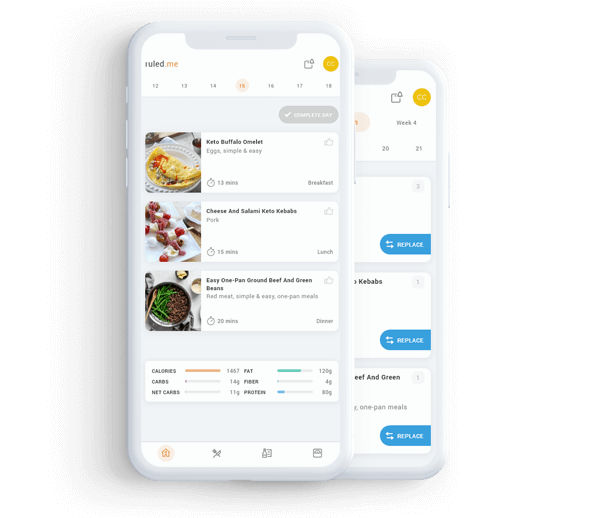
Note: Remember that on the ketogenic diet, you should aim to limit your carbohydrates to be below 30g per day. If you prefer to follow along and have meal ideas made for you, try our Keto Academy Program >
The best type of vegetables for a ketogenic diet are both high in nutrients and low in carbohydrates. As most of you can guess, these are dark and leafy. Anything that resembles spinach or kale will fall into this category and will be the best vegetable to include into dishes/meals.
If you’re looking for low-carb vegetables that aren’t leafy greens, think about the ones that grow above ground mostly from the cruciferous family. These include broccoli, cauliflower, zucchini, lettuce, cucumbers, and more. You can use the visual guide to help decide which vegetables are best.
Many people choose to eat salads as a way to get their greens in for the day. Salads are super quick to make, and you can put almost anything in them. Next time you’re not sure of what to make, get some inspiration from these:
- Warm Asian Broccoli Salad
- Keto Mixed Green Spring Salad
- Crispy Tofu and Bok Choy Salad
- Thai BBQ Pork Salad
You can also simply toss leftovers in salads as long as the combinations make sense. Time and time again we make cheeseburger salad with our leftover cooked ground beef. It’s such an easy way to make lunch!
Another way to eat vegetables is with your dinner. Many side dishes also complement the ketogenic diet because they’re often very fatty. Next time you need to pair a meal with a side dish, consider one of these options:
- Easy Creamed Spinach
- Mashed Cauliflower with Parmesan
- Au Gratin Brussels Sprouts
- Lemon Roasted Spicy Broccoli
Or you can simply roast/saute some vegetables in coconut oil and spices before serving.
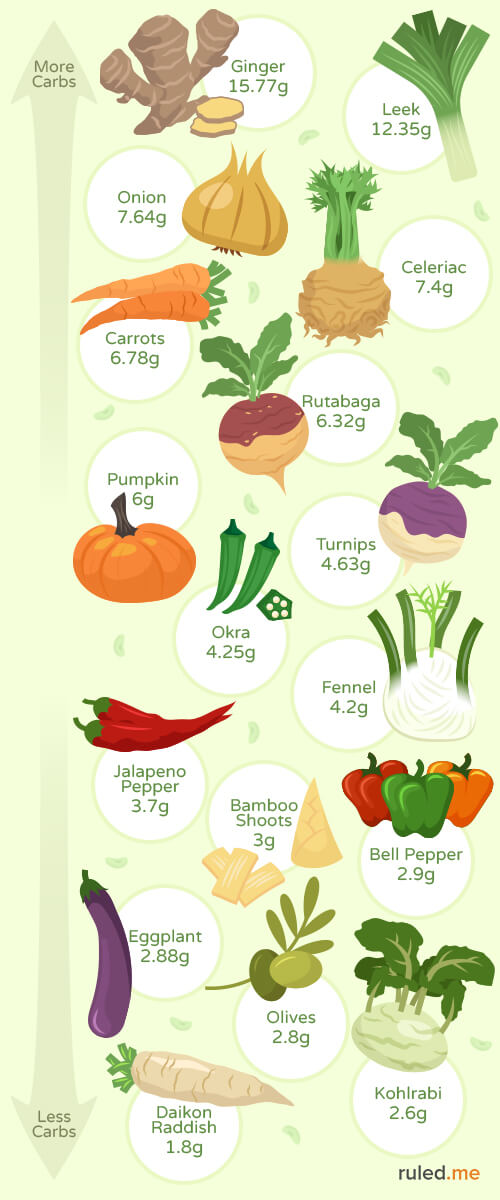
Below you’ll find a visual guide to higher carb vegetables and vegetables with some color. Generally, the brighter and more colorful the vegetable, the less low-carb they are. There are a few exceptions like bell peppers and jalapenos, which can be used for added texture and flavor in meals.
Always do your best to avoid sweet or starchy vegetables as they are high in carbohydrates. These include (but are not limited to) peas, corn, potatoes, sweet potatoes, yams, yucca, parsnips, beans, quinoa, legumes, and other high starch vegetables.
As a general rule of thumb, the sweeter the vegetable is – the more sugar it has in it. You have to be very careful with the amount you consume from things such as carrots, onions, and squash. You can easily see the difference in carb counts between the above and below ground vegetables above. Of course, you can eat these in moderation, but you need to watch your intake.
Many people choose to use a mixture of the higher carb vegetables with lower carb ingredients. It’s a great flavor enhancer, but you don’t want over-saturate your diet with carby vegetables. Next time you’re in the mood for something a bit more on the sweet side, consider making one of the following:
- Korean BBQ Stuffed Bell Pepper
- Sausage and Pepper Soup
- Roasted Bell Pepper and Cauliflower Soup
- Cheesy Cauliflower Onion Dip
We also see a lot more dessert recipes with the higher carb vegetables because of their natural sweetness. Ginger and pumpkin especially come to mind. If you’re in the mood for an autumn inspired treat, consider adding vegetables to your desserts. Some examples are:
Remember always to limit the amount of sweet treats that you eat, especially on a ketogenic diet.
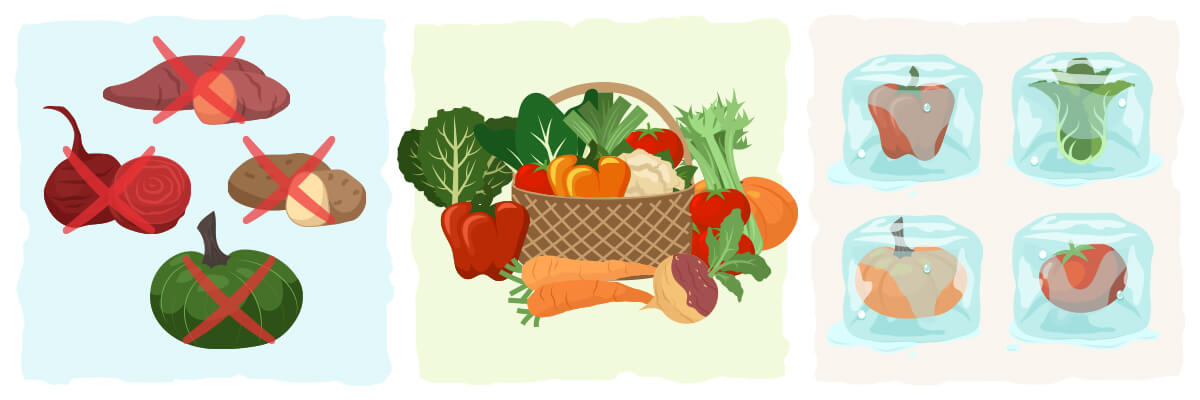
I’ve read a lot on the whole craze of going organic. If you only care about the nutrition, then you do not have to purchase organic vegetables. Though they are proven to be safer for the body (less residue of pesticides and toxins), they contain about the same nutrients as their non-organic counterpart. Don’t be afraid to stock up on vegetables – both frozen and fresh are great to eat!
On a side note, frozen vegetables are usually cheaper than fresh vegetables. If you buy greens in bulk but throw them out often, consider buying frozen. Surprisingly, frozen vegetables are sometimes more nutritious to their fresh counterpart – farms typically freeze greens at peak ripeness, ensuring nutrient density. You may have to cook excess water out occasionally, but it normally isn’t a problem in the final dish.
Most Common Low-Carb Vegetables
Below you’ll find a list of vegetables based on how low carb they are, so if you need help finding a certain one use the Find function (Ctrl + F). These are based on 100g (~4 oz.) or about 1/2 cup servings, which is the general recommended serving size for vegetables.
Note: If the vegetable you’re looking for is not listed, it’s most likely too high carb and shouldn’t be consumed on a ketogenic diet. Double check by comparing the vegetable with a credited nutritional database to see if it fits in with your daily macros >
| Vegetable Name | Serving Size | Total Carbs (g) | Fiber (g) | Net Carbs (g) |
| Broccoli Raab | 100g | 2.85 | 2.7 | 0.15 |
| Watercress | 100g | 1.29 | 0.5 | 0.79 |
| Nopales | 100g | 3.33 | 2.2 | 1.13 |
| Bok Choi | 100g | 2.18 | 1 | 1.18 |
| Celery | 100g | 2.97 | 1.6 | 1.37 |
| Spinach | 100g | 3.63 | 2.2 | 1.43 |
| Mustard Greens | 100g | 4.67 | 3.2 | 1.47 |
| Asparagus | 100g | 3.88 | 2.1 | 1.78 |
| Radish | 100g | 3.4 | 1.6 | 1.8 |
| Avocado | 100g | 8.64 | 6.8 | 1.84 |
| Arugula | 100g | 3.65 | 1.6 | 2.05 |
| Zucchini | 100g | 3.11 | 1 | 2.11 |
| Swiss Chard | 100g | 3.74 | 1.6 | 2.14 |
| Mushrooms | 100g | 3.26 | 1 | 2.26 |
| Kohlrabi | 100g | 6.2 | 3.6 | 2.6 |
| Tomato | 100g | 3.89 | 1.2 | 2.69 |
| Olives | 100g | 6 | 3.2 | 2.8 |
| Eggplant | 100g | 5.88 | 3 | 2.88 |
| Bell Pepper | 100g | 4.6 | 1.7 | 2.9 |
| Cauliflower | 100g | 4.97 | 2 | 2.97 |
| Cabbage (Green) | 100g | 6.1 | 3.1 | 3 |
| Bamboo Shoots | 100g | 5.2 | 2.2 | 3 |
| Cabbage (White) | 100g | 5.37 | 2.3 | 3.07 |
| Cucumber | 100g | 3.63 | 0.5 | 3.13 |
| Jalapeno Pepper | 100g | 6.5 | 2.8 | 3.7 |
| Artichoke Hearts | 100g | 5.38 | 1.5 | 3.88 |
| Broccoli | 100g | 6.64 | 2.6 | 4.04 |
| Bean Sprouts | 100g | 5.94 | 1.8 | 4.14 |
| Fennel | 100g | 7.3 | 3.1 | 4.2 |
| Okra | 100g | 7.45 | 3.2 | 4.25 |
| Green Beans | 100g | 6.97 | 2.7 | 4.27 |
| Turnips | 100g | 6.43 | 1.8 | 4.63 |
| Snow Peas | 100g | 7.55 | 2.6 | 4.95 |
| Brussels Sprouts | 100g | 8.95 | 3.8 | 5.15 |
| Kale | 100g | 8.75 | 3.6 | 5.15 |
| Cabbage (Red) | 100g | 7.37 | 2.1 | 5.27 |
| Pumpkin | 100g | 7 | 1 | 6 |
| Rutabaga | 100g | 8.62 | 2.3 | 6.32 |
| Carrots | 100g | 9.58 | 2.8 | 6.78 |
| Celeriac | 100g | 9.2 | 1.8 | 7.4 |
| Onion | 100g | 9.34 | 1.7 | 7.64 |
| Leek | 100g | 14.15 | 1.8 | 12.35 |
| Ginger | 100g | 17.77 | 2 | 15.77 |
Below is a list of what we consider the “best of the best” when it comes to vegetables. They’re both low in carbs and very high in micronutrients. Make sure that you frequently include the listed vegetables below in your daily meals.
If you’re not sure where to start or how to get more vegetables into your diet, feel free to check our ever-growing library of keto recipes >
Broccoli
A very common vegetable to see in a keto kitchen, and for excellent reason. Broccoli is packed full of vitamins C and K and only has 4g net carbs per one cup.
Some studies show that broccoli can help decrease insulin resistance in type 2 diabetics and may also contribute to protecting against a few types of cancer. It’s a staple vegetable to have on hand!
If you’re not sure what to make with broccoli and you dislike it, consider something unique like these broccoli fritters >
Asparagus
At only 4g net carbs per cup, asparagus should be in everyone’s weekly rotation of low-carb side dishes. You can wrap it in bacon (and serve with aioli), simply grill it, or chop it up and add it to stir fries.
Asparagus is a great source of vitamins A, C, and K and has been shown in animal studies to help reduce anxiety and protect brain health.
Mushrooms
Fungi is a great way to add some flavor into otherwise boring dishes. For example, in our mushroom cauliflower risotto, the baby bellas add a great texture and flavor. They’re extremely low-carb too, at only 1g net carb (white mushrooms) per cup.
Mushrooms have shown incredible anti-inflammatory properties, and over a 16 week period have shown to improve inflammation in those who have metabolic syndrome.

Zucchini
The most commonly used summer squash on keto, we often see it in dishes like Zoodles as a noodle replacement. Be careful with the types of squash you consume as most have much higher carb counts.
Zucchini is very low in carbs at only 3g net carbs per cup; it also serves as a fantastic source of vitamin C.

Spinach
It’s no surprise that spinach is one of the most eaten leafy green vegetables on a ketogenic diet. Spinach has only 3g net carbs per cooked cup of spinach, and almost no digestible carbs raw. This veggie is a great way to bulk up lunches with salads You can make high-fat side dishes like creamed spinach to go along with any meal, too!
Spinach has been shown to protect heart health and reduce the risk of common eye diseases. It also provides tons of vitamins and minerals, most noticeably about ten times the recommended about of vitamin K.
Avocado
Although they’re technically a fruit, avocados are often consumed in the place of vegetables. Avocados are very high in fat, so they’re commonly added into keto diets to help supplement fat intake alongside meals. At only 3g net carbs per one cup, you can see why avocados are chosen time and time again.
Avocados are rich in monounsaturated fats, which have shown to help lower LDL (bad) cholesterol and triglycerides. They’re also a great source of vitamin C and potassium so they can typically help with electrolyte issues.
Cauliflower
Usually the star of unique dishes, cauliflower can be used for a variety of things. You can use cauliflower for wraps, pizza, casseroles, or even mashed “potatoes.” It’s no surprise that it’s one of the most used and most versatile ingredients in most low-carb kitchen pantries.
Besides being fantastic for its versatile cooking applications, cauliflower is very low carb at only 2g net carbs per cup. It’s very high in both vitamin K and C and is associated with lowered risk of heart disease and cancer (similarly to broccoli).

Bell Peppers
Lower in carbs than its colorful counterpart, the green bell pepper (or capsicum) is frequently used in cooking. The good news is that they’re extremely nutritious. They’re filled with vitamin A and have anti-inflammatory properties from carotenoids which they contain.
If you want color, don’t be afraid to add red or yellow peppers since they’re also very low in carbs (only 6g net per one cup, chopped).
Green Beans
Green beans are a member of the legume family, but they have significantly fewer carbs than most other legumes. Sometimes green beans referred to as snap beans. One cup of green beans has only 6g net carbs, so they’re a great addition to many side dishes.
Added texture alone is enough to validate adding green beans to your dish, but the health benefits include improved brain function during aging. That makes these an excellent choice of vegetable on the ketogenic diet. For more flavor, consider pairing it with some pecans for crunch >

Lettuce / Kale
Both kale and lettuce are commonly used in salads across the country. Both are also fantastic low-carb options when it comes to vegetables. They produce plenty of vitamins (A and C) and show to help protect against heart disease.
While kale is more nutritious than lettuce, it also has a significant amount more carbohydrates per serving. Make sure to be careful with the amount of kale you consume as carbs add up fast.


Where do beats fall??
There are about 10 net carbs in a cup of beets. If you eat them it would have to be very sparingly!
Witch fruits are best ? Low carb. Fruits
Hi Angelica, Craig posted an article about that! You can find it here:
https://www.ruled.me/best-l…
Great charts. Probably one of the best outlines for veggies. Especially key since I’m thinking I want some new veggies in my diet! Good call on the avocado as a fruit. But as fruits go, it’s one of the few that I eat regularly!!
I find it confusing sometimes. You’ll find a lot of different information (carbs) on different websites for the same vegetable. I really love eggplant, but was avoiding it because in some nutrition databases the carbs are way higher then 2.88g. The same for peppers and for Parsley root or Root Parsley. I found values from 1,2 g net carbs, 1,6 g and even up to 12g of carbs. Searched in American food database (not listed or at least I don’t find it), my fitnesspal, fatsecret, … Does anyone have the correct value? Do you Craig, or which database would you recommend? Thank you so much for all the great information you provide!!!
Hi Sofie, I am currently updating all the nutritional information on the website to match the USDA database. The info for eggplant can be found here:
https://ndb.nal.usda.gov/nd…
I find this database to have the most accurate information, but it has it’s quirks. If you don’t know the exact term something is listed under it can be hard to find an ingredient. If you mean bell peppers, it’s listed under “peppers, sweet.” Some items like green onions are listed under alternate names (like scallions.)
I also try and choose, “Standard reference” whenever possible
I don’t think parsley root is found in the USDA database because it’s not very common here. (More likely to see parsnips.)
Thank you so much for all the great work and efforts!
Hi Sofie, I am currently updating all the nutritional information on the website to match the USDA database. The info for eggplant can be found here:
https://ndb.nal.usda.gov/ndb/foods/show/2962?fgcd=&manu=&lfacet=&format=&count=&max=50&offset=&sort=default&order=asc&qlookup=eggplant&ds=&qt=&qp=&qa=&qn=&q=&ing=
I find this database to have the most accurate information, but it has it’s quirks. If you don’t know the exact term something is listed under it can be hard to find an ingredient. If you mean bell peppers, it’s listed under “peppers, sweet.” Some items like green onions are listed under alternate names (like scallions.)
I also try and choose, “Standard reference” whenever possible
I don’t think parsley root is found in the USDA database because it’s not very common here. (More likely to see parsnips.)
Hi Angelica, Craig posted an article about that! You can find it here:
https://www.ruled.me/best-low-carb-fruits-avoid/
Great info !
Thank you Sofie!
I’m 63 & have slow digestion wth many issues such as GERD, hiatal hernia, constipation & had my gallbladder removed in 2001. So my question is what should I eat the ok help me go regular & not be nauseous!? I’ve been on keto 2-1/2 more & want it to be my lifestyle. I love that I have no more gluten issues, plus I’ve lost 15 pounds. For me that’s good. But I need to get “moving!” Any ideas?
Hey Judy,
From what I can gather through research, you might be getting nauseous because you are eating more fat than your body can digest at your meals.
Here are some of the things that many sources seem to reccomend:
– taking bile salts with your meals will help you break down the fat
– decreasing the grams of fat you eat at each meal and spreading your fat intake across more meals (e.g., eat 4-5 meals per day with less fat per meal instead of having 2-3 meals per day).
– having some ginger with your meal may also help relieve nausea and other digestive issues.
To help with constipation, increasing fiber intake from low-carb vegetables and keto-friendly baked goods like our higher fiber keto bread recipes should help.
Here is a link to some bread recipes:
https://www.ruled.me/best-k…
The keto bread loaves and the low carb flax bread, for example, are both high in fiber.
You can also find some high-fiber keto vegetable recipes here:
https://www.ruled.me/keto-r…
If you scroll to the bottom of any one of our keto recipes, you’ll be able to find out how much fiber is in that recipe. The general fiber guideline is to have 14 grams of fiber for every 1,000 calories in your diet. Eating more fiber than that every day may be what you need to be more regular.
Another strategy you can try to relieve constipation is eating more probiotic foods like Kim chi or sauerkraut and/or taking multi-strain probiotics with Bifidobacterium in them.
This is what I can gather from the research at this point. These suggestions seem to have the most promise.
Hopefully this helps! let me know if you have any other questions. 🙂
Thanks, that is very useful.
I’m type A blood and have trouble digesting fats and meats. low stomach acid causes the GERD apparently. Blood type diet has helped me a lot, but I want to try keto and I wonder if it’s pos or sustainable for us. we digest carbs really well, not fats and protein so much, without the support of supplements and ginger and stuff mentioned.
Can you please explain why I would eat high fat when I am already fat? I have fat to burn already
Hi Deborah, the way I understand it is that your body uses two kinds of fuels (fats & carbs). If you eat too much of both, you gain weight unless you are very active and have a calorie deficit. And yes, if you eat too much of even just one, you’ll gain weight, but the main idea is using two fuel sources. Carbs (especially from sugars & grains) are highly inflammatory and so they aren’t as healthy for you, anyway. If you are trying to lose weight, you have to feed your body mainly one fuel (fat). Your brain is 60% fat and needs fat, Most of your body runs on fat. Yes, it uses glucose, but your body can get that from other ways other than eating more carbs. So, what you are doing is giving your body mainly one fuel to run on: fat. You don’t give it so much that it won’t burn it’s own stored fat. If you are eating the SAD diet (Standard American Diet) you are eating way too many carbs (and mostly from bad sources). Your body screams at you when it’s low on glucose. It can’t switch over easily to fat burning, so if you are on high carbs and go without a meal, your body is probably going to tear down muscle first, before digging into your fat resources. Going on Keto, you are switching your body to burn fat, so fat is the fuel you eat, and when you need more energy, it just dips into your stored fat.
I hope that helps?
My question is if you eat more fat than your body can burn won’t you gain weight. I have been on keto for 3 and 1/2 months. I have lost 17 lbs and 3 inches off my waist. Really this is not a lot of weight and I got very discouraged at times when I was weighing once a week so I gave it up. I go by my clothes and I measure. I do the gym 3 days a week for about 90 minutes. My macros are not what they should be as I find It hard to eat that much fat and I am afraid if I eat too much fat, I will gain weight. Can you help me understand this better. I am wondering why, if I eat less that 20 grams of carbs a day why my body wouldn’t burn the fat that is already on my body and why I have to give it a large supply every day.
Yes, the general principle here is if you eat more calories than your body needs to maintain its weight, then you’ll gain weight. This is true across all diets for all macronutrients, including fat.
The main reason why you’d want to eat enough fat on the Keto Diet is because when we eat too little fat on keto, it can cause fatigue, cravings, and a decrease in metabolic rate. Eating the right amount of fat will help make your diet more sustainable and healthy for long-term dieting.
However, the “right” amount of fat isn’t necessarily going to be exactly what the keto calc recommends. Based on your
weight loss results, it looks like you are on the right track with your current intake.
To help you customize your fat intake, try aiming for a weight loss rate of 1-2 pounds per week (which is exactly where you are at, great job!) This weight loss rate tends to lead to more long-term weight loss than short spurts of significantly higher amounts of weight loss.
I hope this clears up some of the confusion. If you have any other questions, please let me know.
I suggest to get this book from the library.
Why We Get Fat
Taubes, Gary
You still eat with a calorie deficit, but because your body is in ketosis you don’t feel hungry.
This info on veggies is very helpful. Thanks.
is spaghetti squash acceptable in a Keto diet?
In moderate amounts, you can have spaghetti squash. Be careful as it does add up in carbs, but as long as you portion it correctly it can certainly be a part of the ketogenic diet.
Thank you
I truly enjoy all vegetables, healthy meats, fine without breads, potatoes, etc. But I am bringing my husband into this diet with me and he has differences. NO fish, No mushrooms, loves his bread (he will get over that), not big on spices like thyme, rosemary, oregano… UNLESS in moderate flavored Italian food,
He is NOT a big egg eater and for breakfast wants hot or cold cereal, pop tarts. Do you get my jest. I just want to help start him off with things he enjoys. I’m trying to see if the 30 day meal plan will work or if it will have too much of things he doesn’t like til I can bring him in slowly. His go to nighttime is ice cream.
Veg he eats: Broc, caul, green beans, spinach, lettuce so that’s good… but throw out the door any Brussels sprouts, kale,
For cereal try this one:
https://www.ruled.me/salted…
We also have some baked things like lemon & raspberry rolls, pancakes, etc. The meal plan has lots of eggs/spiced foods…I think he would have a hard time with this plan. Maybe ease him on to keto for a few weeks before attempting the meal plan with him. 🙂
omgosh Loretta – we’re married to the same man!!!
A cereal substitute I do most mornings is ground linseeds with a bit of kefir or yoghurt to wet it. Sometimes I add a few berries and some days add homemade chocolate nut mix that I make in bulk; lightly toast nuts and seeds of your choice in dry pan in batches according to size. Then when done coat them with little amount of honey while warm, then sift plenty of cocoa powder and a little pink salt over to taste, lastly add some dessicated coconut. Cool and store. You don’t want to overdo the honey, just enough so it adds a hint of sweetness and so that the cocoa powder will stick.
For cereal try this one:
https://www.ruled.me/salted-caramel-pork-rind-cereal/
We also have some baked things like lemon & raspberry rolls, pancakes, etc. The meal plan has lots of eggs/spiced foods…I think he would have a hard time with this plan. Maybe ease him on to keto for a few weeks before attempting the meal plan with him. 🙂
Hey Mandi,
Sorry for the confusion. To answer your question, the chart is based on 100g serving sizes. Regarding broccoli, 1 cup of broccoli is roughly 100g, which only has 4 net carbs. So, in other words, 1 cup of broccoli is 4 net carbs.
good article! I thought I could eat sweet potatoes on the slow carb diet 🙂
Sooo…. Is this still active? The most recent posts I see are from months and years ago? I was diagnosed with type 2 diabetes roughly 2 years ago. I brought my A1C down from 9.1 to 5.9 in three months, primarily by losing close to 30 pounds. I did this with diet and some exercise like walking and hiking. Currently I stay around 6.0 – 6.1. I could do better but, as usual, I haven’t really gone all out since I was first diagnosed. At that time I was also out of work for three months because of a collapsed disc. So I had the opportunity to stay home and focus more on diet and nutrition. I also have NAFLD, so cutting out carbs, fat, and reducing my cholesterol is crucial for me. After reading this article and reading some of the posts I can see where this could be really beneficial to me. My problem is, for 6 months out of the year I will be at a somewhat remote wilderness lodge in northern Minnesota. Shopping trips are sparse as is good quality food, not to mention it’s pretty expensive if you do find it. There is a whole foods type store in town (35 miles away) but their choices are limited too. Will this 30 day Keto plan still be beneficial for me in that situation?
Hello. Why does the 100g / 1/2 cup carb list vary from the illustrations per cup? The numbers simply dont equate. The illustration shows says 1 cup of mushrooms is 1 net carb, while the list says 1/2 cup is 2.26 net carbs. Please advise,thanks.
Hey Michael,
Congrats on the awesome results so far!
If you can stock up on keto foods and buy in bulk every couple of weeks or so, I think you can make the meal plan work for you – or you can at least create your own meal plan based on what’s available.
Try following the strategies in these articles to help you:
https://www.ruled.me/eating-keto-budget/
https://www.ruled.me/traveling-on-keto/
If you have any questions after reading these, please let me know.
I’m not sure if you are confusing the items. The chart shows that 100g of mushrooms are 3.26g carbs with 1g fiber – 2.26g net carbs. The illustration shows 2.26g net carbs.
my husband and I have decided to try Keto to have a baby! Anybody else on here done that? we are brand new I mean 4 days in. I’m already feeling fatigue 🙁 suggestions? I’m also afraid of getting other symptoms as well and not sure what kind of supplements I should be taking as well. I want to do this right. I’m afraid Ill be eating too much of one thing and not another. Im not necessarily looking for the weightless though I wont mind, I’m more wanting to eat better and feel better same as my husband. thank you!
Hey Kristin,
Congrats on taking the steps toward having a baby!
For specific recommendations on what you can do to prevent symptoms, I recommend checking out this article:
https://www.ruled.me/keto-f…
Also, you may find it easier to get pregnant by increasing your carb intake to around 75 to 150 grams of carbs per day. This may only be necessary for you if you are experiencing menstrual cycle irregularities, but it is helpful to know of this as a potential back up plan.
If you have any other questions, please let me know. Good Luck!
Do you count net carbs or total carbs..?
Most people track net carbs only. Total carbs is just a good thing to keep an eye on so it doesn’t get too high.
Keep reading and understanding what you need. The fatigue sounds like Keto Flu which we have an entire article on and how to remedy it. As far as micronutrients, we also have an article but supplementing with a multivitamin is usually a good idea. As always, try to get a doctor onboard to monitor you especially in the first few months if you feel out of the ordinary.
Hey Kristin,
Congrats on taking the steps toward having a baby!
For specific recommendations on what you can do to prevent symptoms, I recommend checking out this article:
https://www.ruled.me/keto-flu-remedy/
Also, you may find it easier to get pregnant by increasing your carb intake to around 75 to 150 grams of carbs per day. This may only be necessary for you if you are experiencing menstrual cycle irregularities, but it is helpful to know of this as a potential back up plan.
If you have any other questions, please let me know. Good Luck!
I was on a keto diet years ago but didn’t realize it. I started Atkins and found that if I went over the 20gms of carbs per day I would gain weight. Now I just have to find the mental strength to get through that first week. I’ve also developed an inflammatory response to aged cheeses which I never had before so will have to find other sources of fat. wish me luck.
Hey Tina,
Good luck with your keto diet!
If you need some alternatives for hard cheese, scroll down to the “How to Replace Dairy-based Cheeses” section of this guide:
https://www.ruled.me/guide-…
If you need help with anything else, please let me know.
Hey Tina,
Good luck with your keto diet!
If you need some alternatives for hard cheese, scroll down to the “How to Replace Dairy-based Cheeses” section of this guide:
https://www.ruled.me/guide-dairy-free-ketogenic-diet/
If you need help with anything else, please let me know.
this website is really helpful as far as keto guide is concern, its really amazing
Thank you so much for the kind words!
Great visual tool for a quick reference! Something to keep in mind though if you’re new to keto, is that 100g of leafy greens like kale is a huge volume compared to denser vegetables. You get more volume for your carbs with lightweight veggies. So some might be mislead by the higher carb number on something like kale and avoid it. For exaple I eat a huge salad bowl full of kale (2 oz, or 57grams) and it only comes to 2.8 grams of net carbs. Just something to consider!
Will definitely keep this as a reference when I’m grocery shopping!
Yes, of course. Here is a recipe round-up with 25 vegetarian keto recipes:
https://www.ruled.me/25-vegetarian-keto-recipes/
And a guide on how to follow the vegetarian keto for more ideas:
https://www.ruled.me/comprehensive-guide-vegetarian-ketogenic-diet/
You can also search “vegetarian” on our website for some recipes that may not be in the guide or recipe round-up:
https://ruled.me/?s=vegetarian
It really depends on how you feel and what happens with your health after following the keto diet for a few weeks. If your health isn’t improved by keto, then you may want to try a more plant-based diet that is a bit higher in carbs.
If you’d like more specific information on how to figure out if keto is right for you, I recommend checking out this article:
https://www.ruled.me/is-the-ketogenic-diet-healthy/
If you have any other questions, please let me know. 🙂
Hello everyone …. my ex talked to me about keto … looks interesting , but for a vegetarian like me is quite difficult to follow it … am talking about time … spending time for meals preparation… am a veggie cook but still am struggling, any ideas please????
Hey Yanis,
We created a comprehensive guide to vegetarian keto that you may find useful:
https://www.ruled.me/compre…
If you have any specific questions after checking it out, let me know.
Hey Yanis,
We created a comprehensive guide to vegetarian keto that you may find useful:
https://www.ruled.me/comprehensive-guide-vegetarian-ketogenic-diet/
If you have any specific questions after checking it out, let me know.
Will the Keto Academy work for vegetarians?
Unfortunately not. We are working to get more vegetarian and vegan recipes onto the site, and once we have enough we’ll build a vegetarian and vegan meal plan.
Great article! I’ve been on keto for just five days, and I’m sleeping much better already. Also, my respiratory problems (asthma on excercise and allergies) have disappeared! I’m really enthusiastic about this diet.
After a “keto flu” of about two days, with gaps of low energy, mental confusion, and headaches. I feel now very energized, I was in a great mood when I wake up this morning!
Also, I can go on intermitent fasting very easily, and feel really focused in my job. Being paleo improved my health A LOT, but nothing compared with keto. It’s not an easy diet, but it’s worth giving it a try!
Thank you very much for your work. Great web!
Hey Charlon,
Thanks for sharing your keto story with us. Congrats on the incredible result so far!
If you ever need any help on your keto journey, please let us know.
Such a great article with datailed information!
Thank you very much for this. Question – when you write 100gr, is this 100gr of the cooked or raw vegetable?
It’s for the raw vegetable unless specified that it’s cooked.
hi there,i am on keto diet.its my 2 day.can we eat drumstick vegetable..its an indian vegetable
Hey Gargi,
Yes, you can — but keep in mind that it will add some carbs and net carbs to your meals.
Every 100 grams of drumstick vegetable has 8.53 g of total carbs and 5.3 g of net carbs (similar to red cabbage).
If you have any further questions, let me know 🙂
hi Tyler
thanks for replying. i did check the carbs and it describes that the leaves of Drumsticks (Moringa Oleifera) fresh leaves has
In 100 g
Calories: 64 •Carbs: 8g •Fat: 1g •Protein: 9g
but
Drumsticks (Moringa Oleifera)
Vegetable – Raw, 100 g
Calories: 26 •Carbs: 4g •Fat: 0g •Protein: 3g
but not sure when cooked what is the calorie
You’re welcome! It’ll be roughly the same when cooked.
Great information thank you