

Not sure what to eat on a ketogenic diet? Here’s a quick food list for you to reference.
Below you’ll find a brief overview of what you can eat. Scroll further down to see more details on each section.
Being on a diet isn’t the easiest thing in the world, especially when you don’t know what you should eat. We’ve put together this ketogenic diet food list to help people out there make decisions on what they are eating and shopping for.
Below you can find a quick visual guide to what to eat on a ketogenic diet. Let’s go over some of the commonly identifiable items that people use on keto:
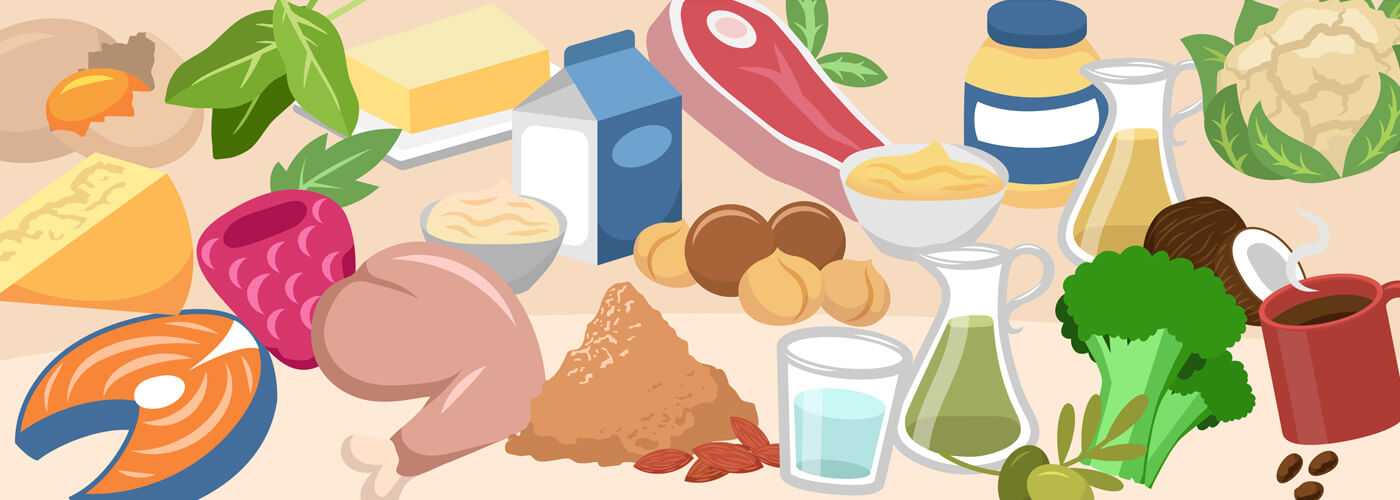
All of the food above sticks to the strict 5% carbohydrate allowance that we use on keto. In general, you can eat from the following food groups:
- Fats & Oils. Try to get your fat from natural sources like meat and nuts. Supplement with saturated and monounsaturated fats like coconut oil, butter, and olive oil.
- Protein. Try to stick with organic, pasture-raised and grass-fed meat where possible. Most meats don’t have added sugar in them, so they can be consumed in moderate quantity. Remember that too much protein on a ketogenic diet is not a good thing.
- Vegetables. Fresh or frozen doesn’t matter. Stick with above ground vegetables, leaning toward leafy/green items.
- Dairy. Most dairy is fine, but make sure to buy full-fat dairy items. Harder cheeses typically have fewer carbs.
- Nuts and Seeds. In moderation, nuts and seeds can be used to create some fantastic textures. Try to use fattier nuts like macadamias and almonds.
- Beverages. Stay simple and stick to mostly water. You can flavor it if needed with stevia-based flavorings or lemon/lime juice.
Here’s an overview video that quickly goes over our keto food list. If you scroll down, you can see in-depth breakdowns of each section along with some ideas on what types of food to eat! If you’re not much of the planning type and would rather follow along to get meal ideas, take a look at our Keto Academy Program >
Fats and Oils
Fats will be the majority of your daily calorie intake when you are on a ketogenic diet, so choices should be made with your likes and dislikes in mind. They can be combined in many different ways to add to your meals – sauces, dressings, or just simply topping off a piece of meat with butter.
Fats are vital to our bodies, but they can also be dangerous if you are consuming too much of the wrong types of fats. There are a few different types of fat that are involved in a ketogenic diet. Different foods usually have various combinations of fats, but the unhealthy fats are easy to avoid. Here’s a brief overview:
- Saturated Fats. Eat these. Some examples of these are butter, ghee, coconut oil, and lard.
- Monounsaturated Fats. Eat these. Some examples of these are olive, avocado, and macadamia nut oils.
- Polyunsaturated Fats. Know the difference. Naturally occurring polyunsaturated fats in animal protein and fatty fish are great for you, and you should eat these. Processed polyunsaturated fats in “heart healthy” margarine spreads are bad for you.
- Trans Fats. Completely avoid. These are processed fats that are chemically altered (hydrogenated) to improve shelf life. Avoid all hydrogenated fats, such as margarine, as they’re linked to heart disease.
Saturated and monounsaturated fats such as butter, macadamia nuts, avocado, egg yolks, and coconut oil are more chemically stable and less inflammatory to most people, so they are preferred. Below, you can see some common ways to increase the amounts of fat you eat on a ketogenic diet.
You also want to have a balance between your omega 3’s and omega 6’s, so eating things like wild salmon, tuna, trout, and shellfish can help provide a balanced diet of Omega-3’s. If you don’t like fish, or just prefer not to eat it, we suggest taking a small fish oil supplement. You can also take krill oil for omega 3’s if you are allergic.
Keep an eye on your intake for nut or seed based foods, as they can be quite high in inflammatory omega 6’s. These include items like almonds, walnuts, pine nuts, sunflower oil and corn oil. Eating fatty fish and animal meat, keeping snacking to a minimum, and not over-indulging in dessert items that are dense in almond flour is usually enough to keep your omega’s at normal ranges.
Essential fatty acids (the omegas) provide core functions to the human body, but they are often times out of balance when on a standard diet. On keto, with a little bit of preparation, your omega fatty acids are easily manageable. If you want to know more about essential fatty acids, omegas, and how they interact with our body on a ketogenic diet, you can read more here >
Some ketogenic diet foods that are ideal for fats and oils (organic and grass-fed sources are preferred):
- Fatty Fish
- Animal Fat (non-hydrogenated)
- Lard
- Tallow
- Avocados
- Egg Yolks
- Macadamia/Brazil Nuts
- Butter/Ghee
- Mayonnaise
- Coconut Butter
- Cocoa Butter
- Olive Oil
- Coconut Oil
- Avocado Oil
- Macadamia Oil
- MCT Oil
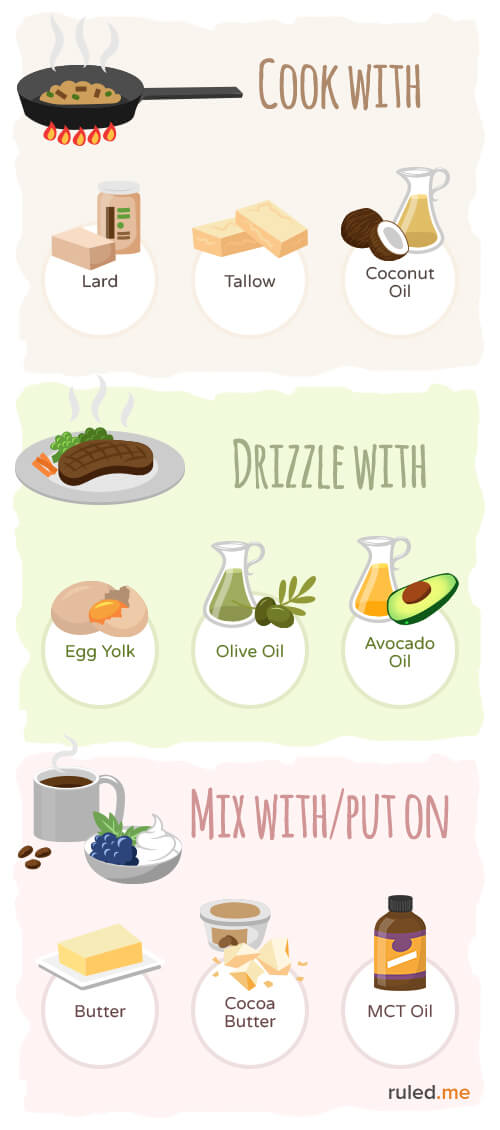
If you’re using vegetable oils (olive, soybean, flax, or safflower) choose the “cold pressed” options if they are available.
If you tend to fry things up, try to go after non-hydrogenated lards, beef tallow, ghee, or coconut oil since they have higher smoke points than other oils. This allows less oxidization of the oils, which means you get more of the essential fatty acids.
Protein
Below, you’ll find a visual list of proteins that are commonly consumed on a ketogenic diet. Note that the higher the amount of protein, the less you will want to consume.
Your best bet when it comes to protein is choosing pasture-raised and grass-fed. This will minimize your bacteria and steroid hormone intake. Try to choose the darker meat where possible with poultry, as it is much fattier than white meat. Eating fatty fish is a great way to get omega 3’s in as well.
When it comes to red meat, there’s not too much to avoid. Cured meats and sausages can sometimes have added sugars and added processed ingredients. If you eat steak, try to choose fattier cuts like ribeye. If you like hamburger meat (ground beef), try to choose fattier ratios like 85/15 or 80/20 in some cases.
One thing you do need to be careful of when dealing with meat is your protein intake. Too much protein on a ketogenic diet can lead to lower levels of ketone production and increased production of glucose. You want to aim for nutritional ketosis, so you must not over-consume on protein.
Try to balance out the protein in your meals with fattier side dishes and sauces. If you choose to eat lean beef, you have to be especially careful with the portioning of protein. Jerky and other beef snacks can add up in protein very fast, so make sure to pair it with something fatty – like cheese!
Note: If you don’t eat pork or beef, you can always substitute lamb in its place since it is very fatty. Replace cuts of meat like bacon with similar, leaner items. Add extra fat if needed.
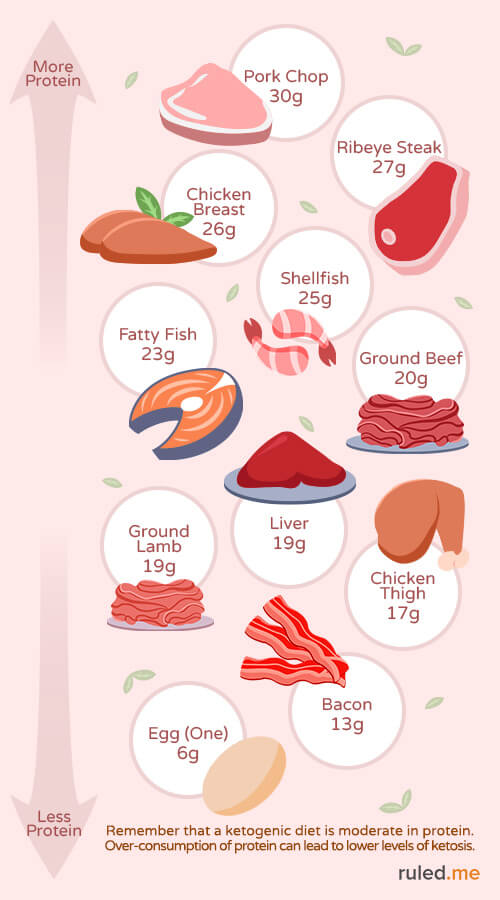
Some examples of how to get your protein in on a ketogenic diet are below:
- Fish. Preferably eating anything that is caught wild like catfish, cod, flounder, halibut, mackerel, mahi-mahi, salmon, snapper, trout, and tuna. Fattier fish is better.
- Shellfish. Clams, oysters, lobster, crab, scallops, mussels, and squid.
- Whole Eggs. Try to get them free-range from the local market if possible. You can prepare them in many different ways like fried, deviled, boiled, poached, and scrambled.
- Beef. Ground beef, steak, roasts, and stew meat. Stick with fattier cuts where possible.
- Pork. Ground pork, pork loin, pork chops, tenderloin, and ham. Watch out for added sugars and try to stick with fattier cuts.
- Poultry. Chicken, duck, quail, pheasant and other wild game.
- Offal/Organ. Heart, liver, kidney, and tongue. Offal is one of the best sources of vitamins/nutrients.
- Other Meat. Veal, Goat, Lamb, Turkey and other wild game. Stick with fattier cuts where possible.
- Bacon and Sausage. Check labels for anything cured in sugar, or if it contains extra fillers. Don’t be overly concerned with nitrates.
- Nut Butter. Go for natural, unsweetened nuts and try to stick with fattier versions like almond butter and macadamia nut butter. Legumes (peanuts) are high in omega 6’s so be careful about over-consumption.
Here’s a nutritional list of some of the most commonly consumed proteins on keto and their respective nutritional profile. Keep in mind that you still need to balance your protein intake with fat.
| Keto Protein Source | Calories | Fats (g) | Net Carbs (g) | Protein (g) |
| Ground beef (4 oz., 80/20) | 280 | 23 | 0 | 20 |
| Ribeye steak (4 oz.) | 330 | 25 | 0 | 27 |
| Bacon (4 oz.) | 519 | 51 | 0 | 13 |
| Pork chop (4 oz.) | 286 | 18 | 0 | 30 |
| Chicken thigh (4 oz.) | 250 | 20 | 0 | 17 |
| Chicken breast (4 oz.) | 125 | 1 | 0 | 26 |
| Salmon (4 oz.) | 236 | 15 | 0 | 23 |
| Ground lamb (4 oz.) | 319 | 27 | 0 | 19 |
| Liver (4 oz.) | 135 | 5 | 0 | 19 |
| Egg (1 large) | 70 | 5 | 0.5 | 6 |
| Almond butter (2 tbsp.) | 180 | 16 | 4 | 6 |
Remember that protein is always to be consumed in moderation. If you need help knowing how much protein to eat, we recommend visiting the Keto Calculator >
Vegetables and Fruit
Below, you’ll find a visual list of fruit and veggies that are commonly consumed on a ketogenic diet. Note that the higher the amount of carbs, the less you will want to consume.
Vegetables are a paramount part of a healthy keto diet, but sometimes we’re stuck with decisions we might regret later. Some vegetables are high in sugar and don’t cut it nutritionally – so we need to weed them out.
The best type of vegetables for a ketogenic diet are high in nutrients and low in carbohydrates. These, as most of you can guess, are dark and leafy. Anything that resembles spinach or kale will fall into this category and will be the best thing to include in anything you can.
Try to go after cruciferous vegetables that are grown above ground, leafy, and green. If you can opt for organic as there are fewer pesticide residues, but if you can’t then don’t worry. Studies show that organic and non-organic vegetables still have the same nutritional qualities. Both frozen and fresh vegetables are good to eat.
Note: Vegetables that grow below ground can still be consumed in moderation – you just have to be careful about the number of carbs that they have. Usually, underground vegetables can be used for flavor (like half an onion for an entire pot of soup) and easily moderated.
In general, there’s no fitting rule that works perfectly. Try to choose your vegetables with carbohydrates in mind and portion them based on their carb counts.
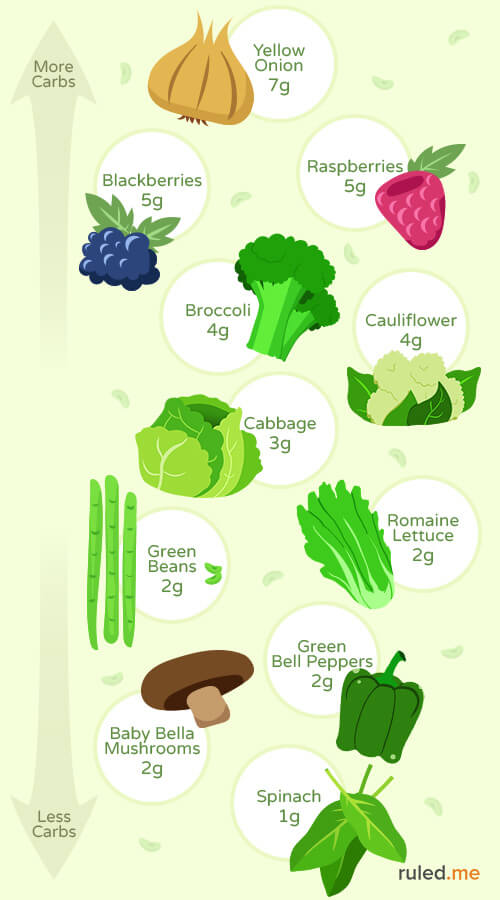
Be careful and monitor the vegetables (and their respective carb counts) you add to any of your meals. Especially try to limit your intake of:
- Higher carb vegetables. This includes onion, parsnip, garlic, mushrooms, and squash.
- Nightshades. This includes tomato, eggplant, and peppers.
- Berries. This includes raspberries, blackberries, and blueberries.
- Citrus. This includes lemon, lime, and orange juice (or zest) in water and in recipes.
- Completely avoid starchy vegetables and large fruits like potatoes and bananas.
Here’s a nutritional list of some of the more commonly consumed vegetables on keto. Keep in mind that the weights are the same of everything listed so that it will impact the skew of the carb counts. For example, in a meal you may have 6 oz. of broccoli in the side, but you would not have 6 oz. worth of berries in the morning. You may mix 6 oz. of berries into a pudding with 4 servings.
| Keto Veggie/Fruit Source | Calories | Fats (g) | Net Carbs (g) | Protein (g) |
| Cabbage (6 oz.) | 43 | 0 | 6 | 2 |
| Cauliflower (6 oz.) | 40 | 0 | 6 | 5 |
| Broccoli (6 oz.) | 58 | 1 | 7 | 5 |
| Spinach (6 oz.) | 24 | 0 | 1 | 3 |
| Romaine Lettuce (6 oz.) | 29 | 1 | 2 | 2 |
| Green Bell Pepper (6 oz.) | 33 | 0 | 5 | 1 |
| Baby Bella Mushrooms (6 oz.) | 40 | 0 | 4 | 6 |
| Green Beans (6 oz.) | 26 | 0 | 4 | 2 |
| Yellow Onion (6 oz.) | 68 | 0 | 12 | 2 |
| Blackberries (6 oz.) | 73 | 1 | 8 | 2 |
| Raspberries (6 oz.) | 88 | 1 | 8 | 2 |
You may notice that fruits and vegetables that grow underground tend to have higher carb counts, so they must be monitored and limited. To see a full list of low carb vegetables, take a look at the best low-carb vegetables list >
Dairy Products
Below, you’ll find a visual list of dairy that is commonly consumed on a ketogenic diet. Note that the higher the amount of carbs, the less you will want to consume.
Dairy is commonly consumed in tandem with meals on keto. Try to keep your dairy consumption to a moderate level. Most of your meals should be coming from protein, vegetables, and added fats/cooking oils.
Raw and organic dairy products are preferred here, if available. Highly processed dairy normally has 2-5x the number of carbohydrates as raw/organic dairy so it does add up over time. Make sure to choose full fat products over fat-free or low-fat as they will have significantly more carbs and less “filling” effects.
If you have lactose sensitivities, stick with very hard and long-aged dairy products as they contain much less lactose. Some examples of dairy you can eat on keto are:
- Greek yogurt
- Heavy whipping cream
- Spreadables including cottage cheese, cream cheese, sour cream, mascarpone, creme fraiche, etc.
- Soft Cheese including mozzarella, brie, blue, colby, monterey jack, etc.
- Hard Cheese including aged cheddar, parmesan, feta, swiss, etc.
- Mayonnaise and mayo alternatives that include dairy.
Dairy is a great way to add extra fats into meals by creating sauces or fatty side dishes like creamed spinach, but always remember that it does have protein in it as well. You should always take this into account when pairing dairy with protein-heavy dishes.
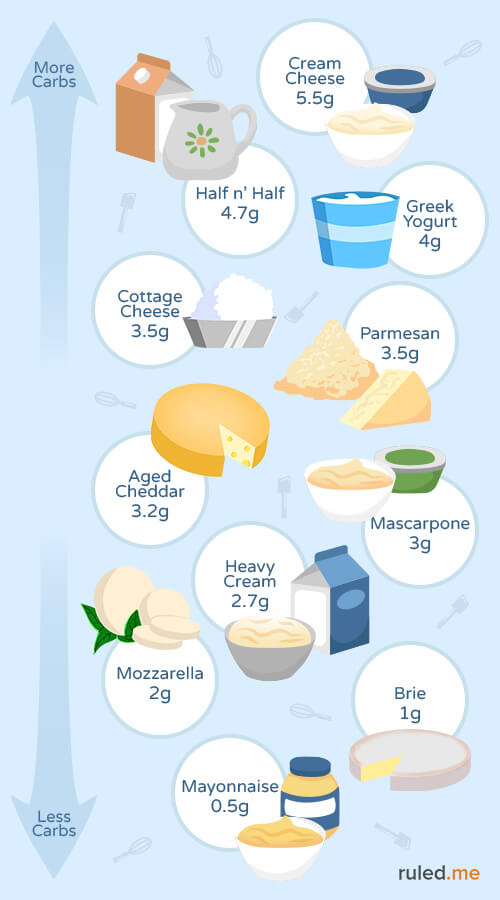
Below you’ll find a nutritional list of the most commonly consumed dairy items on keto. By far the most common dairy items used are heavy cream (for tea/coffee) and cheese (for added fats in meals). Note that the nutrition values in the table are based on 1 oz. servings while the visual guide is based on 100g servings (~1/2 cup).
| Keto Dairy Source | Calories | Fats (g) | Net Carbs (g) | Protein (g) |
| Heavy cream (1 oz.) | 100 | 12 | 0 | 0 |
| Greek yogurt (1 oz.) | 28 | 1 | 1 | 3 |
| Mayonnaise (1 oz.) | 180 | 20 | 0 | 0 |
| Half n’ half (1 oz.) | 40 | 4 | 1 | 1 |
| Cottage cheese (1 oz.) | 25 | 1 | 1 | 4 |
| Cream Cheese (1 oz.) | 94 | 9 | 1 | 2 |
| Mascarpone (1 oz.) | 120 | 13 | 0 | 2 |
| Mozzarella (1 oz.) | 70 | 5 | 1 | 5 |
| Brie (1 oz.) | 95 | 8 | 0 | 6 |
| Aged Cheddar (1 oz.) | 110 | 9 | 0 | 7 |
| Parmesan (1 oz.) | 110 | 7 | 1 | 10 |
Some people experience slower weight loss when over-consuming cheese. If you notice that you have hit a plateau or slowed down in weight loss, you may want to consider reducing the amount of dairy you eat. To see a full list of low carb dairy products, take a look at the best keto dairy list >
Nuts and Seeds
Below, you’ll find a visual list of nuts that are commonly consumed on a ketogenic diet. Note that the higher the amount of carbs, the less you will want to consume.
Nuts and seeds are best when they are roasted to remove any anti-nutrients. Try to avoid peanuts if possible, as they are legumes which are not highly permitted in the ketogenic diet food list.
Typically raw nuts can be used to add flavorings or texture to meals. Some people choose to consume them as snacks – which can be rewarding but may work against weight loss goals. Snacking, in general, will raise insulin levels and lead to slower weight loss in the long term.
Nuts can be a great source of fats, but you always have to remember that they do have carbohydrate counts that can add up quickly. It’s also particularly important to note that they do contain protein as well. Nut flours especially can add up in protein rather fast – so be wary of the amount you use.
Nuts can also be high in omega 6 fatty acids, so it’s good to be careful with the amount you consume. For typical eating, you want to stick with fattier and lower carbohydrate nuts.
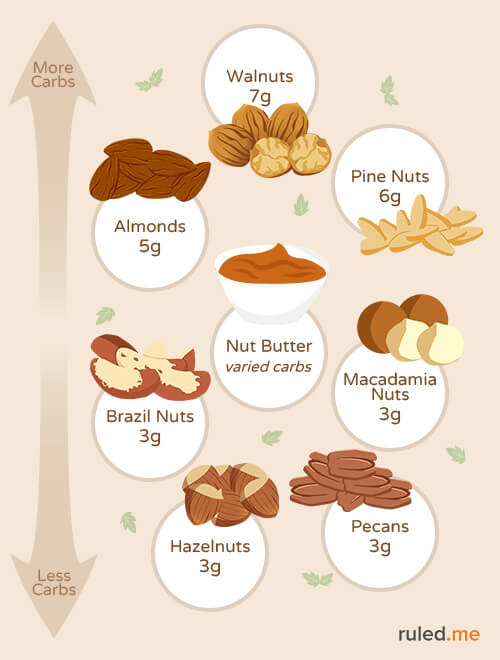
Next time you’re thinking about opening a new bag of nuts to eat, consider what’s better for you on keto from the following:
- Fatty, low carbohydrate nuts. Macadamia nuts, brazil nuts, and pecans can be consumed with meals to supplement fat.
- Fatty, moderate carbohydrate nuts. Walnuts, almonds, hazelnuts, peanuts, and pine nuts can be used in moderation to supplement for texture or flavor.
- Higher carbohydrate nuts. Pistachios and cashews should rarely be eaten or avoided as they’re very high in carbohydrates (2 handfuls of cashews is almost a full day’s allowance of carbs).
Note: If you have a nut allergy, a common substitution for almond flour is sunflower seed flour. Just keep in mind that this has higher levels of omega 6 fatty acids.
Below you’ll see a nutritional list of some examples of the most commonly consumed nuts on keto. Remember that snacking will slow down weight loss:
| Keto Nut Source | Calories | Fats (g) | Net Carbs (g) | Protein (g) |
| Macadamia Nuts (2 oz.) | 407 | 43 | 3 | 4 |
| Brazil Nuts (2 oz.) | 373 | 37 | 3 | 8 |
| Pecans (2 oz.) | 392 | 41 | 3 | 5 |
| Almonds (2 oz.) | 328 | 28 | 5 | 12 |
| Hazelnuts (2 oz.) | 356 | 36 | 3 | 9 |
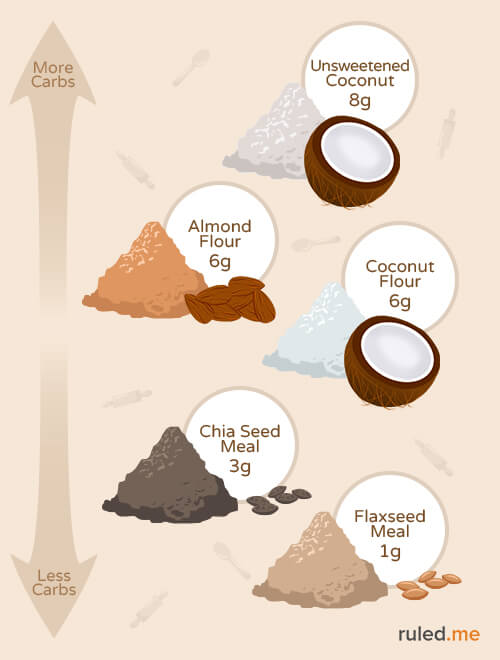
Below, you’ll find a visual list of nut and seed flours that are commonly consumed on a ketogenic diet. Note that the higher the amount of carbs, the less you will want to consume.
Nut and seed flours are great to substitute for regular flour. Commonly consumed on keto, seeds and nuts are frequently seen in baked recipes and dessert recipes. We often see the use of nuts (in almond flour) and seeds (in flaxseed meal) but should be eaten in moderation.
You can usually use a mix of multiple flours to get a realistic texture in baking recipes. Combining flours and experimenting with your baking can lead to much lower net carb counts in recipes. We think these lemon poppyseed muffins (a mix of almond flour and flaxseed meal) make a great texture when combined with the fats from the heavy cream and butter.
Remember that different flours act in different ways as well. For example, you would only need about half the amount of coconut flour as you would almond flour. Coconut flour is much more absorptive and generally, requires more liquid.
Besides baking, you can also use these flours as a breading when frying foods or even as a pizza base!
When you get creative enough, there’s always a way to make a low-carb version of an old favorite. If you need some ideas, check out our keto cheat sheet >
You can see a nutritional list of some examples of commonly consumed keto nut/seed items below:
| Keto Nut/Seed Baking Source | Calories | Fats (g) | Net Carbs (g) | Protein (g) |
| Almond Flour (2 oz.) | 324 | 28 | 6 | 12 |
| Coconut Flour (2 oz.) | 120 | 4 | 6 | 4 |
| Chia Seed Meal (2 oz.) | 265 | 17 | 3 | 8 |
| Flaxseed Meal (2 oz.) | 224 | 18 | 1 | 8 |
| Unsweetened Coconut (2 oz.) | 445 | 40 | 8 | 4 |
Water and Beverages
Below, you’ll find a visual list of beverages that are commonly consumed on a ketogenic diet. Note that the more restricted they are, the less you will want to consume.
The ketogenic diet has a natural diuretic effect, so dehydration is common for most people starting out. If you’re prone to urinary tract infections or bladder pain, you have to be especially prepared.
The eight glasses of water we’re recommended to drink? Drink those, and then some more. Considering we’re made up of about two-thirds water, hydration plays a substantial role in our everyday life. We recommend that you try to drink as close to a gallon of water a day as possible.
Many people choose ketoproof coffee or tea in the morning to ramp up energy with added fats. While it is a great thing, it’s also important to consume flavored beverages in moderation. This is amplified when it comes to caffeine as too much will lead to weight loss stalls; try to limit yourself to a maximum of 2 cups of caffeinated beverages a day.
Note: Many people experience the Keto Flu when transitioning to keto due to dehydration and lack of electrolytes. Make sure that you replenish your electrolytes and drink plenty of fluids. An easy way to do this is by drinking bone broth or sports drinks sweetened with sucralose or stevia.
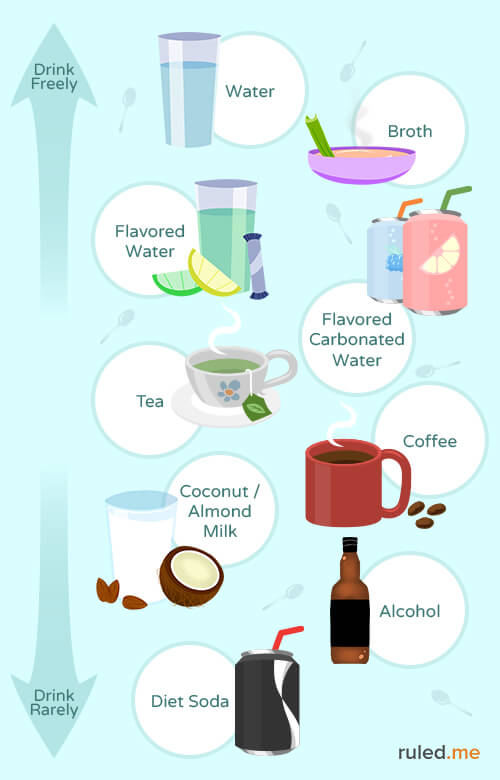
Some examples of commonly consumed beverages on keto are below:
- Water. This will be your staple, go-to source for hydration. You can drink still or sparkling water.
- Broth. Loaded with vitamins and nutrients. More importantly, it will kickstart your energy by replenishing your electrolytes.
- Coffee. Improves mental focus and has some added weight loss benefits.
- Tea. Has the same effects as coffee, but many don’t enjoy tea. Try to stick with black or green.
- Coconut/Almond milk. You can use the unsweetened versions in the carton from the store to replace your favorite dairy beverage.
- Diet soda. Try to severely reduce or completely stop drinking this. It can lead to sugar cravings and sometimes insulin spikes in the long run.
- Flavoring. The small packets that are flavored with sucralose or stevia are fine. You can alternatively add a squeeze of lemon, lime, or orange to your water bottle.
- Alcohol. Choose hard liquor. More beer and wine will be too high carb to consume. Frequent consumption of alcohol will slow weight loss down. Read more here >
Many people enjoy keeping themselves accountable by creating challenges for themselves. We use a 32 oz. water bottle and put four hair ties around it. Each time we finish a bottle, we take away a hair tie. Keep drinking until there’s no more!
Spices and Cooking
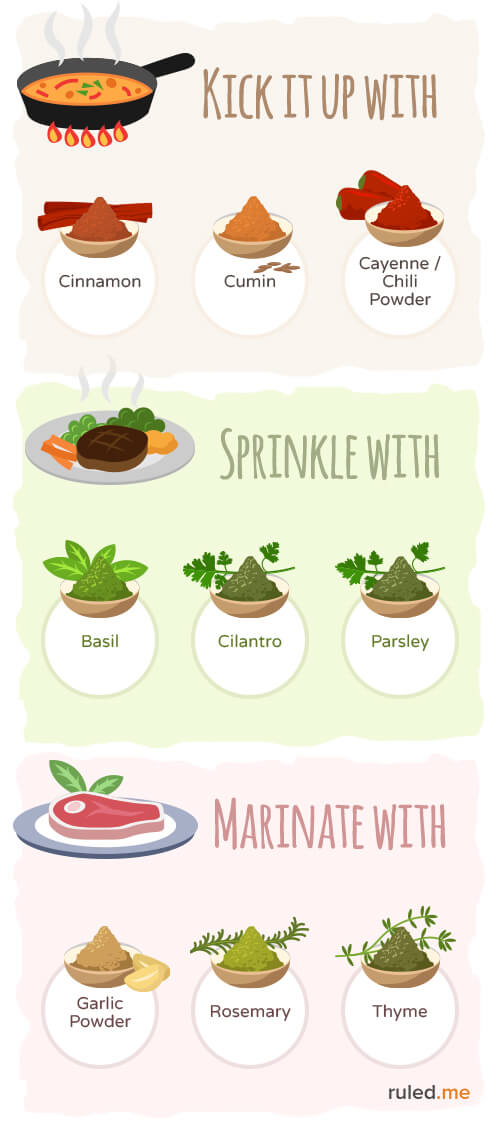
Below, you’ll find a visual idea of spices that are commonly consumed on a ketogenic diet. Even small ingredients can add up in carbs; make sure to monitor spices and condiments that you add to your meals.
Seasonings and sauces are a tricky part of ketogenic diet foods, but people use them on a regular basis to add flavor to their meals. The easiest way to remain strict here is to avoid processed foods. There are many low carb condiments and products on the market, and there’s no way to list them all. A handful of them are great, but the majority use high glycemic index sweeteners – which you want to avoid.
Spices have carbs in them, so make sure you are adding them to your counts. Sea salt is preferred over table salt, as it is usually mixed with powdered dextrose. Most pre-made spice mixes will have sugars added to them, so make sure you read the nutrition label beforehand to make sure you know what’s inside. If you have the choice, never include added sugar into your spice blends or food.
Below you’ll find some common herbs and spices that people use on a ketogenic diet. Always remember that spices do have carbs in them, so you should make sure to adjust your nutrition based on this.
- Cayenne Pepper
- Chili Powder
- Cinnamon
- Cumin
- Oregano
- Basil
- Cilantro
- Parsley
- Rosemary
- Thyme
Both salt and pepper can be used for seasoning without worrying about the nutritional information.
Typically speaking, the number of carbs in spices is minimal, so you don’t have to drive yourself crazy with measuring and recording. When using a lot of spices in a recipe, carbs can add up quickly.
If you want to see some examples of recipes where we use spices, feel free to look at our ever-growing library of keto recipes >
Condiments and Sauces
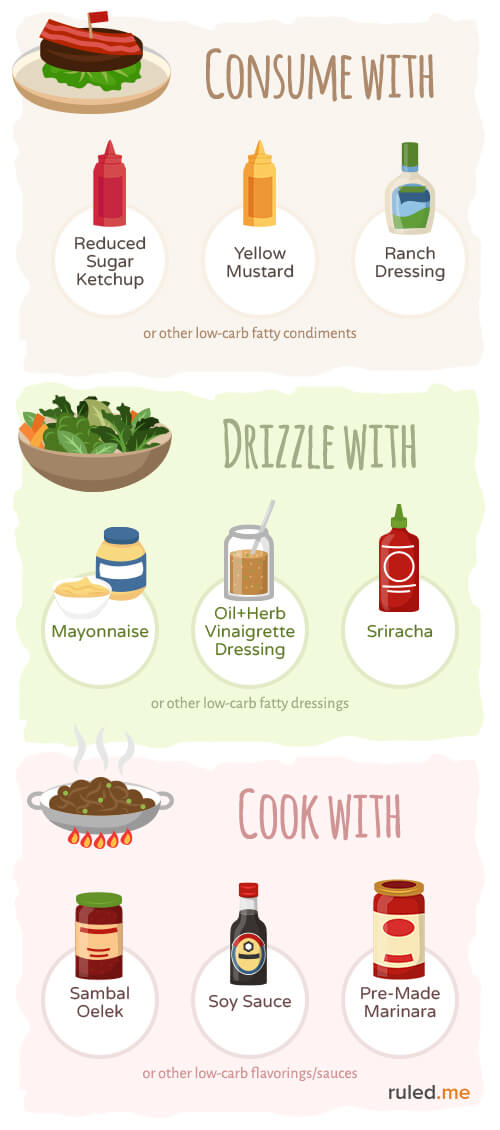
Below, you’ll find a visual idea of condiments that are commonly consumed on a ketogenic diet. Sometimes there is a lot of added sugar in just a teaspoon of sauce; double check nutrition labels to make sure it fits into your macros.
Sauces, gravies, and condiments, on the whole, have a lot of a gray area on keto. Generally, if you want to be strict, you should avoid all pre-made sauces and condiments unless listed below. They can have added sugars or use sweeteners that aren’t friendly on the ketogenic diet.
If you choose to make your sauces and gravies, you should consider investing in guar or xanthan gum. It’s a thickener that’s well known in modern cooking techniques and lends a hand to low carb by thickening otherwise watery sauces. Luckily there are many sauces to choose from that are high fat and low carb. If you’re in need of a sauce then consider making a beurre blanc, hollandaise or simply brown butter to top meats with.
Although great in health and theory, you may be like many others and not have the schedule to be able to make everything from scratch. Although it varies from brand to brand (make sure to read the ingredients), standard pre-made condiments for keto include:
- Ketchup (choose low, or no sugar added)
- Mustard
- Hot Sauce
- Mayonnaise (choose cage-free and avocado oil where possible)
- Sauerkraut (choose low, or no sugar added)
- Relish (choose low, or no sugar added)
- Horseradish
- Worcestershire Sauce
- Salad Dressings (choose fattier dressings like ranch, caesar, and unsweetened vinaigrettes)
- Flavored Syrups (choose acceptable sweeteners)
Try to err on the side of caution when it comes to keto condiments that are pre-made. Make your sauces and gravies using thickeners, and try to make your own condiments where applicable. Always double check the nutrition and ingredient list on your food to make sure that it fits in with your dietary requirements.
If you need some more ideas on how to use sauces and condiments in recipes, consider reading our keto cheat sheet >
Sweeteners
Below, you’ll find a visual list of sweeteners that are commonly consumed on a ketogenic diet. Note that the less accepted they are, the less you will want to consume.
Staying away from anything sweet tasting is the best bet – it will help curb your cravings to a minimal level, which essentially promotes success on the ketogenic diet. If you have to have something sweet, though, there are some options available to choose from.
When searching for sweeteners, try to go after liquid versions as they don’t have added binders (such as maltodextrin and dextrose). These are commonly found in blends like Splenda and can add up in carbs very, very quickly. For keto, you want to try to stick with lower glycemic index sweeteners.
Please note that this is just a small list of sweeteners that people use on keto. There’s tons of different brands and blends out there – we frequently use a mixture of stevia and erythritol in our dessert recipes. You may find something that suits your tastes better, though, just make sure that it is on the acceptable sweetener list.
Typically you want to stay away from any brands that use filler ingredients like maltodextrin and dextrose, or high glycemic sweeteners like maltitol. Many low-carb products that claim low net carbs usually use these sugar alcohols. Many candies that are “sugar-free” also use these sweeteners. Avoid them where possible. These specific sweeteners respond in our body in a similar way sugar does.
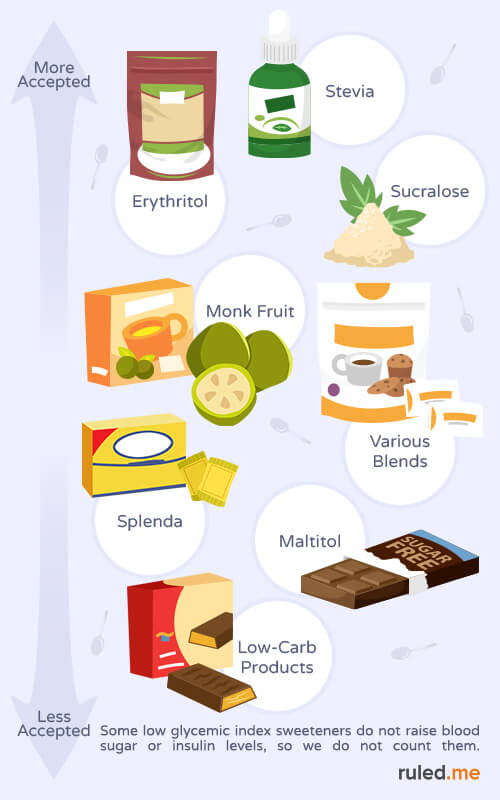
When a sweetener has a low glycemic impact (or a low glycemic index), it has little effect on blood sugar. The higher the glycemic index is, the higher your blood sugar will spike during consumption. Here’s our recommended list of 0 GI sweeteners:
- Stevia. One of the most common sugar substitutions used on the market today. Incredibly sweet with no glycemic impact. The liquid form is preferred.
- Sucralose. A very easy, but very sweet substitution to sugar that has a lot of misinformation around it. Many people confuse this with Splenda, but sucralose is the pure sweetener. Liquid versions are preferred.
- Erythritol. This is a great sugar substitution that has 0 glycemic impact. It’s special because it passes through our bodies undigested, and is excreted without absorbing the carbs.
- Monk fruit. This is a less common sweetener and usually used in combination with others. While somewhat rare, if you can find it, it makes a great balanced sweetener.
- Various blends. There are numerous brands on the market that combine these sweeteners in their ratios. Be careful and read the ingredients.
For those looking for something just a little closer to real sugar, you can use Xylitol. It cooks and tastes very similar to sugar, but it has a slight glycemic impact (13 vs. 100 for sugar). It is great, but please keep in mind that it is very toxic to animals and it will raise insulin levels slightly. These are the two most cited reasons for not using Xylitol.
If you want a more detailed list of the best and worst sweeteners to use on keto, click here >
Cravings and Sugar Addiction
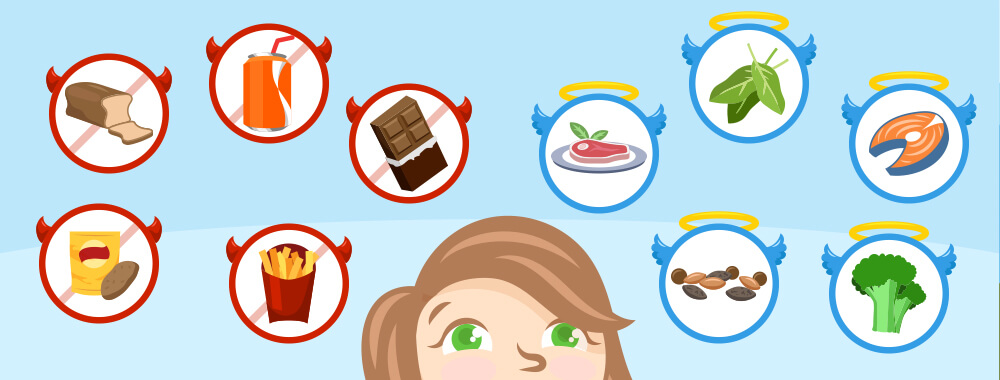
Most of the cravings that we get are caused by sugar. Sugar, at the end of the day, is an industry that’s run on addiction. There have been numerous studies showing that sugar stimulates the reward centers of the brain.
When we constantly consume sugar, we release dopamine in our brain – creating an addiction and an increased tolerance. Over time you will have to eat larger and larger amounts of sugar to continue the dopamine secretion. Once our body is dependent on a chemical reaction in the brain, we can find that we’re craving things even when we’re not hungry.
When trying to shift from a high carb diet to a ketogenic diet, cravings can definitely get strong. It’s always best to try to clean house before you start so that you don’t have food around you that can lead to cravings. We recommend that when switching to keto, you restrict using sweeteners completely for the first 30 days. It normally leads to breaking sugar addiction and ultimately not having cravings.
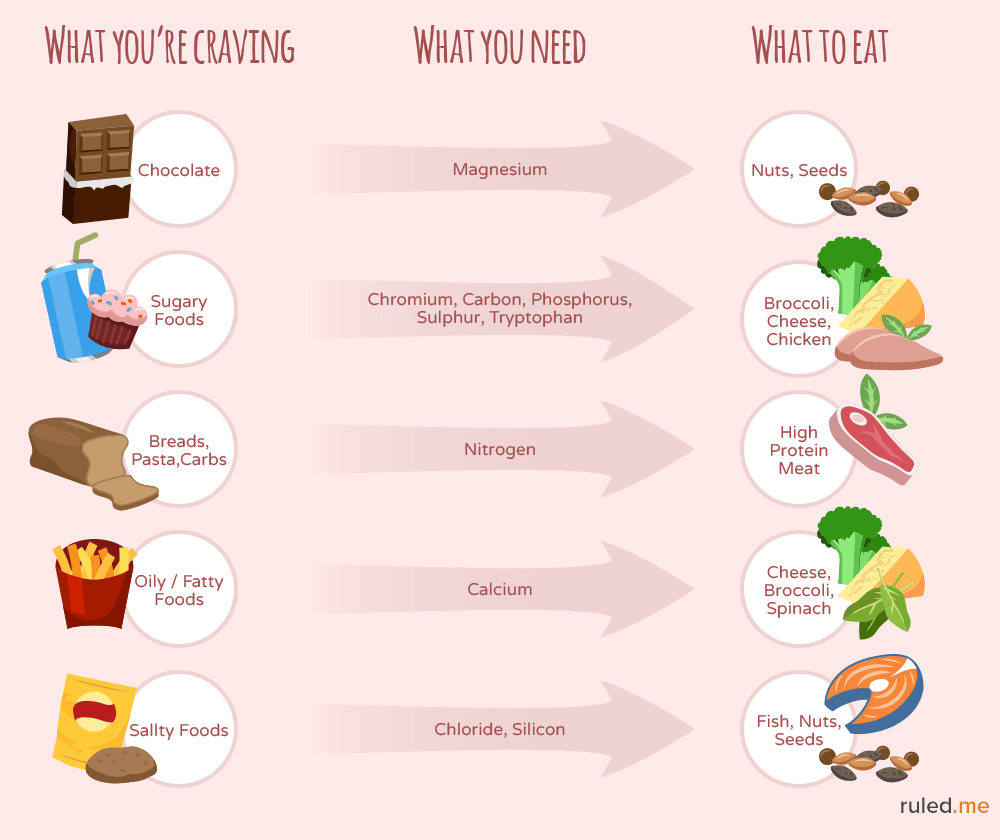
Besides sugar, sometimes our bodies crave food because of lack of nutrients. The craving usually goes away if you fulfill your nutrient intake in a different way. Below you’ll see a few ways to get rid of pesky cravings that hit.
Hidden Carbs and Nutrition Labels
Going on a ketogenic diet can be very difficult in the very beginning. Knowing what to eat and what not to eat takes some time to get used to, so if you make some mistakes in the beginning don’t be too hard on yourself. It’s better to make a mistake and learn from it than to make a mistake and not realize it was in error.
There’s always going to be foods that are bad for us when it comes to eating. Some foods are particularly sneaky at hiding carbohydrates from us. Here’s a small list of common items that sometimes have hidden carbs:
- Low-carb products. There’s a lot of choices when it comes to bars, snacks, and foods. It’s better to stay away from these, but if you have no choice make sure to read the label. Many use high glycemic index sweeteners in their products.
- Spices. As mentioned above, spices do have carbs – but certain ones have more carbs than others. These include onion powder, cinnamon, garlic powder, allspice, and ginger. Always read labels and make sure no added sugar are in your spice blends.
- Fruit and berries. Most fruits are not allowed to be consumed due to the high sugar content. Many people still eat berries, but you have to control your portioning with these. Be careful blueberries and cranberries as they add up in carbohydrates fast.
- Tomato-based products. Lots of people use tomato sauces and canned diced tomatoes. Make sure to read the nutrition labels – food companies are infamous for messing with serving sizes to make their foods seem “healthier.” Make sure that there are no added sugars.
- Condiments. It’s almost tradition to add sauce to a meal – but be careful about your favorites. Sometimes condiments and sauces can show minuscule serving sizes which skew the actual carbs that are inside. Make sure you read the nutrition and ingredient lists well.
- Peppers and chiles. Be very careful when you use small peppers as sometimes they can be incredibly sweet inside. There can sometimes be 3-4g carbs in a tiny chili pepper. When using bell peppers, try to opt for green as red/yellow bell peppers will have slightly more carbs.
- Diet soda. You can drink diet soda, but it’s recommended to cut it out completely. Some people report being knocked out of ketosis after a large consumption of artificial sweeteners. Studies also show a link between sugar cravings and artificial sweeteners – cutting the soda out will help curb your cravings.
- Chocolate. You can eat chocolate on keto, but you have to be very cautious with the serving sizes. You want to stick to very dark chocolate (90% or higher), as this will have much fewer carbs.
- Medicine. Cold medications, cough syrups, and flu remedies often contain lots of sugar. Some of the generic over the counter cough medicines contain 20g of carbs per serving, so be very careful when sick. There are usually sugar-free or diabetic alternatives.
There are so many food items out there that contain hidden sugars and carbs. Always be careful about what you’re purchasing and try to make as much from scratch as you can from home.
Foods to Avoid
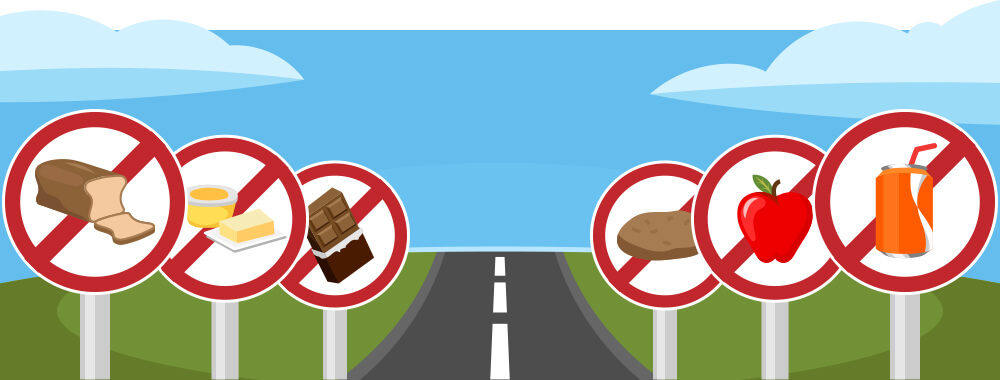
By now, you should have a pretty good idea of what to eat on a ketogenic diet. Make sure that you read and re-read through the list of acceptable foods to build a mental image around what type of meals you will want to eat.
If you’re still unsure about any products or food items that might not be keto friendly, don’t worry too much. Below, you’ll find a list of things that you should always be on the look out for.
- Sugar. It’s typically found in soda, juice, sports drinks, candy, chocolate, and ice cream. Anything that’s processed and sweet you can think of most likely contains sugar. Avoid sugar at all costs.
- Grains. Any wheat products (bread or buns), pasta, cereal, cakes, pastries, rice, corn, and beer should be avoided. This includes whole grains like wheat, rye, barley, buckwheat, and quinoa.
- Starch. Avoid vegetables (like potatoes and yams) and other things like oats, muesli, etc. Some root vegetables are okay in moderation – be sure to read the section on vegetables.
- Trans Fats. Margarine or any other spreadable replacement butter should be avoided as they contain hydrogenated fats (bad for us).
- Fruit. Avoid any large fruits (apples, oranges, bananas) as they’re extremely high in sugar. Some berries can be consumed in moderation – be sure to read the section on fruits.
- Low-fat foods. These tend to be much higher in carbs and sugar than full-fat versions. Make sure you read the package to make sure a mistake isn’t made.
In general, the more “real” the food, the better it is for you. While some processed foods are acceptable, many are not. Make sure that you read through the ingredients and nutrition information to make sure that it can fit within your diet. If you want to take things further and skip label-reading altogether, we put together a list of the strictest zero-carb options that fit keto without any counting.
Is it also worth mentioning urine ph levels. I found my urine became extremely acidic on a keto diet which I dont think is healthy. You can fix this by ensuring you eat lofs of leafy green veges, drinking alkaline water (can buy drops for this) and/or maybe having potassium citrate.You should not have potassium citrate in too large quantities though as can cause problems in the stomach.
Buy some ph test strips to check your current level.
Hi, Harry.
I disagree vigorously with regard to the “ph of your urine” being indicative of anything meaningful. Here is a whole page full of articles debunking the measuring of one’s health with ph paper dipped in urine or saliva. There are confabulous myths that have been circulating for decades about “the ph of the system.” For instance, there is this one: “If your system is alkaline, you cannot have cancer.” The tremendous majority of those who speak that myth do not even know what “the system” is. Something that is true about ph is this:
Your blood MUST remain between ph 7.3 and 7.5. Variation from that level means death.
I was checking the ph of my urine for several months, and was being driven goofy because the level never remained the same, and also because I could eat the most “alkaline-producing” foods I could find, yet “the ph of my system” remained either neutral or slightly acidic.
One day, I accidentally dropped the roll of ph paper in the toilet. What a wonderful day that was for me! I never bought another roll, and now I am happy all the time! (Well, at least I am happy I discovered that ph testing of “the system” was nonsense, and so could give it the heave-ho.
Elliot
Hi Harry and Eliot,
My personal health experience as well as my experience in chemistry/biochemistry/medical sciences would suggest that you are both correct in a way. I do not think my interpretations are unassailable, but do hope that this can be helpful to other readers with health issues.
I have been extremely prone to yeast overgrowth in the GI tract, esophagus, airways and probably in other areas less apparent. For many years I had to take powerful anti-fungal drugs and limit sugars and starches in my diet to control this. Then about 10 years ago my M.D. internist/gastroenterologist with openness to alternative approaches suggested that my body might be “going acidic”. I was aware of this notion of body pH in alternative medicine for at least 15 years prior to this but had never investigated it because, being a scientist (Ph.D.), I believed that the body strictly controlled pH as part of homeostasis. I accepted the “coral calcium” supplement that she gave me and even bought a pH meter for home use to precisely monitor urine and saliva pH. I was still very skeptical but I was also desperate and thanks to the internet I could get a good device for just over $100.
Discovering that I could easily modulate the pH of saliva and more importantly, urine, with mineral carbonates allowed me over the last ten years to completely control the yeast overgrowth and see that it was unquestionably linked to urine/saliva pH. No anti-fungal agents necessary. Whenever I get the beginnings of yeast overgrowth symptoms, I check first urine in the morning for pH. Without exception for ten years, pH was around 6 or below when I was having the beginnings of problems. I never had a yeast problem start for ten years if my pH was 6.3 or above, without exception. This relationship was independent of whether I was eating a lot of sugars and starches. However, what I always found was that sugars and starches eventually drove my urine pH down such that I would have to pH adjust with mineral carbonates or I would soon be suffering from yeast overgrowth.
So, how would I interpret this? My suspicion is that there are key areas of the body that strictly adhere to the “physiological” pH range correctly given by Elliot, perhaps many vital organs as well as especially the brain, or you are dead. It is clear however that in some cases tissues can drift considerably out of this range. This is well established in the case of cancer that certain afflicted areas have become quite low in pH quite a while before death. My own experience suggests that there are also some “boundary areas” such as the GI tract, esophageal, and airways mucosa that can drift at least a bit. I am sure the body has developed systems to contain this drift. Most likely by dumping acidic species into the urine which would have the effect of amplifying the pH effect in urine. Acid/base equilibria can become a pretty complex matter in a system as complicated as the mammalian body, but after giving this a great deal of thought, I am convinced that this is all explainable under existing models.
I have only done a ketogenic diet for about 10 days now (and I feel great) and I have noticed that my urine has indeed tended significantly acid yet with no yeast overgrowth. This would be the first exception in 10 years of careful monitoring. Is this because of the virtual absence of sugars and starches in this diet, or are mucosal surfaces staying in a state (presumably pH near normal physiological) that does not permit yeast growth to get out of control? One way that I can test this is by eating significant sugars and starches when I eventually decide to come off the ketogenic diet. Will yeast overgrowth immediately occur?
Bottom line: first urine in the morning may not reflect pH tendencies in the body when the body is in ketosis as it clearly appears to in states of non-ketosis. It would not be hard to speculate as to why this might be the case.
I do not want to claim in an absolute way that my interpretation is correct. What I would say is that urine pH can be an extremely powerful proxy for some physiological states indicative of disease. As indicated, I suspect that in non-ketogenic diets it is indicative of pH trends in the body: for instance a drop in pH from 7.45 to 7.35 in most of the body may result in an amplified drop in urine pH down near 6 or below.
I agree with you Elliott! I got into all the pH ‘hype’ for awhile but further research and study showed me it’s all nonsense! Our bodies are designed to be balanced and strive always for homeostasis. Worrying about pH is a waste and for the record, acid KILLS PATHOGENS it doesn’t allow them to flourish! That ‘cancer thrives in alkaline environment’ statement is misquoted and repeated so often people believe it’s true but it’s NOT.
Great comprehensive keto diet food list! Tons of good info! Thank you for providing such a great resource. I would like to add one thing to what you’ve written. I do think buying organic is important for maximum health benefits, but realize not everyone is able to do so. For this reason, I always share info about the Clean Fifteen and the Dirty Dozen. Basically, these are lists that help to prioritize which foods should be purchased organic or not eaten at all, due to the pesticide levels. Here’s a link to that info: http://www.ewg.org/foodnews/summary.php
Thanks again for such a helpful post!
~KD
Thanks for the article Craig, I am sharing it (of course) – you done good again!
Love this site and all of the recipes! You’re a genius!
Donna,
Thanks so much! Hope you do well in 2014, keep us all updated 🙂
Hi,
Is the ketosis process stopped by any deviation? I had a dinner and a friends house. The salad dressing was laced with sugar. I had two servings. I was on my tenth day in and really felt an incredibly positive change regarding energy. I got such a flush rush after the sugar – for the first time in my life I was able to appreciate the effects it has on my system. So what now – have I lost ten days work? Can ketosis kick in again or must I go through the five day process again? Thanks for feedback on this.
Nidsky,
I’m not sure what 5 day process you’re talking about, I am guessing you are referring to Atkins? Anyway, with a ketogenic diet you can get knocked out of ketosis if you consume too much sugars/carbs. Just go back to eating under 30g carbs a day and your body will resume ketosis after some time (probably 2-3 days). You don’t need to do a “5 day process” to enter ketosis, it happens naturally as you eat under 30g carbs a day.
As for the salad dressing, it might not have been enough to knock you out of ketosis, as I don’t know the carb counts/serving sizes. But either way, continue what you’re doing and you’ll see great changes in your body 🙂
Just getting started..very overwhelmed. Never could I believe that eating high fat would help me lose weight. But I am going to try. I am very overweight and was contemplating the “sugical” route until a friend suggested Keto. Just not sure of my daily numbers..how do I get my calorie/carbs/protein numbers for my weight & height??
Lynda,
There is a keto calculator that is available on the website. Please look at the navigation menu and you will see it: “Keto Calculator”. You can use it to fill in your information and get the necessary amount of nutrients to eat a day. Make sure to read the instructions on each part so that you get the proper amount of macros.
I am eating a lot of cheese. Mozzarella and provolone. My carb intake is less than 30g per day. I also eat eggs and nothing but Hellman’s mayonnaise to dip my beef and chicken into. I feel blotted. Is the blotted feeling part of the transition from glucose to fatty acid energy to fuel my bodily cells?
If you feel bloated you might have a sensitivity to all of the cheese you’re eating. Try cutting it down a bit and see what happens.
I found a sugar free caramel Macchiato International Delight coffee creamer. It has 1 carb, no sugars, no trans fat and the word hydrogenated is not in the ingredients but it does say maltodextrin in the ingredients. Is this something that I could use sparingly with my coffee in the morning or is it a no-no?
Thanks
Heather
Heather,
Maltodextrin is not always “liked” by people because it’s not always gluten free. It’s quite processed but it’s still OK to use sparingly in your coffee. That said, sometimes it doesn’t agree with peoples stomaches, but you’re using such a small amount that I don’t see it being a problem.
I’m just starting doing research about this diet. I’m type1 diabetic and I wonder how safe it is to use this diet so that I can use less insulin. The red flag for me is that it causes ketosis, which I’m not sure about whether it will then lead to diabetic ketoacidosis. Ive been diabetic on insulin for 34 yrs.
Lórien,
Diabetic ketoacidoses is caused by the peancreas, where it doesn’t produce enough insulin for the movement of fatty acids in the bloodstream. If that happens, your blood pH level is thrown off into a slightly acidic level – which is very dangerous. Just keep an eye on your insulin levels and you will be fine – as long as you’re regulating them then there’s no problem.
It’s pretty rare that is happens, to be honest, as long as you’re keeping an eye on your insulin levels then it’s pretty hard for it to occur. If you have any more questions just let me know and I will explain more in depth.
So the main issue as I transition into ketosis in the first few days will be low blood sugar, not really DKA? I’ll have to lower my insulin intake as my body adjusts to ketosis, omg it sounds scary…but if I have a low blood sugar episode I’ll have to have sugar which will take me out of ketosis…I’m just thinking out loud here…I might see saw back n forth till I get it right. Ok…I’m going shopping today…just gonna jump right into it. Weeee
Don’t let it scare you, I know a lot of diabetics (T1) that have done keto and they have no problem with it. If you’d like to, we have a group on facebook also – you can join there and there’s many diabetics that can help and give first hand experience with it all. I think that would be better suited as I’m not diabetic so I don’t know the ins and outs of your blood sugar and insulin levels. Either way, I think you’ll love keto and find you feel MUCH better on it 🙂
Hi Craig….is there a way to get a copy of the keto food lists in a printable form? I like to have a list I can look at when shopping and I don’t have the type of phone I can do this from.
Barb,
Right now my website isn’t really in printable form, but you can highlight the whole page and copy/paste it into a word document. That will also keep the tables in tact. You can easily print from there and delete any stuff you might not want 🙂 Give it a few months – it is a lot of work to make a website “printable” without the fluff so I’ll be working on it soon.
Hi Craig,
If you haven’t done so already, I will do the food list in Word and email it to you, if you can magically transform it into a pdf, and then you can put a link for it on your page. Doing that kind of stuff is quick for me 😉 It would only take me an hour or so to do it.
I could transfer it all over to a PDF file if you want me to. Wouldn’t take me too long. I’ll try to get it done tomorrow if I can 🙂
Hi Craig,
Thanks for the great info. Is coconut milk or cream ok to use? additives. I generally use the 60% w/ no additives. There is also a 70% one available which is higher fat, less water.
Thanks,
Ronna
Thanks Ronna! Yes, coconut milk and cream are OK to use. I personally only use coconut cream for the fat content though. The milk itself can be a bit carby if you get the wrong brands.
What about 3items that I now eat– full fat grass fed yogurt, organic carrots, and organic kale? These help to keep me regular, which can be an issue for me.
All of those foods are do-able, but only in moderation. If you overeat on them they can contain quite a lot of carbs, so just be careful and count how many carbs are in each to make sure you’re not having too much.
I have started the keto diet, I am on day 5 going well, your diet list is very helpful, I felt very dizzy for the fist couple of days, I am on a 1000 cal per day, I have to loss a lot of weight, it really bazar that I can eat full fat foods, in the past diets were all low fats and did not get anywhere,
Mel, 1000 calories is far too little to be eating to lose weight. That will do damage to your body if you continue to do it. Use the keto calculator on the website, and read some more of the articles on the website to get a better understanding of the diet. If you feel dizzy, it is most likely for 2 reasons: Not enough food and not enough salt.
I agree with most stuff on the list but why no green pea?
Green peas are quite high in carbs for their other nutritional qualities.
And btw, organic food is to avoid pesticide residues not worries about nutritional content
I know this much, but it’s also more expensive. I was just giving reason on why you could get away with eating non-organic food. And also, organic foods still have pesticides from cross contamination a lot of the time.
Hi Craig, thanks for all this helpfull info.
Ive just started this eating plan, its going well and ive been in ketosis for the past 5days. I have spent every spare moment reading up on this to try and understand the whole concept a bit better but one thing I am still unsure of is weather you have to be using up all the fat you consume before you 1start using up stored fat?
I am using keto sticks and was wondering, when it shows a high pressence of ketones if that is due to the fat I am eating or the stored fat being broken down and used as fuel?
Actually ketostix show the acetone, which is a mostly unused ketone – so they aren’t all that accurate. It usually means you’re dehydrated too, if you’re getting a dark color. You use up eaten fat first, but that is why you should be in a calorie deficit. Your OWN stores of fat can only cover so much energy a day (see other articles for this), so you have to supplement with dietary fat while still keeping yourself in a calorie deficit. So, when your body is done processing and using your dietary fats, it goes after your body fat.
Hope that helps!
How does a glass or two of wine fit into the keto plan? Or rather, how CAN it?
Typically you want to stick with dry red or white wine, which have around 5g carbs per glass. If you can fit it into your macros, it’s fine. I just don’t suggest making it a daily habit. Alcohol will get processed before everything else, so if you are consuming any type of alcohol daily, it can create weight loss stalls.
What about fruit?
You can eat small amounts of berries in moderation, but it’s not even normally recommended until you are completely fat adapted.
hi, excellent info, getting ready to start it, I always have confusion with portion sizes any easy ball-eyeing short cut to this …..humm laziness I guess? And can I eat coconut meat from the fresh coconut and the fresh coconut water? thanks
Ahmed, thanks! There’s no real easy way to eye-ball it besides getting used to all the portions you use. Once you get used to it all, it gets quite easy. As for coconut, you have to be careful. Coconut water and meat can be quite high in carbohydrates (and easy to go overboard with it). It can be eaten in moderation though.
Hey all, I’m JUST starting out on the ketogenic diet and I had a few questions. 1) Is it okay if I eat big protein and fat-rich breakfasts and lunches, but then only eat a blend of almond milk and mixed greens (kale, spinach, chard) for dinner? I’m trying to lose maximum weight but still getting my veggies in. I’m afraid that the mixed greens and almond milk have too much carbs though. Almond milk has 8g carbs per serving/cup and I grab three big handfuls of mixed greens which turn to nothing in my vitamix blender, but I’m worried I might be taking in too many carbs. Thoughts?
Jon,
That’s fine as long as at the end of the day your fats/protein ratios are still in check. Almond milk should only be around 1g carbs per cup. It sounds like you’re getting the sweetened almond milk so try looking for unsweetened. You could also try unsweetened coconut milk (also 1g per cup). That would significantly reduce the carb count and allow you to add a few more ingredients to spice it up a little bit. “Maximum” weight loss will only happen if you’re in nutritional ketosis and in a caloric deficit, so make sure your macros are on point and your calories are not too high.
Hope that helps! If you have any questions or need support you can always join the facebook group: https://www.facebook.com/groups/keto.diet
Hi,
Can you tell me or send me a link to where you have listed all the items you buy on Amazon for your recipes? I know I read it somewhere. Thanks in advance.
Hey Janice, sure! In the navigation bar at the top, just click “Our Store”
Hope that helps!
Hi Craig!
First of all, thanks for this website and the recipes. They have been a lifesaver for me as I begin this process! I’m a week in and according to the keto calculator I should be consuming 1630 cals a day. I have a spreadsheet where I track all my intake in fat, protein and carbs according to the keto calc results-no problem there.
My question is, is it normal to still be hungry between meals? I’m pretty hungry. I’m drinking water all day long. I lift weights 5 days a week and each of those days I also do 30 min of cardio in the am and then again in the pm.
If it’s just that I need to adjust to this type of eating I’m cool with that. Just wondered what you thought. Thanks!
Shannon, it sounds like you may need to eat more calories. You shouldn’t be hungry between meals and you might have to wait a bit longer to become keto adapted. But that said, 1600 calories for someone that lifts 5 days a week and does 30 mins of cardio is still quite low.
Hello! I am just starting with the keto diet and had a question. What is a way to increase fat intake without increasing protein as well? The only way I can think of is to do shots of coconut oil, but that would also drastically increase my caloric intake. I eat a lot of bacon/eggs/avocado, but too much avocado has too many carbs.
Thanks!
Jessica
Hey Jessica. You can source stuff like macadamia nuts, oils in your cooking, extra butter, salad dressings, and things like that.
Thanks for the prompt reply! I am on Day 4. First three days I lost 3.5 pounds, but not the fourth. I think I was snacking too much on the macadamia nuts throughout the day. I’ve dieted before, and it is hard to tell the difference between hunger and carbohydrate withdrawal. Do you recommend three square meals, or four? I am up 16 hours at a time and am usually hungry as soon as I wake up.
I also think that I am getting too much protein and not enough fat. I was reading a separate article about how you incorporate cream cheese because it is mostly fat. Is this a good idea even if I am not fat fasting? I also do high intensity exercise 3-4 times a week.
I’ve also been drinking 1-2 cups of bouillon to help with “keto flu”. I put a scoop of coconut oil or ghee to help with my fat intake also. Tastes especially good with beef broth.
I think what you do for people is great. I feel that keto is so complicated, especially since it is hard to know WHEN you’re doing it right.
Thank you
Jessica
Jessica,
Sure thing! Keep in mind that most of the weight you lose in the first week is water weight. So if the results don’t continue like that, don’t lose hope. As for your meals, you can eat 2, 3, 6 meals a day – pretty much whatever works best for you and your hunger.
If you think you’re eating too much protein it can be a problem on keto because excess protein will be converted into glucose, slowing the state of ketosis you’re in. Try to track what you’re eating so you can get a better idea of what you’re doing. You can also use the keto calculator at the top of the site to help out with knowing how much you can eat during the day.
I wish you the best!
Craig
Thanks so much for the helpful information on your site. My husband and I have been eating lchf for almost 4 weeks now. It seems like our weight loss has stalled. We initially lost about 10 pounds each. We’ve both blood tested and are eating similar foods but it seems as though his ketone reading is much lower than mine. Does dairy prevent some people from going into ketosis?
Sara,
Dairy can slow nutritional ketosis with a number of people since there’s a largish number of people with sensitivities to dairy. Check out the article on weight loss plateau’s I wrote and it should explain a bit more and offer a bit more advice 🙂
Fantastic information. I’m 47 and have been seesawing between 210 and 180 lbs for several years. Im now in the process of working out and eating healthily but i decided a few days ago to start a ketogenic diet. Im three days and its tough. I really would like to know if I can continue taking HMB – beta hydroxy beta methylbutarate and Creatine Monohydrate? Thanks
Thanks Simon! Glad to hear you’ve start to work out and eat healthy – you should be able to take both those supplements with no problem on keto 🙂
Hi. I’m vegetarian and eat no fish or eggs either. Knocking out the meat list seems to limit my food list considerably. Any suggestions?
Christine, I don’t specialize in vegetarianism, but you would most likely be doing a lot of avocado, nuts, cheese, cream, and oils. To get protein you’d be doing some vegetables, tofu, and other things similar. Hope that helps, but like I said I don’t have too much experience with vegetarianism 🙁
Hi Christine W, I wanted to let you know that I am not much of a meat eater but I have to live a ketosis lifestyle to stay well. I eat avocado pretty much everyday and rely on nuts and cheese for protein. I buy a lot of different varieties of cheese so it doesn’t get boring and only 1-2 ounces will meet your protein needs at each meal. My breakfast consists of a spoonful of coconut oil with a palm full of pecans – my nut of choice, almonds and walnuts are good too. If you’re not dairy intolerant you can blend pure no added sweeteners whey protein powder to heavy cream and a little sour cream and about 4 frozen strawberries, you can sweeten it with stevia or xylitol and you’ll have lots of protein and be stuffed from the fat, also makes a great salad dressing base! I also take up to 4 tablespoons each of organic virgin coconut oil and extra virgin olive oil (cold pressed only) daily, if not in my food then on a spoon.
Do all those suggestions sound keto friendly Craig? I need to make sure I’m on the right track too because my urine tests aren’t very consistent, I’m a big water drinker and maybe that’s throwing it off.
That sounds good Megan, though I’d suggest adding less strawberries or forgoing the strawberries totally. You could use extracts or flavored protein to get the flavors you’re looking for instead 🙂
I’ve heard some people make reference to “carbing up” occasionally. I’ve been in Ketosis for two months. Should I take a day to “carb up”, or is it best to stay on course?
Greg, it’s best to stay on course. I’ll be posting an article about carbing up in the future (and why I’m against it).
This site, which I happened across, is just awesome. I plan to start after my best friends wedding this weekend. One question – how does this type of diet affect blood pressure issues? Any information on this subject would be welcome. Thanks again, awesome information!
Hey Cheryl,
Keto normally decreases blood pressure in people (so if you’re on meds, you may have to stop taking the meds eventually, which to me is never a bad thing). You can also get a bunch more information about the diet by reading around the site 🙂
Hi there,
I’ve recently started looking in to this and I was wondering – if you are eating all the meat/protein/eggs/cheese etc but are NOT managing to get your carb intake to below 30g will you actually put on weight? Or is dropping lots of carbs still a good thing as I do eat a lot of carbs. So if you don’t actually manage to get into ketosis is all that protein/fat worse for you?
Thanks.
Emma,
Well that’s a loaded question. It depends on how many carbs (and what type of carbs) you are consuming. You also need to realize that this diet is not high in protein. It’s moderate protein, containing above 70% calories from fats. So it’s a fat centric diet. Excess protein can be (and will be) converted into glucose, therefore allowing your body to store more of the fats you’re eating rather than using your dietary/body fats as energy.
If you don’t plan to do this 100% then I suggest rethinking it and doing something similar to plaeo (reduced carb, no dairy, real food, etc.)
Hope that helps.
Thanks for getting back to me so quickly. I’m just a bit scared i’ll eat the fattier stuff and then not have managed to keep my carbs low enough. I’m a single mum with a toddler and I feel this would need time devoting to it to get it right which I just don’t have right now. Would the Atkins work? or The Egg diet?
Emma,
I would just take your time to read up and understand everything first. Don’t jump head first into this. Take your time to absorb the information and know what you are going to do. Once you know what you are doing to do, do a bit of planning and it won’t be a time consuming ordeal. Atkins is similar to this except that it’s more forgiving and has more protein. The Egg Diet – waste of time in my eyes. In the end, it’s up to you.
Ok, great thanks. Only thing is I want to lose a few pounds for an event on 19th June and wanted to try and kickstart it quickly so I would see some results and have more motivation to keep going. Might give the Atkins a go to try and get started.
Hi Craig
I’ve been on a food pack diet and my body is gone into ketosis, if I was to introduce some of the foods on this list, meaning to make a evening meal, would this jeopardise what I’ve been doing with the food packs? I have a wedding in sept and am desperate to shift a large amount of weight.
Many thanks
Karen
Karen,
I’m not sure what you mean by food packs? Is this one of the programs you follow that are very calorie restrictive? If so, then I suggest you stop with that. I believe one of the major ones is Idealprotein. This will cause you to lose a lot more muscle mass than eating properly. It also will cause metabolic damage if you’re restricting your calories greatly, which in the end just means putting weight back on after you finish with that program.
I have been eating paleo since October but am thinking of trying this as a way to shed these last 5-6 pounds. Is it safe while nursing? I have to be gluten dairy and egg free
Yes Heidi, it’s perfectly safe to do so (even while gluten, dairy, and egg free). Take a look at the other articles on the site and it’ll explain it much more in depth 🙂
Is turkey a good food to eat? Specifically ground turkey I didn’t see it on the lists unless I missed it!
You can, but I suggest staying away from it. I use it in a few recipes in here but it’s very, very lean (and you want fat).
Can you drink small amounts of vodka when trying to ketoadapt?
Erin,
It’s possible but it’s best to cut alcohol completely while you are becoming fat adapted.
Hi Craig,
Just curious as to how some of the fats can be taken. With things like olive oil & organic coconut oil the nutritional value is given in ml rather than grams. Is this a problem or do you just still use the values? Also if using these oils to cook chicken for example does the nutrional value change? Sorry if this seems a bit basic as I’m currently trying to work out my macros & the fats is the only thing causing me a bit of concern. Lastly, would it seem right for me to be aiming at 84% intake of fats or does this seem to high? (I want to slim down whilst maintaining muscle so used 0.6g protein per lb of lean mass).
Thanks in advance!
I measure out my oils by the tablespoon and calculate macros based on this. I’m not sure about where you live and the measurements, though if you are using mL. As for if you cook food, I just pour out the oil from the pan into my dish and eat the oil with the food – that way I know I’m getting everything. And for your fats %, it sounds fine to me!
I’m really interested in starting a keto diet and enjoy all the foods listed so thats a bonus. The only thing im concerned about is muscle wastage….? I work out every other day, mostly HIIT stuff with weightlifting afterwards. If i cant replenish the glycogen stores in the muscle wont i eventually be susceptible to muscle wastage? Although i work out alot my diet is pretty rubbish so am overweight, i defo need to make a change! Thank you x
Hey Eiran. I’ve read a relatively large amount of studies done on bodybuilders when I was researching for articles and it’s not as prevalent as you may think. Protein (and the amino acids) can supplement your muscles, as well as the fats you eat. You don’t have to refill glycogen to have performance gains (or stop muscle loss). From what I read, you should be fine eating around 0.8-1.1g protein per pound (this is actually a pretty optimal number for muscle gain) of lean body mass. Keto is a muscle sparing diet, so as long as you’re not in a massive caloric deficit, your body will still go to your fat stores before it will go for muscle tissue. Hope that helps!
Thats fab thank you for getting back to me!! 🙂
Sure thing!
Oh, sorry—here is the link about the uselessness of testing your ph: Hi, Harry.
https://www.google.com/search?q=urine+and+salivary+ph+nonsense&ie=utf-8&oe=utf-8&aq=t&rls=org.mozilla:en-US:official&client=firefox-a&channel=fflb
Please note that it is not only the “Quack Watch” quack who debunks ph testing. (“Quack Watch” is a site run by a man who does not believe in anything non-mainstream. He would have been one of the people in the excellent movie, “Never Do Harm,” who was trying to prevent the mother from taking her daughter to Johns Hopkins to try the ketogenic diet. Beware of what you read on “Quack Watch!”)
One last, but MOST IMPORTANT THING about “ph testing” while on the ketogenic diet:
Doing so can completely through you off the mark! Let’s say you’re doing everything right with regard to eating according to the diet. But then you buy a roll of ph strips (which, by the way, ARE used as a legitimate indicator by DIABETICS) and test your urine. You get an “acid reading,” and now you don’t know what to do. You start asking unnecessary questions, you begin fooling around with the diet, and maybe you even quit the diet because it’s “endangering your health by making your system acidic.”
In a nut shell: Do NOT allow a decades old, never proven, fallacious rumor, such as the ph of your urine, to interfere with carrying on with the ketogenic diet, the magnificence of which you can witness by watching the movie, “First Do No Harm.” It’s a film about a family whose younger son develops epilepsy, and how, just before The State gets its chance to begin mucking about in the boy’s brain, the mother whisks him off to Johns Hopkins, where he goes on the ketogenic diet, and never has another seizure.
The movie will bring tears to your eyes.
I got pretty scared when I was having pains in my back, right around where my kidney should be, and had a very acidic PH test stick. I just drink more water and every couple of days I do a tonic with water, lemon juice, apple cider vinegar, and baking soda. Puts me right back to normal almost immediately. But having acidic urine can lead to kidney stones, that’s what I’m worried about. Most people with half a brain will hopefully realize that ph test sticks are only testing your urine and not your body’s overall acidity, which is largely regulated by blood etc.
I am on day 12 of the Keto diet, just started working out, gained 2 pounds but lost a total of 2 inches already with reduction of 1% body fat in those 12 days. How often should I weigh. It did get me upset to see that I was gaining weight.
Melody,
That sounds like good progress. I would suggest weighing every 2 weeks. You may see that you are gaining weight, but that might be muscle. During the first 30-60 days of working out, if you haven’t in the past, you can gain quite a lot of muscle (more than regular gym goers). Keep measuring the bodyfat % and the inches – those are what matter more 🙂
Your nut list concerns me. I have found that an ounce of peanuts (raw) have 2.2 Net Carbs (4.6g total carbs – 2.4g fiber). Also wouldn’t the best nut to choose from be pecans, followed by brazil and then macadamia. They are under 3% cals from net carbs.
P.S. I did not take flax seeds into consideration.
Hello Kon,
I got most of the nutrition information off of the packaging lists of nuts that I had seen in the store. I went around the store (to commonly known brands) and recorded the nutrition value on them. It may differ from brand to brand (depending on where they’re grown, what process is used on them, etc.). The list is in alphabetical order, but the best and most widely available nuts (where I live) are Macadamias and Pecans. Because of their fat value and low carb values, they are the 2 best to me.
After stumbling upon this site, I looked around at other places. There are so many copy and pastes out there that have the exact same charts as you do. Just find it hard to believe you actually recorded the data off packaging in the stores rather than looking it up on USDA’s database. Anyways, don’t mean to grill. I bought keto strips from Walgreens, was wondering if those would give me a good idea for testing or are they just pH strips. Also I always heard hard liquor such as whiskey, vodka, gin, tequila, considered keto friendly to drink.
Check my mfp page and maybe friend me https://www.myfitnesspal.com/food/diary/kon_e3
I go through cuts and bulks year round, but dabble in ketosis for a short period during the cut cycle to get me through that <10% BF. Last year I did it, all I ate was meat/fish, cheeses, and mayo. Let's just say that was horrible for my digestion. This year I'm not consuming cheese, instead it's nuts.
Lastly I always thought calorie count wasn't needed for Keto, otherwise I can just count as usual with the usual deficit and still consume carbs.
You were actually correct. When I view the site (logged in as an admin), I see it in real time. When you see the site as a visitor, the website shows cached (“saved in advanced”) pages. This is due to site speed and wanting the site to load quickly. I went through and checked on my other computer and it was serving up a cached page from a long time ago. I had since redone the macros on everything and made it more uniform (having 1 oz, instead of 1/2 cup here and 3 oz there). It should be loading correctly now if you re-load the page – sorry about that!
Calorie counting, for most people isn’t needed. It is a tool that should be used, though, for a lot of people that are quite overweight (which you don’t seem to fall into that category). In a normal metabolism, with a normal endocrine system, the protein and fats will fill you up/satiate you enough to naturally limit your calories. This isn’t the case with some people, though, as they always feel hungry – no matter what. So I suggest using calorie counting as a tool for losing weight with keto (mostly for sedentary people).
Hope that all helps and thanks for pointing out the mistake!
Really appreciate the great tables of key nutritional values of foods useful in a ketogenic diet! That will be helpful for me to optimize my portion sizes. I am doing this diet for general health and weight reasons but am also interested in the potential use of such a diet against some types of cancer.
You’re very welcome Dan! I’m in it for the long run for the practical use and health factors. If you’d like to, I wrote a brief article on the Ketogenic Diet and Cancer here: //www.ruled.me/ketogenic-diet-cancer/
I know it’s not all that conclusive or complete, but there’s not tons and tons of research on the topic at this point – but it does seem very promising!
Hi Craig, thanks for the helpful list. I am on day 6 and my stomach feels weird, I’m eating healthy items and watching my carb and calories intake. The stomach feeling is almost like I wanna get sick but I’m hungry type of feeling. Thanks again.
Sure thing. Your stomach may feel weird from the heightened intake of fats. Normally what I’d suggest to someone in your case is to try to eat balanced meals (protein and fat, not just fat alone). That normally helps with the stomach issues in the first 2 weeks or so as your body adjusts 🙂
I am preparing to go into nutritional ketosis again mostly for HEALTH reasons although dropping some weight would be wonderful too. Since doing this before, I’ve focused on HEALTH more than weight and try to eat clean real food, grassfed drugfree beef, our own free range chicken eggs, etc., and also milk kefir, homemade fermented veggies, beet kvass and such. I hope these foods will be a good part of this plan. Fermenting is SO healthful and the sugar(s) are consumed by the beneficial bacteria so it’s all good. What do you think?
I think you should be fine doing that Marci. I know a lot of people that use either probiotics or use fermented foods for their gut to properly function and for the health benefits. It sounds like you’ve thought this out and will do fine – just don’t forget about the fats that you need!
Thank you for this site. I’ve just discovered it. It seems that many are using this diet for weight loss. I am on a journey with breast cancer and am considering this diet for that reason. I need to GAIN weight and am wondering how I can best facilitate that, and avoid losing.
Also, I’m concerned about your inclusion of “Sucralose” on the list of allowed sweeteners. I hope you will do the research on the danger of this neurotoxic sweetener.
Thank you!
Hey Judy and thanks. I’ve dove into the research on sucralose and there is not too much argument for or against it. If you see all of the studies against it, they are mostly in environments that wouldn’t be replicated in consumption, misconstrued, or provide no real results. A lot of speculations and negative press is against sucralose, but as it stands – I haven’t seen any conclusive studies on the negative health benefits.
That said, if you are doing this for cancer, I would definitely recommend doing this as clean as you possibly can – which means cutting out sweeteners of all kinds. Even the “natural” sweeteners I use such as stevia and erythritol are highly processed before sale. So, as it stands, it seems like no sweetener is truly that fantastic. The green leaf ground stevia is probably the best of all choice (not including yucca root, due to carbs), but most people find it giving a disgusting aftertaste (which I have to take into account).
I do try to focus on weight loss, so this is the reason I mainly keep the information weight-loss centered. When it comes to medical advice and decisions, that is totally up to you and your doctor. I can only give so much advice, and since most people are using this to lose weight, I keep most of my advice weight loss centered. I hope you can understand that 🙂
I have a 14 yr old special needs child who is having a very hard time battling seizures. He is on 3 medications and still having multiple seizures daily. I know some have recommended this due to its help in seizure reduction. Is this something a child can follow easily? He is lactose intolerant and has trouble with anything artificial. i have removed high fructose corn syrup, nitrates, GMO, fast food from his diet. He drinks Lactaid Milk and have switched to organic eggs which still bother him. He drinks a cranberry blend juice for his kidneys as well as mixing his meds with it. Are there any child-friendly food lists I can view to see if this might help him? thanks
Nicole,
Pretty much anything can be made for kids if you have the will to do it. It’s a lot tougher to do this for kids, especially ones that are a bit of picky eaters. But being that he’s lactose intolerant and doesn’t want artificial foods – that would be just fine on keto (and even encouraged on keto). You can still find plenty of great fats in meats, oils, and things like avocados.
You’d have to get a bit creative, I’m sure, to make him want to try the food – but it can certainly be done. Check out the recipes on the site and see for yourself the kinds of things you can make. There’s a food list (just search “food list” on the site) that you can check out, but it’s relatively incomplete and used primarily as an example – but should give a good idea.
Hope you and your son the best, but if you ever have questions feel free to post 🙂
I started the keto diet for weight loss. I’m 5’8″ and weigh 155 lbs. Three weeks in, I’d lost only 1.6 lbs. Took four days off and I’m having a hard time getting back into ketosis. I get between 1200-1700 calories depending on my exercise that day, and aim for 100g fat, 90g protein and stay well under the 30g of carbs- generally 10-15g. What am I doing wrong?!
Katie,
I’d go over and re-calculate your macros on the keto calculator to make sure you’re getting the correct nutrients into your body. Keto does take a little while with some people to happen. Especially between the intial water weight drop and the keto adaption, it’s sometimes common to see little to no weight loss.
I’ve been thinking about doing this diet for a while now, but I’ve been told that with the keto diet I won’t be able to exercise as hard as I do. I do crossfit and I box, I also do a lot of water sports like surfing, paddle boarding, etc. As active as I am I still have a problem with cravings, I love Italian food and sweets. Because of my bad eating habits I don’t seem to get lean and fit like I want to. What are your thoughts on it?
Thank you
-Nissy
Nissy,
Keto in the beginning will take some energy out of you, so you will definitely notice a dip in performance. This might last around 3-6 weeks time, but once your body becomes fully fat adapted (assuming you’ll be following proper macros) then you will be fine – with no dip in performance, and sometimes even better performance.
So I’ve just the ketosis diet, which is a high fat and low carb diet.
The idea behind it is if you don’t have cabs in your body your body will then use fat for energy meaning you will loose weight.
My question is, if carbs turn into Glucose and that’s what you are cutting out, and also eating too much protein turns into Glucose also then that will add weight?
So if I’m working out, and on this diet but not eating much carbs or loads of protein won’t I start to burn more energy than I have meaning my body will start to use energy from muscle tissue? meaning working out will actually loose more than I gain?
and in-turn if I eat protein and that turns into glucose then workout Won’t I just start putting on weight? as the glucose is now my energy not the fat so if the fats not being burned it’s being stored?
Thanks for your advice.
Hey Gareth,
In a sense, yes and no. You want to maintain a state of ketosis because it does help burn fat – but you also want to maintain it for the health properties and to keep your body in balance. If you’re constantly overeating on protein, then this state of ketosis can’t be reached (but you can still lose fat).
No, the whole point of ketosis is to start using your fat as energy. If you’re working out, you still have to eat enough calories to feed your body enough energy so it doesn’t delve into your muscle for amino acids. You have to still eat enough protein while working out – you can visit the keto calculator on the site to help you with that.
Glucose can be used during workouts, but is normally suggested to try a standard ketogenic diet first. Using glucose (which is turned into glycogen) during workouts is common among weight lifters for competition purposes. This is known as TKD (Targeted Ketogenic Diet) and CKD (Cyclical Ketogenic Diet). I have written a few articles on these, but I honestly suggest trying a standard ketogenic diet first.
Hope that helps.
Hello! Thank you for answering my question I just have one more!
What is the point of the Keto diet, I mean you still have to eat less total cals than I burn to loose weight right right? but If I was eating carbs and still eating less than I was burning I would still loose weight right? and that weight would also be fat so where is the benefit?
I’ve been looking at your recipes they look AMAZING 🙂
Gareth,
Well, calorie counting is a good tool – but it’s pretty oversimplified. With keto, you usually eat more than you expect you can – which has to do with the type of nutrients you are eating and the thermodynamics of food. But at the end of the day, you do have to burn more than you’re eating to lose fat (in a nutshell, though say that is oversimplifying it).
Keto has great health benefits, that’s why most do it. It’s not that restrictive (especially if you’re a savory eater) and the treats are still pretty good. To me, it’s more sustainable as an actual life long diet rather than a fad diet you use to lose 5-10 lbs. and gain it back.
But, at the end of the day if you’re just wanting to lose weight and you don’t care about health benefits, don’t plan to make a long term change, or just don’t think this diet is suited for you – there are other ways to lose weight.
Actually if you have most of your weight in the middle, you will not lose weight eating fewer calories than you consume, if they are carbs. Trust me I have tried it and so have millions of other middle-age people. It just doesn’t work. You have to go Keto to lose the spare tire
Craig, I really didn’t mean to offend you in anyway, if I am going to make a lifestyle change then I want all the information I can get, I’m not an expert on this Keto stuff, and there is so much conflicting information on this diet online and your website seems to make the most sense to me!
I have eaten the ‘Keto Way’ for about 5 days now until this morning all I could think about was sugar, I mean I was obsessed I felt like I had no energy just crap in general! But today I’m full of energy is this normal?
Also, I think I’m eating the Keto way but then I do some research and find out I’m not? For example 5 days I have been doing this I eat eggs and streaky bacon for breakfast, some form of meat for lunch with broccoli or onion which I hear either can throw you out of Keto? I drink two cups of black coffee in the morning no sugar obviously! I also hear this is a bad idea.
I feel a little constricted I mean for instance I want to go and make a lettuce wrap now with bacon and red onion, but I hear even red onion is a no-no on Keto is that right?
I just want to say thank you for reading and replying to my silly comments and for creating such a great and informative site! (it’s just a lot to get your head around for a beginner)
Hey Gareth,
No offense taken – that was more of a compliment than anything. Let me address your questions in order they were asked:
Yes, that’s totally normal. You go through a period known as “keto flu” where your energy levels drop and you feel like crap. This is generally your electrolytes getting pee’d out (ketosis is a natural diuretic, do you have to increase water to counter that, which also reduces salt levels in our body – so you have to make sure you’re eating enough salt). Once your body adjusts, you start to get over this phase and the energy levels increase more than baseline when you started.
Broccoli is fine on keto, and can be eaten. You just can’t eat massive amounts of it. It’s all about moderation when it comes to veggies. Onions are a bit iffy, but you can certainly use them – you just have to watch out for their carb count. They’re mostly sugar and water, so you can’t just have 1 onion to yourself for dinner and expect to stay in nutritional ketosis.
Coffee is fine. I generally have a rule of thumb that 2 cups is the max. Studies show that 3 and more cups of coffee a day will interfere with weight loss, but 1-2 cups will actually help with weight loss.
Lastly, red onion has the same philosophy as all vegetables – just watch your intake, you don’t want too many carbs at once.
Hope that all helps.
Hello Craig,
Im one week on the keto diet, its been hard in some ways to stay under 30g of cards, but. ive done it. no sugar cravings. I drink about 3 litres of water per day. However within a week. I have developed a kidney stone, strange as this is first time stone for me. ? research into keto diets used in epilepsy , show a 300 percent chance of developing stones. That is huge in terms of medical stats.
I do want to ask about nuts too, as the previous person did, which you did not answer. why are Brazil nuts not on your list of preferred nuts surely almonds and brazils would be top? you seem to ignore brazils altogether? other than the chart.
Hey Amanda,
Kidney stones have been a problem for some of the epileptic children that were studied. Though, many were deficient in potassium, and once supplemented with potassium citrate, reduced the kidney stones drastically (from 25% down to 0.9%). Generally, the best way to counter kidney stones is to eat vegetables that have lower potential renal acid loads (usually you’ll see spinach being one of the lowest and nuts being some of the highest) which helps reduce the acidity in urine. This normally helps with the extra calcium that your body releases while balancing your blood pH from being in ketosis. Increased calcium levels will increase the chance of stone formation.
I would honestly say that one week is far too little time for a kidney stone to form because of you switching to ketosis and could be a myriad of other things from previous diet/eating habits. I wouldn’t solely cause the blame to a ketogenic diet, rather, a combination of multiple factors.
As for brazil nuts, I just didn’t include them. There’s thousands of different foods I could have put on this chart, but I just chose a few to give examples to people that were wondering what types of food to eat on a ketogenic diet. It’s moreso for the examples to see what you can and can’t eat, and then make your own decisions from there. Brazil nuts were left out, just like tons and tons of other foods were left out. I simply don’t have the time or resources to create some kind of database that compiles all of the food in one place (that’s what the USDA database is for).
Hope that helps and makes sense.
Craig
Hi Craig, I have come across your website and love all I see and read so far, you seem very knowledgeable to this keto lifestyle. I am on my 5th week following induction phase of Atkins I guess you would say as I only had that list of foods to go by and a group I am on most sseem to be following Atkins.. However First of all I am 52 this year female and have switched from following Weight Watchers which I have lost 50 lbs on over the past 1.5 yrs but stalled and needed a change so decided to try LCHF, so far I’m loving it. My questions or concerns is this… I have a history of kidney stones and was told that my oxalates were to high thus to avoid foods with high oxolate counts but mainly to lower my animal protein to being 6 ounces a day and this will not Stop me from getting more but it will slow down the growth of the one I have and lessen or slow the growth of more. How do I incorporate this WOE with the need to lower the protein intake and not add to any risk of producing MORE kidney stones. I don’t want to even go through the pain of the one I have now which is apparently 7mm in size. I see a Urologist for this to keep track of it’s growth and placement.Thanks for your help.Also bought your 30 meal plan download and recipes look awesome!
Thanks! If you drink plenty of water and eat foods that are low in oxalates, you should be fine. There was a few studies a while back that talked about keto and kidney stones, and they were mainly fine after increasing water intake and lowering oxalate dense foods.