


To follow a ketogenic diet properly, you must restrict daily carbohydrates to around 20-30g of net carbs. This simple rule should be followed by everyone who is on a ketogenic diet, but there is one exception — athletes.
By “athletes” I mean anyone who is doing high-intensity type training multiple times a week. During high-intensity exercise, the body relies on glucose for fuel rather than fat.
To provide our muscles with the sugar they need to perform high-intensity training, we must supplement with carbs by implementing the cyclical ketogenic diet or the targeted ketogenic diet.
Cyclical Ketogenic Diet or Targeted Ketogenic Diet? Which One Should I Use?
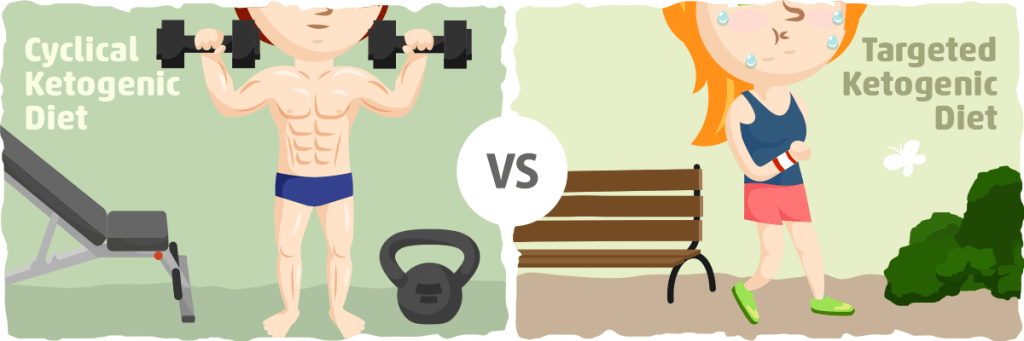
The cyclical ketogenic diet devotes one to two FULL days of high carbohydrate consumption in order to fully refill muscle and liver glycogen stores. This means that cyclical ketogenic diet is not for those who are not able to perform the necessary amount or intensity of training.
For example, this diet variation is not recommended for low to moderate intensity trainers and exercise beginners because they most likely will not be able to fully deplete their glycogen stores and get back into ketosis if they follow the cyclical ketogenic diet. For this reason, if you’re a beginner or intermediate trainer or do ultra-endurance exercise, then a Targeted Ketogenic Diet is the best way for you to use carbohydrates as a performance enhancing tool.
On the other hand, if your rigorous training schedule contains high-intensity workouts that deplete your glycogen stores, enabling you to get back into ketosis each week, then the cyclical ketogenic diet is for you.
The primary purpose of the cyclical ketogenic diet is to use carbs as a tool to maximize muscle growth and exercise performance, while you also get the benefits of the standard ketogenic diet. The downside, however, is that you might gain some body fat with that extra muscle mass.
What is the Cyclical Ketogenic Diet (CKD) Exactly?
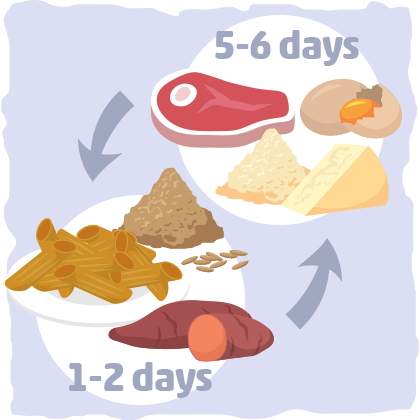
The standard format for a cyclical ketogenic diet is 5-6 days of ketogenic dieting and 1-2 days of high carb eating.
Others have also experimented with 2 week cycles, where 10-12 days are of ketogenic nature and 3-4 days are carb loading. The 2 week split has also had good results, but it doesn’t fit around everyone’s schedules as neatly.
The primary goal here is to temporarily switch out of ketosis to refill muscle glycogen, in order to sustain training performance in the next cycle.
If you are on a ketogenic diet for health reasons (hyperinsulinemia or hypertension), you may find the cyclical ketogenic diet unworkable as the hormonal response can trigger health symptoms that are being treated by a low carbohydrate diet.
Since the goal of a cyclical ketogenic diet is to completely deplete muscle glycogen – a proper workout schedule is needed for optimal results. A good workout plan example would be:
- Monday/Tuesday – Full body split. Monday could be legs and abs, and Tuesday could be chest, back, and arms.
- Friday – Full body, high rep depletion workout.
The amount of training to completely deplete your glycogen is dependent on the amount of carbs you had in your carb up phase. If low rep, heavy weights are being used, then 2-3 sets should be necessary. Conversely, if high rep, moderate weights are being used, you would need to do 5-6 sets.
How do I do the Cyclical Ketogenic Diet?
The low-carb portion of the cyclical ketogenic diet is identical to that of a Standard Ketogenic Diet. The nutrition is as follows:
- Calories for gaining mass: 18 calories per pound of body weight.
- Calories to lose weight: 12 calories per pound of body weight.
- Calories to maintain weight: 15-16 calories per pound of body weight.
- Carbohydrates: 30g or less per day. The fewer consumed, the faster you enter ketosis – this is more critical, as you only have 5-6 days of low carb.
- Protein: During the first 3 weeks eat 0.9g per pound lean mass or 150g, whichever greater. Afterward, set for your goals (1.0-1.2).
- Fats: Remainder of caloric needs.
After you’ve depleted glycogen stores and are in ketosis, you are ready for the carb-load portion of the Cyclical ketogenic diet.
Beginning the Carb-load and Getting into Cyclic Ketosis
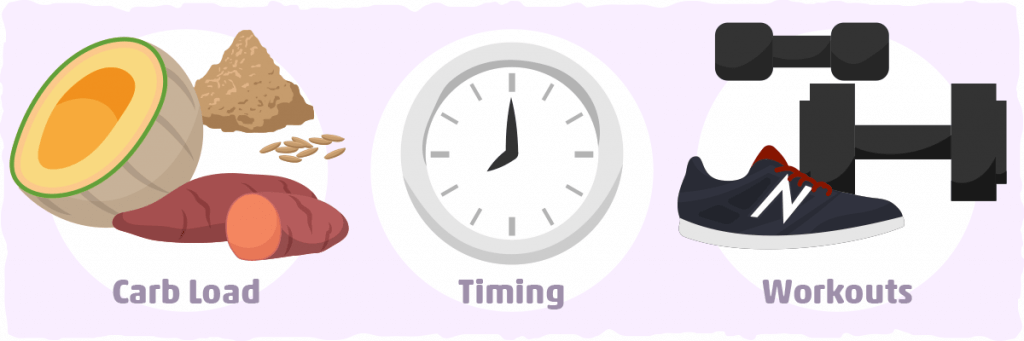
To gear yourself toward an anabolic state, you will want to begin your carb loading 5 hours prior to your final workout. At this time, 25-50g can be consumed, along with protein and fats to begin higher production of liver enzymes.
1-2 hours before the final workout, a combination of glucose and fructose is recommended to refill the liver glycogen. 25-50g is a good place to start, and you can add more as needed.
The Carb-load
Most commonly, people just consume whatever they want during their carb-loads. Although quite haphazard, it still provides results. For those of us who want a more scientific approach, I will go through the guidelines for proper nutrient intake while doing a carb load.
Nutrient Intake
Your own experimentation is the best thing to recommend here, but I will provide you with some guidelines to help:
- First 24 hours: Carbohydrates will make up 70% of your total caloric intake. 15% protein, and 15% fats split evenly. Higher GI foods can be consumed, but it is best to stick with whole food carbohydrate sources rather than processed foods.
- Second 24 hours: 60% carbs, 25% protein, 15% fats. Lower GI foods should be consumed.
If you are not sure what Low GI and High GI foods are exactly and would like more precise guidance, read our recent article on What To Eat on The Cyclical Ketogenic Diet. It will clear up any questions you may have regarding what foods to eat and what is going on inside your body during the cyclical ketogenic diet.
Re-entering Ketosis After Carb Up
Emptying the store of glycogen in the liver will ensure your merry way to ketosis. The easiest and most foolproof method to do this? Simply follow these steps.
- Day 1: Do not eat after 6pm.
- Day 2: Wake up and perform HIIT or intense weight training on an empty stomach. Begin strict ketogenic diet with 0-2% carb intake. The combination of high-intensity exercise and a strict ketogenic diet will help deplete glycogen stores so that you can get into ketosis more rapidly.
- Day 3: Wake up and perform MISS (medium intensity steady state) or medium intensity weight training on an empty stomach. Return to normal ketogenic diet with 3-5% carb intake.
- Optional: consume MCTs for an extra ketone boost.
How Long Until I Am Back in Ketosis?
Everyone will get back into ketosis at different rates after their last high-carb meal. How long it takes you to get back into ketosis depends on many factors, including:
- How keto-adapted you are. The longer you have been on a ketogenic diet, the more your body is adapted for this. If you’ve been on it for a year, you will find it much easier to enter ketosis after a carb re-feed than say someone that has done it for a month.
- How much exercise experience you have. The more you train, the easier it will be to enter ketosis. This is mainly due to the fact that trained individuals can work out for longer periods of time at higher intensities than untrained individuals. Because of this, people with more exercise experience can deplete their glycogen stores and start burning ketones more quickly.
- How much high intensity exercise you do. High-intensity resistance training and conditioning will provide better results than aerobic training. Aerobic training will not deplete your glycogen stores nearly as much as a high-intensity workout.
- What you eat during your carb re-feeds. The better your carb choices (for example, eating mostly lower GI carbs like legumes, fruit, root vegetables, and unrefined grains), the easier it will be to re-enter ketosis.
- How consistent you are with the diet. The more consistent you are with your cyclical ketogenic diet (proper carb ups, not cheating, etc.), the easier it will be to come back to ketosis – and your body will adapt more efficiently after each refeed cycle.
Although there are some genetic and lifestyle factors that affect ketosis that may not be under your control, this list consists of every variable you can adjust to get back into ketosis more quickly after your refeeds. However — an important question still remains — is this dietary approach really worth the extra effort?
What the Science Says About Cyclical Ketogenic Diets
The research literature on cyclical ketogenic diets is scarce. However, there are two 2017 research studies that provide us with evidence that combining the ketogenic diet with carbohydrate re-feeding is a good idea for athletes.
In one study, twenty-five college-aged men were divided into a ketogenic diet group and a western diet group for ten weeks. After the ten weeks, the ketogenic dieters were put on the western diet for a week.
The results are fascinating. Not much difference was found between the two groups in the first ten weeks; however, the ketogenic diet group experienced a significant increase in lean body mass and power output on the Wingate Power Test (cycling at max intensity for a short period of time) after one week on the western diet. The same improvements were not found in the western diet group.

In the other 2017 study, researchers looked at the effects that a low carbohydrate diet, a high carbohydrate diet, and a periodized high carbohydrate diet (similar to a cyclical ketogenic diet) had on elite race walkers. The results confirm many suspicions that a strict low-carbohydrate diet can hurt performance at higher intensities, but what happened to the race walkers who were on the periodized high carbohydrate diet? They experienced a significant improvement in performance.
Although these two studies are not testing the same cyclical ketogenic diet schedule that we are proposing in this article, they provide evidence that you can combine the ketogenic diet with a high-carbohydrate diet to improve athletic performance and body composition. However, you don’t have to follow the diets that these studies used to get these results. All you have to do is follow the cyclical ketogenic diet by depleting glycogen stores, getting into ketosis, and then replenishing glycogen stores with a carb refeeding day or two. This way you get the benefits of keto-adaption, ketones, and carbohydrates.
But don’t forget — this diet is only meant for experienced trainers who regularly exercise high-intensities. How do you know if you fit into this category? We’ve provided a simple guide below so that you know exactly what we mean by “high-intensity.”
How Much is High Intensity?
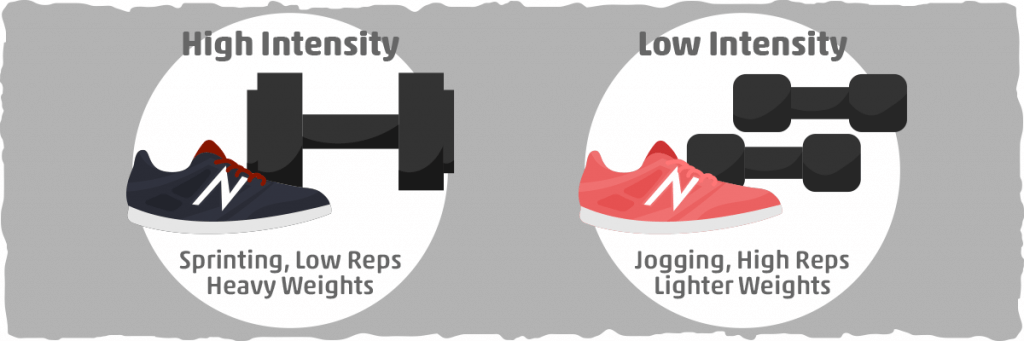
Typically anaerobic exercises with repeated intervals that use bursts of strength will be considered high intensity. This type of exercise training increases energy demands of the body to the point where the cells have to start burning glucose for fuel.
How do you know when this happens? When you start huffing and puffing out of your mouth during exercise. This is an indication that your body is starting to burn more sugar than fat, which is what you want to happen so that you can deplete your glycogen stores and get into ketosis.
Here are some examples of high-intensity training vs. low-intensity exercise:
High Intensity:
- Low reps with weights done above 80% of your one rep maximum.
- Sprinting or wrestling.
- Circuit training (CrossFit courses).
Low Intensity:
- High reps with weights below 80% of your one rep maximum.
- Jogging or marathon running.
- Yoga
It is also important to realize that the cyclical ketogenic diet should NOT be used to improve your endurance limit; rather it should help you overcome strength barriers. Carb loading to get 2 more reps of your 15+ rep set is not a good time to use this, it should be used to get 2 more reps out of your 6-rep max set.
Putting It All Together
If you are on a standard ketogenic diet and do high-intensity exercise regularly, then you may benefit more from a cyclical ketogenic diet. With this dietary approach, you will be able to combine the benefits of burning ketones with having enough sugar available to improve performance, strength, and muscle gain.
The most common cyclical ketogenic diet format is 5-6 days of a standard ketogenic diet with 1-2 high-carb refeeding days. During the ketogenic diet phase of the cycle, make sure you do fasted high-intensity training to deplete your glycogen stores and push your body into ketosis more rapidly.
During your carbohydrate refeed, it is best to consume complex carbohydrates from whole food sources as high GI foods can impair your ability to get back into ketosis. On the first day, we recommend that you get at least 70% of your calories from carbohydrate sources like potatoes, yams, carrots, bananas, pineapples, raisins, and white rice. During the second day, it is best to decrease your carbohydrate intake by 10% and eat lower GI carbohydrates like whole grains, peas, blueberries, lentils, and black beans.
After your carb re-feed, focus on depleting your glycogen and increasing your ketone levels again and repeat the cycle — that’s it. By implementing this dietary strategy, you will reap the benefits of a high-carbohydrate diet and a ketogenic diet at the same time.
However, if you don’t exercise at high-intensities regularly or if you are an exercise beginner, then the standard ketogenic diet or the targeted ketogenic diet will be the best option for you. To find out which ketogenic diet you should follow, check out our article that explains the three ketogenic diets.
i was on a low fat diet and lost 51 pounds of fat. i am 5’10, 174 pounds. i want to lose more body fat and keep my muscle. i am one day into the ckd diet. lol. any other pointers or tips. it feels so wrong (in a good way) to be eating so many fats. i have to continually tell myself it’s ok that this is gonna work. do you have any success stories from the ckd diet? or know of any bodybuilders who have used the ckd diet to cut up? any info is appreciated. i like your website, it’s been a great help!
I don’t personally have any success stories of the CKD working, but a few people in my facebook group were doing CKD with a lot of success. Also, there is a forum on the bodybuilding forum that is specifically for Keto and there are many success stories there 🙂
Hi I have just started TDK 3 to 4 weeks ago. I weigh 186lbs female but can’t seem to kick fruits. I exercise moderately and do occasional arm weights of 12 lbs. lol I am in no way a serious weight lifter but want to get there some day. I have lost 10 lbs in 4 weeks on TDK but always eat fruits of some sort on the weekend. No other carbs. Can I do CDK and get the same results with my daily 3 mile walks and intense 20 minute 3 times a week high intensity stationary bike training?
I’m a bit confused.
If the purpose of a ketonic diet is to use fat as fuel, why would CKD be necessary by asking the body to use glucose? Would this be good for those who have a VERY low body fat (i.e. body builders & fitness competitors)? If not, workouts should be able to be fueled by fat even if one is doing resistance training.
My body fat is about 19% and I was thinking of using CKD once I’ve hit between 7-9% body fat during competition season. As I thinking of it now, all I would need to do then would be to increase my fat to fuel my workout.
As you can see, I have many questions about the application of CKD.
Thanks for any information that you can provide.
Sandy,
I definitely think that TKD and CKD are optional routes for athletic purposes. Some people (most, if they really dial down into it) can do just fine in the gym, building muscle, and losing fat on a SKD, but some people don’t want to give up the power they have when they’re in the gym. When you switch from a standard high carb diet to SKD, you generally lose a lot of power and it takes a good chunk of weeks to become properly fat adapted. The reason behind CKD is mainly to give yourself enough Glycogen to use to give yourself power while working out, and it can generally increase the amount of muscle you can build in a shorter time frame compared to SKD, but it certainly isn’t necessary if you don’t want it to be.
Yes, CKD is more fit for body building and competitor competition goers, rather than the average joe just trying to go to the gym to get a bit more aesthetics. What I normally suggest to people is to stay in a standard ketogenic diet for at least 6-7 weeks to become fully fat adapted, and then decide whether they even need or want to introduce carbs to their diet. It’s more a personal decision and it varies for everyone on whether it’s actually needed or not.
Hope that helps!
Thank you for taking the time to respond. I appreciate the insight.
I’ll come back to CKD in 6 -7 weeks if I think it is needed as suggested. I’ve scheduled a bod pod test at a local university. It will be interesting to compare results over time.
Sounds good – let me know how it goes!
Im new to this discussion, since it’s been 3 years now, would be interested to hear how things have gone since.
First: the site and all this info helped a lot!
I’m in cutting for about 40 days, and has about couple weeks that I started doing the CKD.
Despite the difficulty, I found quite satisfactory the fact that I can eat carbs at the weekend, giving the idea of being ‘virtually’ without dieting and without suffering. haha
I am currently consuming around 30-30 net carbs and ketosis levels are still good. (mostly in the end of the day)
However, I believe that the replacement of glycogen in the muscles during the weekends, my weight loss is not apparent in the scale.
Should I continue at this and ignore the scale? Actually I’m using myfitnesspal and all macros are 99% accurate, since my diet is constant.
I believe I have 14-15% of BF right now and my goal is to reach 8%. =]
I would suggest reading more about CKD. I’m not sure what type of carbs you’re eating, and I’d also suggest reducing your carbs more during the week days. 30g net carbs seems like you’re pushing toward your limits if you are doing CKD. Depending on work outs, you should see small amounts of movements on the scale, but it definitely will be a little slower on CKD.
Just wondering if I should lower my calorie intake in cardio days and off days? Should I switch up my macro nutrients on these days? Currently running 75/20/5 on 2500 cals for lifting days. 5’11 208lbs working out 4 days a week, cardio wens, sat, Sunday.
I’m a 190 lbs male with about 19% body fat. I’ve done carb cycling while never being in ketosis even though my girlfriend I live with is on an SKD. Essentially, muscle hypertrophy occurs up to 48hrs after training (most of it ocurring in the first 24 hrs). I have just concentrated on eating 15% surplus total calories and at least 1g per lbs of body weight of protein in the 24-36 hours following high intensity resistance training while eating the remaining calories during this time in fat and carbs (about half calories each). I do resistance training twice a week. In between resistance training I go semi-low carb (50-125g) and do 1 or 2 cardiovascular exercise sessions (intervals on an elliptical, sprints, etc.) What I’ve found is that my energy level is notceably lower and mood more irritable when I am in the “semi low-carb” phase. If I’m not a pro body builder or pro athelete, would a TKD be most likely easier on me than a CKD while providing more effective lean muscle gains than being on an SKD considering most of my exercise is compromised of intense resistance training? If eating 25-50g carbs pre-workout isn’t going to take you out of ketosis for more than a few hours, why wouldn’t you do a TKD instead of an SKD if you are trying to build (and eventually maintain) lean muscle mass?
It is really a case by case scenario. Some people do extremely well with SKD and continue to do it. Some people just don’t feel that “pump” when they’re lifting, so they go to TKD. Sometimes TKD just isn’t enough and CKD is for people that are doing very intense workouts almost daily. The goal is to work up in baby steps like this to see what works best for you.
Keep in mind prior to a TKD or CKD, you always want to become keto adapted, and this does take 8-12 weeks of SKD first. If you’re not keto adapted (your body changes on a cellular level), then going straight to CKD or TKD will probably not yield the results you want.
Hi, What a great article; very helpful! If I took a week off of this diet, would it take 3 weeks to re-adapt? I’ve been doing this for 5-6 weeks and it took almost 3 wks to adapt and feel ok. I’m going away for Easter and I don’t think I can stay away from carbs… Any advice or info would be most appreciated.
Hey Melissa – generally speaking for actual adapting, it can take between 3-6 weeks. It all depends how long you were on it prior and how much working out you’re doing. As far as getting back into ketosis (not adapted nutritional ketosis), it should only take a few days.
“Low reps with weights done above 80% of your one rep maximum.” Someone please explain this to me.
You want to do low amount of reps with this. 80% of your one rep maximum just means what you max out on. Whatever weight that you can only do 1 rep of and not any more, do 80% of that weight.
Thanks man!
Sure thing!
Hey! Thanks so much. I’m going to start using this methodology because Friday night and Saturday afternoon, always involve a lot of carbs for me. I plan to use the exercise to try and go back into ketosis and stay there all week. That’s really my goal. I use the ketogenic diet for prolonged balanced mental clarity and energy because I spend most of the weekday studying. But with the carbs every weekend, how on earth can I stay in ketosis all week? This seems like the ticket. Hopefully it will work.
Specifically about REENTERING KETOSIS, if I’m starting to carb load at 10am Friday, do the final workout Friday at 1-2pm, that means I’ll continue to carb load through Saturday evening. When you wrote day 1 to stop eating at 6pm, would you be talking about Saturday evening or Sunday evening in my case.
What would work best for me is to wake up Sunday morning and try to bust into ketosis right then, so would that mean I should work out Sunday and Monday? What is really my “day 1 day 2 and day 3” for my situation and what might be the best way to schedule the workouts.
Sounds good, just make sure that you’re doing enough exercise to warrant CKD. Satuday night at 6pm would be where you want to stop.
For re-entering keto, that’s correct. Wake up on Sunday and start getting back into ketosis from there. Work out and deplete glycogen. Hope that helps, and I’m really sorry for the late reply. I was in the middle of 2 cross country moves.
No no, thanks a million. Truth is, it’s been going awesome in the meantime. Really awesome. It really works for my needs. Your website set me up so well! Success to you mate. Thank you.
Great article my man! Just one question; you mention success stories of two weeks Keto 3-4 day refeed splits. Could you provide evidence of this? Cheers pal
hey there i have a question 🙂 what happens if i do only a single day of carb loading but eat much more fat with it? eliminate the second day and just carb load for 1 day with carbs,fats and minimal protein.Will be any spill over?
You’d probably want to just stick with a carb load and work on burning that off fasted with HIIT the following morning. If you’re lifting a lot, then add in a lifting routine with your HIIT to deplete your glycogen.
Thanks! I mostly read the ketogains subreddit and find a lot of information through there. If you take a visit, you’d certainly be able to find plenty of stories 🙂
Hi. So this looks basically like the Anabolic Diet, right? I tried that a few years back only for about a month or so and changed my body comp while maintaining body weight, but I was doing more bodybuilding/powerlifting style workouts at the time. Now, I’m training MMA/BJJ 4-5 days per week, and am wondering if CKD or TKD would work better in regards to the longer cardio sessions, especially for conditioning workouts. I’m 4 weeks into SKD right now, and down 15 lbs so far. I’m not so interested in getting size/strength gains anymore but my energy levels are definitely slipping and they were much better on a basic IIFYM diet where I was consuming 200-350g of carbs per day. Any thoughts or suggestions?
Truth be told your workouts aren’t intense enough for TKD to be really effective. You’d be able to probably get better results on SKD. Though this will mean giving up fruits (and switching to small amounts of berries instead).
Let me start by apologizing with the time it took to get back to you. With a lot of cardio + lifting, CKD might be the better choice. It sounds like your workouts are high enough for it as well.
For energy, SKD is pretty known to drop your performance for around 5-8 weeks. Once your body really becomes fat adapted, you should see the change in power as well. Though if you don’t notice this, it would be good to try TKD out to start – then transitioning if you still feel like you aren’t where you want to be.
Hi, thanks for publishing this article! I’m interested in the keto diet to lose fat, but I’m not sure which would be more appropriate for me- the SKD or CKD. I am female, weighing about 142lb, 5ft4. I’ve read that the SKD spares muscle mass. Problem is I dont just want to maintain my muscle mass but I would like to gain more mass while losing fat at the same time. I hit the gym about 4 times a week, doing low rep weight training. I usually use as heavy weights as I can to build mass and probably only do HIIT cardio once a week. The CKD sounds more appropriate for my situation but is it recommended to start with the CKD right away? Or would you suggest beginning with the SKD and then switching to the CKD later?
so with the ckd it only requires you to workout 3 times a week and thats it?
After 2 or 3 days of a high fat – low carb diet (preferably less than 30g per day counting only sugars, fiber is fine) The idea is to workout until you deplete your reserve muscle glycogen then your body (after being slightly adapted to using fat as energy) will begin converting and burning your fat stores.
So it completely depends person to person how much you need to workout. How much glycogen (sugars) you have stored, and what intensity/duration of the workout should look like. For me, a 190 lb 5’11 guy, honestly all I had to do was hard cardio and strength training every other day after 3 days on a ketogenic diet (I aimed for less than 20g of sugar to speed up the process) and used a test trip, sure enough I was producing ketones and burning fat already.
2 Weeks in and I’ve already lost 8 pounds and feel great. The first 3 days are a struggle though as your body switches enzymes and you might have slight brain fog and feel sluggish, but stick through and the results speak for themselves.
For me one of the hardest parts of this was finding the right food, and this site really helped https://www.dietdoctor.com/… mixed and matched recipes and most of them are actually delicious.
I buckled under a pure-ketogenic diet, it was too tough, so just now finding this cyclical one where there’s a carb loading day is a godsend. And another plus side is that this requires you to workout more so that’s a bonus for motivation
Best of luck
You -could- work out 3 times a week at be on CKD, but generally CKD is considered for professional trainers.
I’ve been lifting for a while now and i’ve found the targeted keto diet to be much easier to stick to. Hate feeling extra bloated when it’s my carb day
I’m confused! When I’m in the first 24 hours of eating carbs should I exercise?
You usually exercise the day after you eat to start replenishing your glycogen stores – normally people carb up on their rest days.
I work out (heavy resistance training) in the evenings after work, Monday to Friday. I’m on about my 6th week of regular keto dieting. I started at about 20% bf trying to get down to 15% or lower without losing too much muscle mass. I’d like to go cyclical, but it doesn’t look like I can do it properly sticking to my routine. I would have Friday night and Saturday as my carb up, but I refuse to do any training again until Monday night. There’s not a chance in hell of me getting up Sunday morning and doing fasted HIIT. My weekends are for resting. Is there a variation that is better suited for me?
Sorry for the late reply here – TKD would be more up your alley I think 🙂 Consume a tablespoon or so of very fast acting carbs prior to workout (like pure maple syrup).
I have read that women have a more difficult keto adapting? Do you agree? When I test blood ketone levels, I am never higher than .6 mmol and I can’t get past the cravings. I am trying to maintain muscle and lose body fat. I am 5’8 1/2″ at 139 lbs and 48 years old. I strength train full body twice a week and do Hiit cardio at least twice a week … all fasted…..HELP!
Hey, let’s say I’m regularly on keto, then eat carbs-pizza one day and then after this cheat day / meal I keep keto dieting. What happens to the body when I eat pizza? How much time does it take to go back to ketosis? I’m regularly on ketosis, during these, say, 30 days; what happens if at the 15th day I eat carbs? What happens if I do this while on targeted ketogenic dieting for bodybuilding?
Hi. First of all, great article.
I workout 6 days a week (5 days heavy muscle training and 1 day HIIT). I am on extreme SKD from 1 month (less than 15 gms of carbs). I have obtained great results but I have also lost some muscle mass. Now i plan to bulk/build muscle. Although CKD sounds great, I am still a bit confused about the best fit being CKD or TKD. I believe CKD will be more effective for muscle gain, but TKD is much easier to comply with. I am all ears to any advises that experienced peeps over here have in this matter. Thanks in advance. Cheers!
Hey man did u ever find anything out, I have these same questions
question – everyone I’ve talked to says keto takes 3+ weeks to start taking effect when you first start. Would it be necessary/beneficial to wait a month before transitioning to CKD from a SKD?
I’m planning to start CKD.
But I’m confuse about macros calculation for gaining muscles.
Shall I use the keto calculator or multiple my weight with 18 like it says above….
Hey Edoardo,
To answer all of our questions in two words — it depends.
In general, eating a traditional pizza slice will increase your blood sugar and insulin levels. This will shut down ketone production and cause you to start burning more carbs for fuel. If those pizza calories drive you above the calories you need to eat to maintain your weight for that day, then you will gain weight.
After that one pizza meal, it may take you anywhere from a couple hours to a couple of days before you get back into ketosis. To get back into ketosis more quickly, you can try skipping breakfast the next day (assuming that your cheat meal was dinner) and/or do a high intensity workout for 45 min to an hour.
To avoid all of this confusion, I’d suggest trying out keto pizza, so you can stay in ketosis. Here’s a link to some of the best keto pizza options:
https://www.ruled.me/best-keto-pizza-recipes/
To answer your other questions — If you eat carbs for one cheat day a month, then you will experience the same effects that I said would happen when you eat pizza, but it will take you a day to three days to get back into ketosis.
I’d suggest either doing a standard keto diet, cyclical ketogenic diet, or targeted ketogenic diet, rather than doing a bit of all three (which is what you are suggesting). Having a cheat day AND eating carbs around your workouts will make it much more difficult to get back into ketosis consistently.
Plus, If you are looking to gain as much muscle as possible, you don’t need to eat carbs. All you need to do is eat 0.8 to 1.2 grams per pound of lean body weight of protein and follow weight lifting workouts that don’t depend on glycolysis (like a 5×5 workout). We actually explored this topic in much more depth in this article on keto bodybuilding if you’d like some more info:
https://www.ruled.me/comprehensive-guide-bodybuilding-ketogenic-diet/
Can you point me towards the scientific rational behind this and why don’t they specifically exclude grains in the carb loading?
It depends on what you are planning to use CKD for. In general, following a SKD 3-4 weeks is best because you’ll most likely be keto adapted by then and you’ll be able to get back into ketosis more easily after a refeed.
Hi, first off thank you for your amazing website! the content has brought me so much value!
Seond
I’m 5’7 female, 147lbs, 22% body fat
My weekly workout looks like this
– high intensity
– 5x week
– fasted weight lifting (high reps for upper body days / low reps for lower body)
– finishing with fasted HIIT after weight lifting
Ive done 2 week of straight SKD, but damn, my gym energy has gone extremely down, to the point of just feeling so unmotivated to workout.
Can I transition to a straight CKD of 5 low carb and 2 high carbs? Or do I have to follow a SKD for 6-8 weeks so my body can adapt to ketosis?
Thanks again!
-Kata
Hi Shantanu,
I’m reader as well on this page. I have been reading alot of the articles on this page, I dont have an educated answer but I can suggest you look at the TKD article from this site. It will answer your questions. Also look at the discussions as well. They answer this question.
Best of luck!
– Kata
Hi Billy, look at my comment above
Great article, great site! I refer a lot of patients I start on SKD here as a resource. Quick question:
I workout 6 days a week – run and lift 2-3 days and 2 hours MMA 3-4 days. I’m definitely running out of gas with TKD, so I switched to CKD. Do I still need 25-50 gm of PWO carbs if I’m following CKD? I assume the point is to burn through glycogen stores and not preserve it, so I wouldn’t use PWO carbs.
Thanks!
Hey Hrishikesh,
Stick with the keto calculator and adjust from there. This will provide you with much more accurate estimates.
If you want to find out more info about how to build muscle on keto, check out our keto guide to bodybuilding:
https://www.ruled.me/comprehensive-guide-bodybuilding-ketogenic-diet/
Hey Andrew,
Basically, the CKD allows you to get the benefits of carbs for high-intensity exercise performance without missing out on the benefits of keto. If you’d like to take a deeper look at why we need carbs for high-intensity exercise performance, check out this article:
https://www.ruled.me/complete-guide-exercise-ketogenic-diet/
When it comes to carb loading, it doesn’t matter what you eat as long as you have low GI and high GI foods at the right times based on what we recommend in this CKD article.
Whole grains tend to be lower in GI and a good source of carbs, so if you aren’t sensitive to any grains, there is no reason to exclude them from the carb loading portion of the CKD.
Thanks for the great question.
Hey Katalina,
It’s really up to you how you approach this. If your goal is to get into a deeper ketosis and be Keto adapted enough to sustain high-intensity activity without carbs, then you’ll need to stick to the SKD — and if you are trying to build muscle on top of that, I suggest following the workout strategies from this article:
https://www.ruled.me/comprehensive-guide-bodybuilding-ketogenic-diet/
On the other hand, if you want to keep your performance up for what you are doing now, then follow the CKD. You will get into ketosis, but whether or not it’ll be a deeper ketosis or lead to becoming fully Keto adapted depends on the person. (My apologies for the vagueness of my answer — there isn’t much research on this topic for me to draw upon.)
Do this make sense to you now? If you have any questions, please let me know.
Hey Rohan,
Thanks for the referrals!
You are correct. Just follow the CKD as is. No need for pre workout carbs.
If you have any other questions, please let me know.
Hi Everyone, I’m new to keto diet but like the sound d of it and am just trying to get a plan in place. I train Intensely but have had a month off and am recovering from a shoulder injury. I normally sit around 9% body fat with a waist just over 30.1/2″ around 69kg total body weight. I’m currently around 71kg 14% body fat and just over 32″ waist. My an is to follow a keto diet for a month or so and exercise 6 days as follows, 12 mins jog 6 mph, 30 mins medium intensity cardio and 15 mins light weights (rehab for shoulder). During this period a 25% calorie deficit. I hope to get body fat down to about 7% and hit the elusive 30″ waist while at the same time becoming ketone adapted. First question, is this realistic? Next step hopefully with a recovered shoulder, will be to go back to working on fitness goals, for this I do intensive hiit 6 days a week incorporating some light/medium weights on some days. My goal would also be to slowly come out of the calorie deficit and stabilise my calories to maintenance level. Second question, will a CKD provide enough energy during the 6 days high intensity training if I load for 2 days? Last question, my third phase of training once fitness goals are reached will be to do strength training and up my calories to increase my lean body mass to around 80/85 kg this would likely be 3 days weights per week, but 1/2 days fitness maintenance. Question, what kind of keto diet would be suitable here, if any? Loads of info and questions, sorry!! Can anyone help?
Hey Andrew,
To answer your first question: a calorie deficit of 25% should work well for you. (However, you might be able to decrease the amount of muscle mass you lose by using a smaller deficit like 15%.)
Regarding CKD, You’re going to have to experiment to see if that works well for you. After a month of normal keto dieting, you might be keto-adapted enough to replenish your glycogen without adding carbs in, but it’s hard to tell if this will be the case for you. I recommend training on the SKD first to see how your body handles it. If you need the help of carbs, you can either try a CKD (with 2 day refeed) or a TKD to see what worst best for you from a lifestyle and exercise performance perspective.
When it comes to increasing your muscle mass, simply eat 1 to 1.2 grams of protein per pound of LBM, maintain a 10-15% calorie surplus, and use a CKD or TKD if you need the help from carbs to fuel your workouts. If you don’t need the extra carbs, just stick to the SKD.
Does all of this make sense for you? If you have any other questions, please let me know.
“During high-intensity exercise, the body relies on glucose for fuel rather than fat.”
This is a completely false statement.
Otherwise, a great, insightful article.
What is your reasoning behind calling this a completely false statement?
I understand that the quote from this article can be understood in many different ways, so here is some more detail on the physiology behind what I wrote:
In general, as the intensity of the exercise increases so will the demand on anaerobic glycolysis (until the intensity is so high that only your creatine/ATP stores can fuel that short burst of activity). Anaerobic glycolysis cannot be fueled by fats or ketones.
Only once the intensity of the activity decreases to the point where you can sustain the effort for longer than a couple of minutes will your body start using more fat and/or ketones for fuel. Typically, at this point, the exercise bout can be defined as moderate or moderate-high intensity.
This matches with my experience; I struggle with these brief high-intensity bursts, but this is not something I’ve seen talked about elsewhere. Can you suggest any sources to read more about this (either practical or academic)?
Hey Eric,
We went a bit deeper into this in our article on Keto and Exercise:
https://www.ruled.me/comple…
There you will find plenty of information and sources for further reading.
I’m confused with the section on re-entering ketosis after carb up. You seem to be encouraging fully depleting glycogen stores on the second day. I thought the whole point of CKD was to fill your glycogen stores to fuel high intensity workouts throughout the week. If one carbs up and then immediately depletes, what’s even the point of carbing up in the first place if you won’t have glycogen for most of the week?
Hey Jake,
If your goal is to re-enter ketosis as quickly as possible while also getting the most out of your refeed, then you would use that approach. However, this is not necessary.
Your approach depends on your training schedule. In general, I recommend planning to do your most intense workouts or competitions during your refeeds or on the following day or two after your refeeds to get the most performance boost.
Does that make sense? If you have any other questions, please let me know.
Ahh
Hey Eric,
We went a bit deeper into this in our article on Keto and Exercise:
https://www.ruled.me/complete-guide-exercise-ketogenic-diet/
There you will find plenty of information and sources for further reading.
hi, my workout routine as below
monday- wednesday =strength high intense, morning, afternoon cardio
thursday- friday = Hiit training
saturday = strength training
sunday = rest day
i feel weaker during SKD for 3 weeks, and would like to try out CKD, im on cutting phase of my workout program to be lean, will the 1 day of carb loading built up my fats as well? thank you for ur reply.