


The three main macronutrients that are relatable to a keto diet are fats, proteins, and carbohydrates. All three of these nutrients have different effects on ketosis because of how our body digests and metabolizes them.
- Fats are 90% ketogenic and 10% anti-ketogenic, due to the small amount of glucose that is released in the conversion of triglycerides into usable energy.
- Proteins are roughly ~46% ketogenic and 58% anti-ketogenic since insulin levels usually rise in response to the absorption of specific amino acids. Insulin indirectly decreases ketone production.
- Carbohydrates are, of course, 100% anti-ketogenic, as they raise both blood glucose and insulin – two key factors that trigger a decrease in ketone production.
Because of their anti-ketogenic activity, protein and carbohydrates will impact our ketone levels and make it harder for us to transition into ketosis. However, the most important thing to understand is how these nutrients are being utilized for energy via our metabolic pathways.
Metabolic Pathways
So, what exactly do I mean by metabolic pathways? Put simply, they are the mechanisms by which the body digests and uses fats, proteins, and carbohydrates depending on its current “state.”
These “states” can be broken down into three main categories:
- Fed – Right after a complete meal.
- Fasting – When we haven’t eaten in 2-8 hours.
- Starved – When haven’t eaten in more than 24 hours.
Fed State
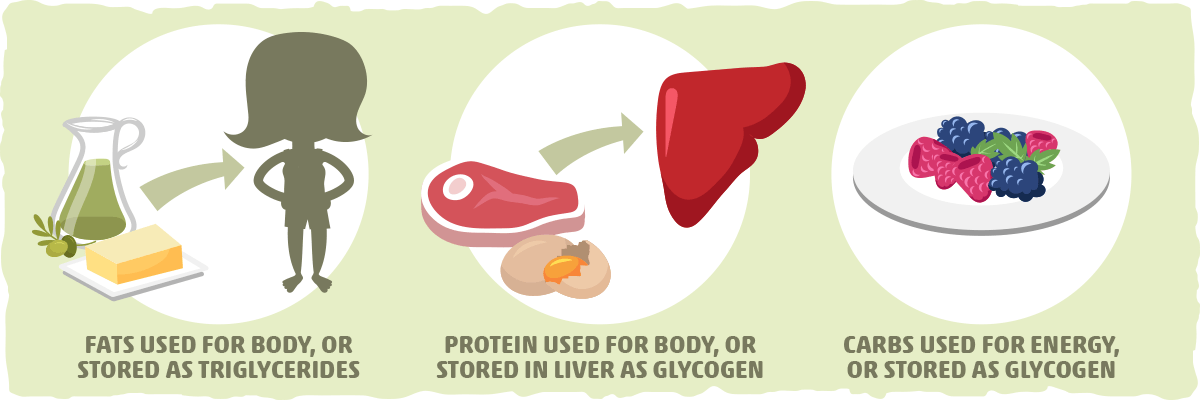
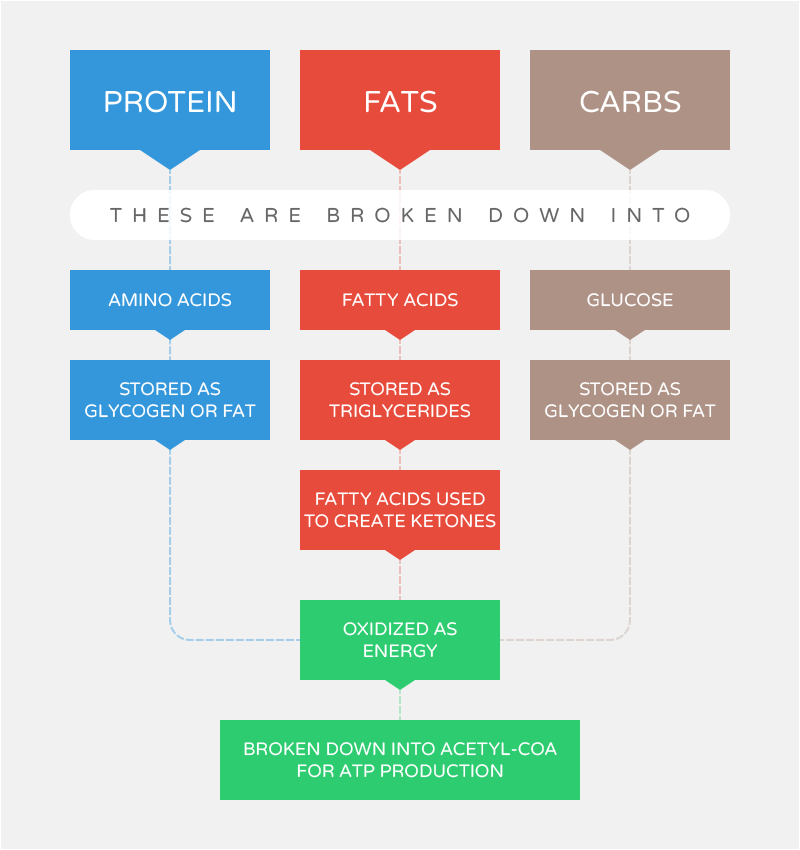
In the fed state (i.e., after we eat a complete meal), the macronutrients we consume are broken down through separate metabolic pathways:
- The fats we eat, except for medium-chain triglycerides, enter the bloodstream through the lymphatic system. Once they enter our circulation, the fats are sent around the body to provide fuel for our heart and other tissues, repair cells, and make different chemicals, hormones, and tissues in the body. Excess fats are stored as triglycerides in the fat cells throughout the body.
- Proteins are processed into amino acids through a process called transamination and sent off to create neurotransmitters, enzymes, non-essential amino acids, and other protein-based compounds. If we have any extra amino acids, they circulate and repair tissue or get converted into glucose and stored as glycogen (our storage form of glucose).
- Most of the carbohydrates we consume are broken down into glucose which is used as an immediate energy source. When our glucose levels increase, the pancreas secretes insulin into the blood. This helps shuttle the glucose into our cells to be used as energy or stored as glycogen or fat for future use.
The fasting state occurs when our blood glucose is at a borderline level, which also means our insulin levels are decreased. With this drop in blood glucose, insulin’s opposing hormone, glucagon, will be secreted, triggering the release of stored fuel from glycogen and fat cells.
Fasting State
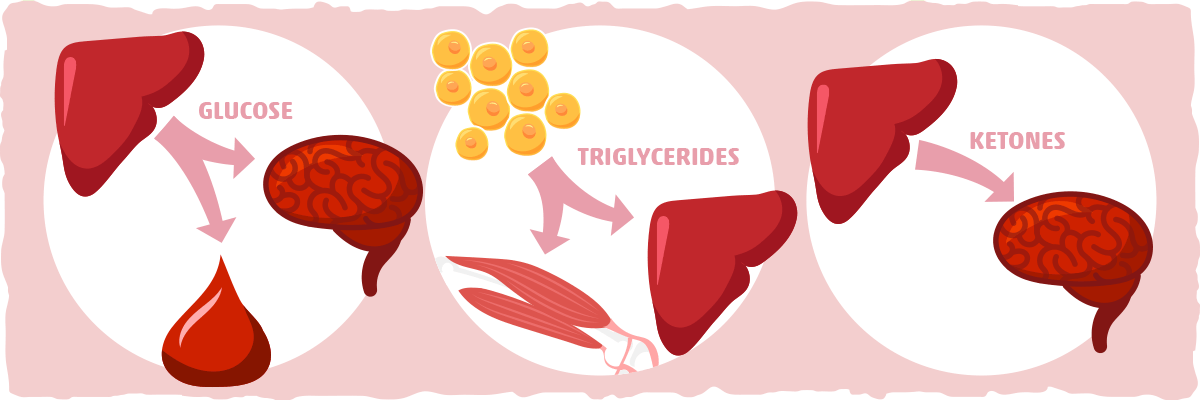
In a fasting state, our stored energy sources, such as glycogen, fat, and muscle, are broken down by different processes and metabolized into the same fuel. Each one is converted into acetyl-CoA, which is an important part of creating ATP (our primary energy shuttling molecule) in the Kreb’s Cycle.
When liver glycogen is released, glucose levels increase in the bloodstream. In turn, this glucose is primarily used by the brain and red blood cells.
Free fatty acids are released from the fat cells that are in the form of triglycerides. These are the primary fuel source for the liver and muscles while we are sleeping or doing low-intensity exercise like walking.
The liver will also form ketones from these fatty acids, which our brain uses for fuel when blood sugar isn’t available in abundance (our brain cells don’t use fatty acids for fuel). More fatty acids from stored fat enter the circulation, and more ketones are produced the longer we stay in a fasted state.
Starved State
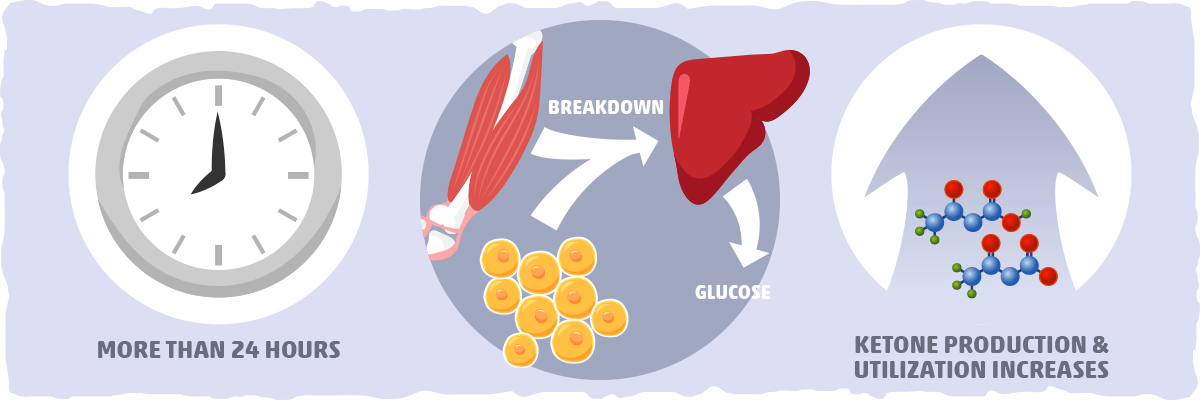
Once we have been in a fasting state for longer than 24 hours, we transition into a starved state. The glycogen in our muscles and liver will run out.
The liver will begin to break down lactate, amino acids (from muscle), and glycerol (from stored fat) to create more glucose to meet the sugar needs that ketones cannot help with.
Ketone production and utilization will start to increase significantly until it supplies around 50% of the body’s basal energy requirements and 70% of the brain’s energy needs. This will help prevent excess muscle loss and maintain cognitive function when calorie intake is significantly restricted.
How does this all relate back to the keto diet? By restricting carbs, we are essentially mimicking a starved state without actually starving ourselves. Without a regular influx of dietary carbs, the body will have to adapt by becoming a fat and ketone burning machine.
However, since the keto diet allows you to consume plenty of nutrients, you will not have to experience the muscle loss or unhealthy decreases in metabolic rate that occur as a result of actual starvation.
In other words, keto dieting allows us to experience the benefits of carb restriction and ketones without having to starve ourselves.
At first, following a keto diet can be a bit tricky. To get into ketosis, you must eat the right amount of carbs, fats, and protein based on your needs, activity levels, and goals. This can be a lot to balance when you are first starting out, so let’s take a closer look at each macronutrient one by one and make them easier digest.
Protein and the Keto Diet
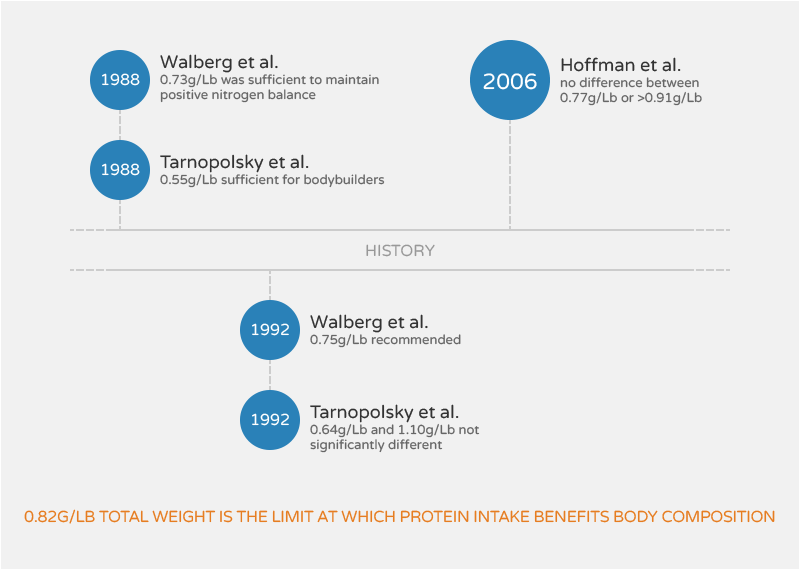
Protein plays a vital role in every diet, but it can be a confusing nutrient while you are on the keto diet. If you don’t eat enough protein, you will lose muscle mass. You might be thinking “well, I can just eat more and more meat to keep my muscle as I lose the fat.” Well, that would be pretty delightful, but consuming massive amounts of protein can also raise insulin levels to the point that it kicks you out of ketosis.
As we learned earlier in this post, protein is 46% ketogenic and 54% anti-ketogenic, meaning that too much of the stuff can decrease ketone production. We have to fall between narrow ranges in our protein intake: enough to maintain or gain muscle mass without impairing ketone production.
This narrow range is quite hard to determine, as it varies from person to person based on their body composition goals, activity levels, current body composition, and body weight. Some have reported trouble maintaining ketosis if they eat excessive protein in a single day, or if they eat too much protein in 1 sitting. Others can have more than 1.2g of protein per pound of body weight and experience no issues with transitioning into and staying in ketosis.
After digging through the research on protein intake, we’ve found these ranges to work best for most people:
- Sedentary: 0.8g of protein per pound of lean body mass.
- Lightly Active: 0.8 – 1.0g of protein per pound of lean body mass.
- Highly Active: 1.0 – 1.2g of protein per pound of lean body mass.
In general, I recommend trying to get away with eating as much protein as you can (I.e., stay around the higher end of your protein intake range). This may be a striking suggestion after learning that protein has anti-ketogenic properties, but we mustn’t forget about the other benefits that protein can have for us.
The Importance of Protein for Your Health and Diet Success
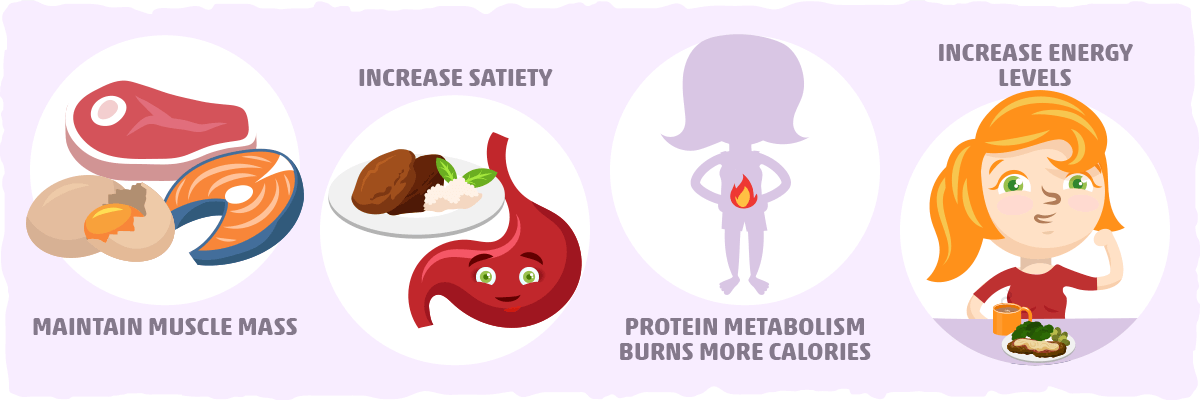
Getting the right amount of protein every day plays a crucial role in the results you get. Here is a list of the main benefits that adequate protein intake can have for you:
- Maintain (or gain, if you do resistance training) muscle mass. Want to lose fat without burning off your muscle along with it? Eat plenty of protein and make sure you exercise throughout the week. Both play an essential role in chiseling your body into shape.
- Decrease cravings and increase your feelings of fullness. Some research suggests that protein is the most satiating macronutrient, which means that it can help you eat fewer calories and lose weight without having to fight against hunger and cravings. In other words, by increasing your protein intake, you can make your diet much easier to sustain and your results much easier to attain.
- Burn more calories than you would while eating an equal amount of fat or carbs. Protein metabolism requires much more energy than fat or carb metabolism. This means that your body has to burn more calories in order to make use of the protein you consume, making it less fattening than the other macronutrients.
- Increase energy levels. Despite the fact that you will be burning ketones for fuel, your body is still going to need some sugar to energize certain cells and metabolic processes. Fortunately, you can provide your body with sugar without eating it. How is this possible? Via a process called gluconeogenesis. During this metabolic process, your liver helps turn specific amino acids from protein into sugar. If you eat enough protein, it will be turned into sugar and stored as glycogen that can help increase your energy levels.
Altogether, these benefits will help enhance your weight loss results while making it much easier for you to stick to the keto diet for the long term. As soon as you figure out how to reap these benefits (by using our keto calculator and/or experimenting with different protein intake levels), you will be ready for the next step: meeting your daily protein needs.
How to Get Enough Protein While Following the Keto Diet
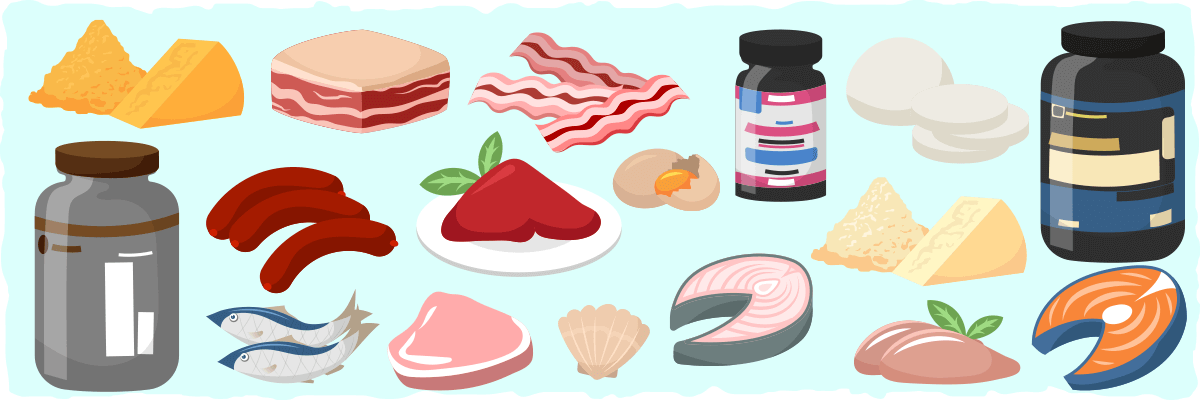
Need help meeting your protein needs while keeping your carbs low? Add one or more of these keto-approved protein sources to your meals:
- Fish. Preferably eating anything that is caught wild like catfish, cod, flounder, halibut, mackerel, mahi-mahi, salmon, snapper, trout, and tuna. Fattier fish is better.
- Shellfish. Clams, oysters, lobster, crab, scallops, mussels, and squid.
- Whole Eggs. Try to get them pasture-raised from the local market if possible. You can prepare them in any way you’d like.
- Stick with fattier cuts and 100% grass-fed when possible.
- Pork. Ground pork, pork loin, pork chops, tenderloin, and ham. Watch out for added sugars and try to stick with fattier cuts.
- Poultry. Chicken, duck, quail, turkey, pheasant and other wild poultry.
- Organ Meat. Heart, liver, kidney, and tongue. Offal is one of the best sources of vitamins, antioxidants, and minerals.
- Unconventional Meat Veal, goat, lamb, and other wild game. Stick with fattier cuts when possible.
- Bacon and Sausage. Check labels for anything cured in sugar, or if it contains extra fillers. Don’t be overly concerned with nitrates.
- Cheese. Cheddar, mozzarella, parmesan, and other hard cheeses. Always purchase full-fat cheeses.
- Keto-Friendly Protein. 100% grass-fed whey protein, collagen protein, casein protein, pea protein isolate, and any other very low-carb protein powders.
For those of you who are trying to cut down on any animal products, please check out our guide to vegan keto dieting. There you’ll find plenty of vegan-friendly protein sources as well.
However, as you munch on these delicious, keto-friendly protein sources, don’t forget about your ketone levels. As we learned earlier, protein has anti-ketogenic properties.
For the most part, if you stick to the recommended protein intake ranges, you should be able to get into and stay in ketosis without any issues. On the other hand, for those of you who are struggling with keto or want to learn more about protein and ketosis, I suggest check out our in-depth article on the topic.
Fats and the Ketogenic Diet
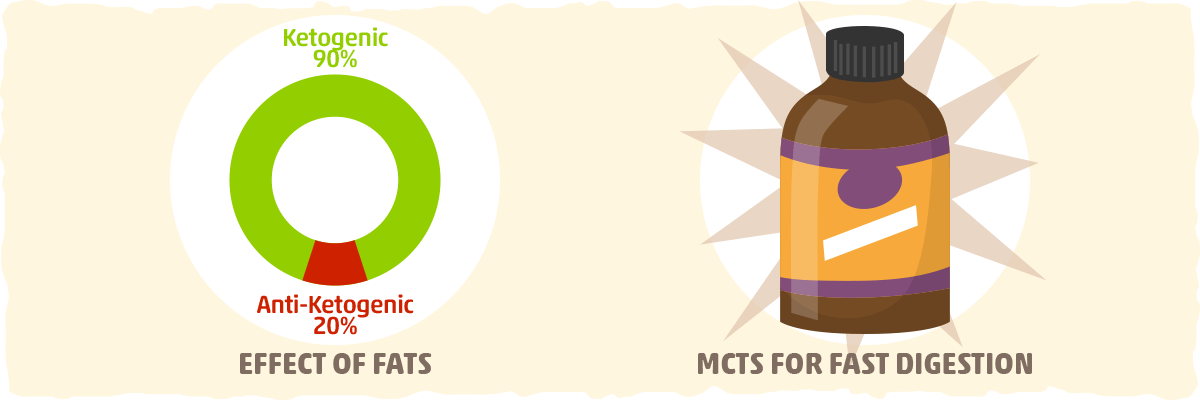
Fats are 90% ketogenic and only 10% anti-ketogenic, so we can get away with significant amounts of fat intake without it having any impact on our ketone levels.
Yes, the glycerol from triglycerides can be converted into glucose, but this will have a negligible effect on ketosis at most. Since fats are mostly consumed over the entire day and not just in 1 sitting, your body will be using the glucose that can be produced from glycerol without you even noticing it’s there.
The only time in the day that you may have to deviate from a consistent fat intake is after a workout. Fats slow down the digestion process and will slow the absorption of the protein you intake after your workout, so they’re not recommended.
With that being said, you can get away with consuming fat after (or before or during) your workouts as long as that fat is coming from medium chain triglycerides (MCTs). MCTs are digested so rapidly that they will not slow protein absorption.
How to Figure Out Your Fat Needs and Meet Them
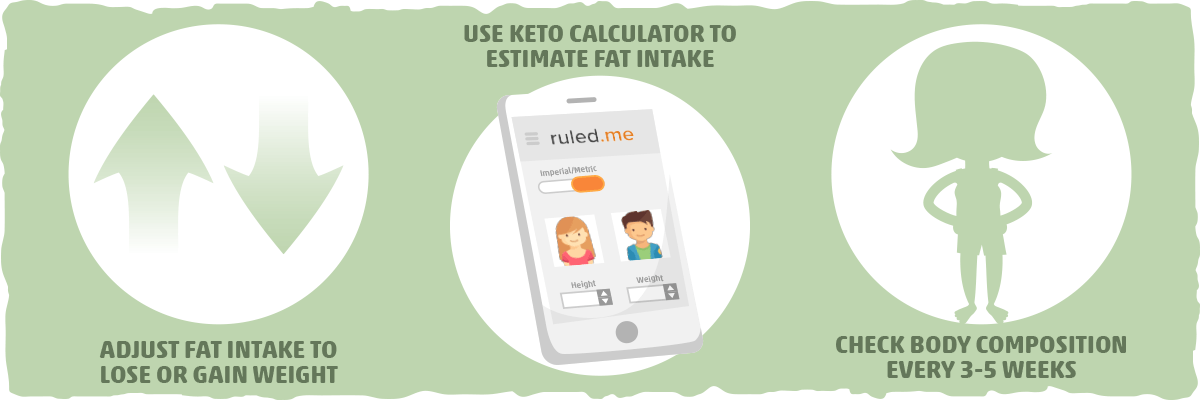
Since fat will be your primary source of calories on the keto diet, you will have to increase or decrease your fat intake to manipulate the rate at which you gain or lose weight.
Although you can guesstimate how much fat you need to eat based on the results you get, I recommend using our keto calculator as a starting point. It will give you an estimated fat intake goal based on your height, weight, gender, activity levels, and goals.
By staying relatively close to what the calculator suggests, you should be able to get the results you are looking for. To ensure that you are on the right track, check your body composition after 3-5 weeks and follow the recommendations from our article titled “How Much Fat Should You Eat on a Ketogenic Diet” if you are not getting the results you want. In that article, you will also find plenty of information and strategies that will help you meet your fat needs.
Carbohydrates on Keto
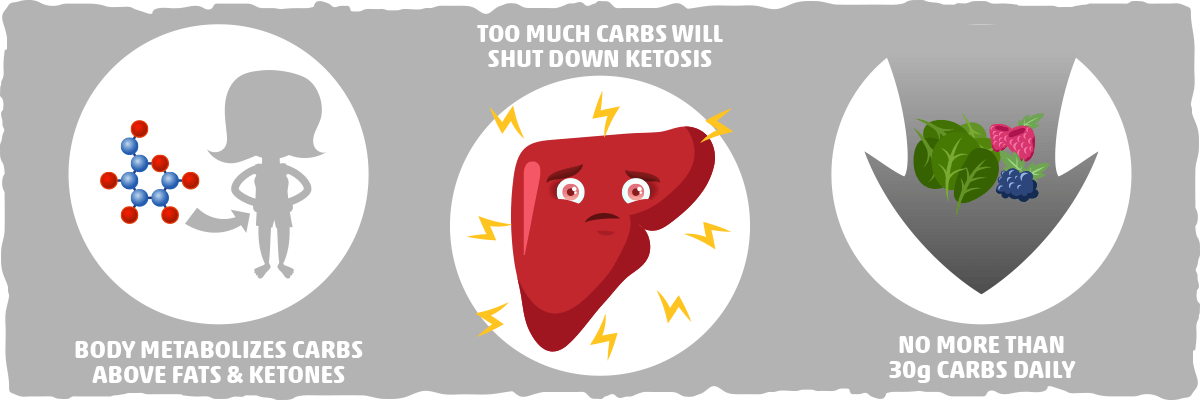
Carbs have the most profound effect on ketosis out of every macronutrient. When we ingest carbohydrates, our bodies will metabolize it first regardless of how much fat or ketones we are burning at the time. In fact, the amount of fat and ketones that you burn will decrease as your carb consumption increases.
This occurs because carbs are broken down into glucose, which can be used by almost every cell in the body as soon as its needed. When enough glucose is available, the liver will stop producing ketones and focus on processing the sugars as a way to prevent an accumulation of too many energy substrates.
To ensure that your daily food intake doesn’t get in the way of ketone production, the general rule is to consume no more than 30g of carbs a day. Although you can eat slightly more carbs and stay ketosis, 30 grams is generally a good place to start for most people. If you’d like to learn how to adjust your carb intake without impairing your keto diet results, I recommend checking out our article titled “How To Find Your Ketogenic Diet Carb Limit.”
But Won’t Fat Make You Fat? What About Carbs? The Science Behind Fat, Carbs, Weight Gain, and Weight Loss
The complex question of what causes us to lose and gain fat has been hotly debated for decades. Obesity is still on the rise in many westernized countries, and the current diet advice doesn’t seem to be helping.
One side of the spectrum claims that fat consumption is to blame. After all, fat is a whopping 9 calories per gram, and since it is already made of fat, it can easily be stored in our fat cells, right?
On the other side stands the hypothesis that carbs are the culprit. More specifically, when we eat excess sugar, we cause a massive insulin spike that tells our fat cells to store fat. As insulin levels stay high (as a result of a high carb diet), it prevents us from burning our stored fat for fuel and losing weight.
Both sides of the spectrum sound like they could be true, and to some degree, they are both right. Yes, fat CAN make you fat. There are biological mechanisms that turn the components of the fat we eat into stored fat.
However, this doesn’t mean that carbs can’t provoke fat storage as well. In fact, carbs can both provoke fat storage and be converted into fat.
When we look at the issue of weight loss and weight gain from another angle, dozens of high-quality studies show that both low-carb and low-fat diets can be used to help us lose fat. In fact, meta-analyses have found that there isn’t much difference in weight loss between the two diets after a year. Interesting, right?
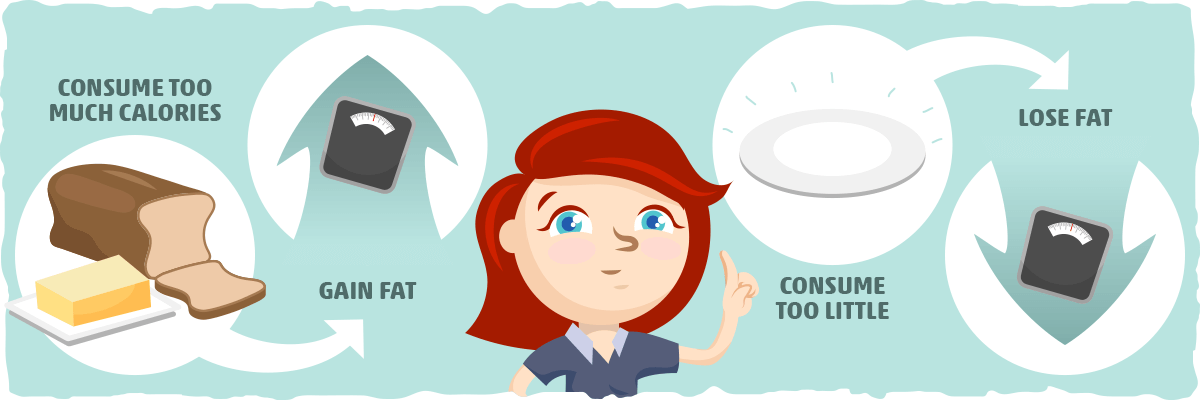
The one variable that can help us bring the biological mechanisms and research data together is calorie consumption. Although it isn’t an exact science, the calories we eat and burn play the most significant role in determining whether or not we gain or lose weight.
In other words, fat and carbs don’t make you fat, but they can be stored as fat. What determines if they are stored as fat is the energy needs of your body at the time those macronutrients are consumed.
In general, when we are in calorie excess (i.e., we consume more energy than our body needs to maintain its weight and metabolic functions at any given time), we will tend to store them as fat for later use. Whether carbs or fat will be stored as fat depends on the content of your diet.
As an example, if you were to eat absolutely no carbs at all, yet consume so much fat that you were in a calorie excess, then you would store that fat as fat. The fat didn’t make you fat, your excess energy intake did.
The same holds true if you were to eat a ridiculous amount of carbs and no fat at all. Those carbs would eventually be stored as fat, not because carbs are a fattening macronutrient, but because being in a calorie excess is literally fattening.
Wow! That was a lot of science. Let’s see if we can distill all of this down into practical strategies you can use to help you lose weight with keto.
Practical Applications – How to Eat the Right Macros to Get the Results You Want with the Keto Diet
Your easiest option is to use our keto calculator to provide you with an estimate of your recommended macronutrient intake. To help you keep track of how much you are actually eating, we recommend using a calorie tracker like MyFitnessPal or Cronometer. If you need help setting it up check out our step by step guide on how to track carbs (and calories) on keto.
For those of you would like to dive deeper into each macronutrient, you will probably find what you are looking for in these articles:
- How Much Fat Should You Eat on a Ketogenic Diet?
- Is Too Much Protein Bad for Ketosis? The Truth Behind How Much Protein You Need on Keto
- How To Find Your Ketogenic Diet Carb Limit
Sources:
- Ketosis and The Ketogenic Ratio – Body Recomposition
- A model for determining total ketogenic ratio (TKR) for evaluating the ketogenic property of a weight-reduction diet – Science Direct
- Ketogenic Ratio, Calories and Fluids: Do They Matter? – NCBI
- The effects of high protein diets on thermogenesis, satiety and weight loss: a critical review. – NCBI
- Diet induced thermogenesis – NCBI
- Optimising foods for satiety – Science Direct
- The regulation of ketogenesis. – NCBI
- Intestinal lipid absorption – NCBI
- Digestion and absorption of fats – University of Washington
- What is Ketosis? – Ruled.me
- Keto & Weight Loss — ruled.me
- Obesity Energetics: Body Weight Regulation and the Effects of Diet Composition. — NCBI
- Effects of low-carbohydrate vs low-fat diets on weight loss and cardiovascular risk factors: a meta-analysis of randomized controlled trials — NCBI Bookshelf
- Very-low-carbohydrate ketogenic diet v. low-fat diet for long-term weight loss: a meta-analysis of randomised controlled trials — British Journal of Nutrition
- Effect of 6-month calorie restriction on biomarkers of longevity, metabolic adaptation, and oxidative stress in overweight individuals: a randomized controlled trial. — NCBI
- Effect of Protein Intake on Strength, Body Composition and Endocrine Changes in Strength/Power Athletes — NCBI
- Dietary Guidelines should reflect new understandings about adult protein needs — NCBI
- Skeletal muscle metabolism is a major determinant of resting energy expenditure. — NCBI
- Controversies in Metabolism — The University of New Mexico
- Factors determining energy expenditure during very-low-calorie diets. — NCBI
- A systematic review of dietary protein during caloric restriction in resistance trained lean athletes: a case for higher intakes. — NCBI
- Energy expenditure before and during energy restriction in obese patients. — NCBI
- Adaptive thermogenesis in humans — NCBI
Hi Criag! I’d like to say again, your AWESOME. I can’t find the previous comment that I would like to refer to, but back on July 21st (-ish) I posted and asked you about my slow weight loss and stalling. You helped me figure out my macros as I was only eating 1000 calories per day. You told me to up the calories and weigh myself in 2 weeks….
Weeellll….
2 days after I increased from 1000 to 1565 calories, I gained 2 pounds (258 to 260)…I stopped weighing and today I weighed in, 9 days later (not 2 weeks like you told me to because I was anxious) and I’m 256. This makes me happy and sad at the same time. (I know I want miracles…) But my lowest weight was back on July 12 of 255 and I hoped to finally break that and keep going. But do you think I’m heading in the right direction now????
I was told I may be eating too much protein as I may be sensitive to it…
My macros are 75%f, 20%p, 5% carbs and 1565 calories. I weigh 256 and I’m sedentary. Thanks for all your help!!!
20% protein is a bit high for a sedentary woman, so you may want to cut back a bit – but it looks like you are heading in the right direction. Make sure you’re getting your water in and stick with it 🙂
Hey Craig, not sure how to do the calculator. I don’t know how much body fat I have. All I know is I’m not supposed to eat over 70 grams protein says my endocrinologist. Can you help me figure out my fat grams, calories, and etc in a day? Thanks.
Michele, you’d have to figure out your bodyfat percentage to use the calculator. There’s many ways to do this from calipers to tape measurements to machines.
Yeah I guessed. I tape but don’t have a conversation tool.
Hi, I love the site: great info!
I do have a question on this part of the post above: “As one of the most restricted nutrients on a ketogenic diet, the carbohydrate has the biggest effect on ketosis. The general rule is to consume no more than 30g of carbs a day if on an SKD.”
When you say 30g of carbs a day, do you mean 30g of net carbs (example, if you had 40 grams carbs, but 20 grams fiber, you would subtract the fiber from the carbs with a result of 30g Net Carbs)? Or, do you mean total carbs, without factoring in fiber? So if you had 40 grams carbs, and 20 grams fiber, you’d still consider the carbs to be at 40 grams.
Thanks!
Hey Nadine,
Yes, you’re correct in saying that I mean net carbs – some people generally restrict their total carbs, but I don’t eat THAT much fiber so I normally just keep to 30g or less net carbs (usually 20g or less).
Excellent, thanks! Relief!
(As a side note, I actually can do math. 40-20=20. I simply made a typo there. 😉 )
Haha, no worries 🙂
Hi Craig,
I’m currently on a ratio of 71/23/6 of F/P/C, and I’m controlling my calorie intake as well. Sometimes at the end of the day I haven’t met my fat intake to meet these ratios, but I just can’t stomach eating anything more, so what will happen if I don’t eat any more fat and my fat ratio drops? Will this throw me out of ketosis?
Thanks!
Georgia, just make sure that your protein ratios are fine. If they are, and you find you can’t eat more fat – then no big deal 🙂
Thanks for that, that sounds good! But I’m still just wondering…if I don’t finish my fat intake for the day, won’t that mean that my protein and carb intakes will be a higher overall percentage of my diet for that day, so my ratios will still be thrown out?
That’s generally why I recommend using the keto calculator so you have the exact amount you need to eat in grams, rather than percentages. That way, you can see how low on the fat spectrum you can go without doing damage to your metabolism. Generally, though, if you are keeping protein low and you can’t reach your fat intake, it’s usually okay.
Hello,
I’m required to consume 100g of protein a day. I’m starting to incorporate light weight training into my weekly exercise routine. What do you recommend eating right after a workout? I was planning to eat acouple pieces of cheese for some protein, but I just read the fat in the cheese will slow down the absorption of the protein. Is a whey protein shake with just water ok? I’ve been trying to stay away from powders as much as possible but it seems like it might be ok in this situation. Also, what are your thoughts on progressive vegegreens?
Thanks a lot,
Matt
ps. Your site is amazing. Thank you so much for your hard work.
Hey Matt and sorry for the late reply. You can consume a protein shake if you’d like or you can also go after a bit of lean protein.
Thanks!
You could use a can of tuna or .25 lbs (112 grams) of chicken breast. Either one is about 100-130 calories and about 26 grams of protein.
Hi…I’m new. I’m also confused. Just starting the ketogenic diet today. I know to stay away from transfats like margarine, but are you saying that all meat is safe to eat, and it’s fat won’t clog the coronary arteries? What does cause the coronary arteries to clog up…Is it mainly the carbs? I’m excited about this diet as a regular diet used to work for me, but since I went through menopause I just can’t lose weight. I have about 35 pounds to take off. Thanks so much…great site!
Normally cholesterol will cause the arteries to clog up (without going into a big explanation). On keto, fats do not cause cholesterol to go up (sometimes it does, but the actual particle count – which is what matters – goes down). I have written a few articles on cholesterol that you can take a read at if you’d like.
One of the main things that causes it is also inflammation, which we see a lot of in high-carb diets.
Anyway, meats are safe – yes. Animal fats are great!
Hey Craig, I try to work out in the morning before work, usually a bit of cardio and some weights. Is it best to have my keto cofee before or after my workout? Should I eat something with less fat prior to my workout? Not sure what would give me the best benefit. Thanks.
If you feel you need the energy, before would be best. It doesn’t necessarily matter when you consume the food. Some people prefer fasted workouts, other’s don’t.
2096kcal Daily Calorie Intake
20g Net Carbs (4%, 80 kcal)
75g Protein (14%, 298 kcal)
191g Fat (82%, 1718 kcal)
My results, I’m trying to lose and get lean like I was. Which program/meal plan do you recommend to download or any ideas would help. Please and thanks in advance!
Most of my meal plans are lower calorie than this. I’d suggest trying to create your own and track what you eat so you can be more specific with your macros.
I’m 5′ 7.5″ 135 lbs yours is actually almost like mine came out, except mine said 1634 cal I did min for weight loss. Which I don’t need I just can’t eat what they say to eat! Even eating fat bomb and walnuts I’m lucky to get 1700. If just cut 400 to 600 off your total kcal intake. My specs came out to 1634 kcal 20 Ncarbs, 65 protein (not enough) 144 fat, I say not enough, because I need to build more muscle. So now you have a reference point. I’ve read do many books with so many formulas I feel like I’m back in physics class! Or med school not sure which.
Hi Craig,
Just wanna become part of this great diet plan, so I was told I got pre-diabetes. How fasting affects it? Thanks! Great job too…
It should help regulate blood sugars – it should help tremendously!
So I’m new to this and have done my calculations.
Cal 1690
g Fat 128g Carbs 20g Protein 115g
cal Fat 1152 Carbs 80 Protein 460
Really? I’m supposed to eat 1152 calories from fat every day?
It’s a high fat diet! 🙂
Hi im new to rhis keto diet how much carbs, protein, and fat do you know to eat
Hi Sally, try using our calculator. It will give you macros tailored to you:
https://www.ruled.me/keto-c…
Help! I started this diet in January. Lost 25lbs but 4 weeks ago I started running every other day and gained 5 lbs. I’ve kept my macros the same. Can’t seem to get rid of this weight. I still have 25 lbs to lose.
Are you measuring inches as well? Is it possible that you are losing inches but staying the same weight because you are gaining muscle from running? If you were not previously as active you might also want to recalculate your macros with your new activity level and see if that helps too.
Thanks for getting back with me. Yes I measure. I finally lost that 5 lbs I gained. It took 3 more weeks to get it off. I’ve lost a little more in size but nothing to brag about. I try and keep my calories 1400-1500. Macros carb 5% protein 20% and fat 75%. I run 3-4 times a week and garden 2-5hours a week.
Ack! I’m glad you’re on the move again. It can be really frustrating when things are going slower than you hope. Keep on going, I know you can do it!
Hey Craig! I love this explanation and specifically the different level of “how ketogenic” macros are, but this has always been the only page I could source this information from which, when discussing with people about this lifestyle, cannot usually be considered impartial review as ruled.me is a keto website, so may I ask you what the source of that is so that people can see that we’re not just telling the story between ourselves basically????
Hey there,
This link will provide you with all the info and resources you’ll need from a non-keto website: https://www.bodyrecompositi…
Fat is just a part of food. Think of macros like they are ingredients. There are foods that are purely fat like coconut oil or olive oil, and there are foods that contain fat along with other things like protein (meats, eggs, etc)
The best way to keep track of how much fat you are eating is to track all of your food. If you use a website like My Fitness Pal it will help you see what is contained in each item that you eat.
Thank you Laura. great name my daughters name….. i am finally getting my head around fat. yes i cook with virgin coconut oil and butter. i used to think eating meat was enough. but now i understand meat is for protein .. and the fats are based on butter and lard coconut oil and lots of other fats. i buy very fatty foods. like pork belly and lamb. i consider these foods to have more fat percentage wise than most meats. . ratio to ratio fat vs protein
thank you for the reply Laura. great name by the way. same as my daughters 😉
Hello 🙂 I’m trying the keto calculator to get my macros. I’m confused as to the values that it gave me. I’m a female, 35 years old, 5 feet 3 inches tall, 155 pounds, visually
estimated fat percentage is 35-39%, with sedentary lifestyle.
The results are these:
Based on your inputs, we suggest you eat: 0 calories. From those, -34g fats, 20g net carbs, and 57g protein
0 calories and -34 g fats are confusing me. Can someone help and explain it to me?
Thank you so much 🙂
Hi Crissie,
You should have got 1225 calories, 102 g fat 20 net carbs and 57 g protein
Hello 😉 thank you for all of the detailed info in this site! I’ve calculated my Macros ( I think 🤔) 53, 142lbs, 5ft 2.5 inches, I picked moderate ? ( I’m an active Yoga instructor but don’t hit the gym regularly ( cardio and wts ).
Been eating keto friendly diet to get used to this way of eating for 2 weeks.
My confusion: Should I be measuring food I eat ? Count calories? If I’m making recipes how do I know what’s in the portion I’m having? I’ve checked ketones with urine sticks ( not much of anything happening ) I’m eating more dairy than I’ve had in years and feel like my fingers are stiff at times..
I will check out fitness pal and see if this will help . Please any suggestions would be greatly appreciated 🙌🏻😊
Michele
Hey Michele,
I think moderately active is good for you.
One of the best ways to keep you on track is by measuring what you eat and tracking your macros.
We have a guide that you can use to help you here:
https://www.ruled.me/carb-t…
And if you think eating so much dairy is becoming an issue, try out some of the dairy alternatives we have in the article:
https://www.ruled.me/guide-…
If you have any other questions, please let me know. 🙂
Hello, I have been on the Keto diet for a little over a month and so far have lost 4.6 kilograms. So far I have been adhering to the 75-20-5 guideline. But today I rechecked my macros and it all changed. Now, here is my info, Male, 179 cms, 126.2 kilos, 47 years old, 40% body fat, moderately active (three times a week, at least 500 calories of excercise, mix aerobic with intervals) 30% deficit, 20 grams net carbs (so far have never exceeded it), and 1 gram protein (never achieved it, always a bit below). According to the calculator I need to get 2032 calories, 143 grams fat, 167 gram protein and 20grams carbs. Here is the thing… according to myfitnesspal, that translates to 40% protein, 75% fat and 5% carbs… what am I not getting here?
Hey Pedro,
It looks like MyFitnessPal is way off. Try adjusting it to these percentages: 65% fat, 30% protein, and 5% carbs. This won’t get you the exact numbers you got from the keto calculator but they’ll be close enough.
If you need anymore help setting up MyFitnessPal, then you are likely to find what you need in our guide on how to use it for tracking carbs and calories on keto:
https://www.ruled.me/carb-t…
Thanks.
i did the math using the macros you provided in the latter half of your post and you are consuming ~63% of calories from fat, ~33% of calories and ~4% of calories from carbohydrates. that all seems to check out and be within proper ranges!
Hi!!! I have a question so I got metabolic testing done in the army for free (husband is military) and the result was RMR is 1933 …..and they suggested to eat no more or less than 1954 a day !!!! I’m 5’1” and 229 lbs with a 54% body fat, I’m 47yrs old I walk 2 miles 3 x a week and so HIIT work out twice a week !!! But when I use ur tool my results are a lot less!!! Please help me understand this !!! What number do I follow to get my macros !!???🤔🤔
There are many different ways to measure RMR and calorie goals which is why you are getting different results.
When using the Keto Calculator, I recommend that you mark yourself as moderately active, enter 0.8 in the protein section, and aim for anywhere between a 20-30% calorie deficit. The numbers that the calculator provides you with will be good macro numbers to aim for.
By eating 1954 calories per day you would lose weight, but at a much slower rate. Increasing the calorie deficit, which is what the keto calc allows you to do, will result in the fastest possible weight loss without starving yourself or impairing your health.
Does this make sense? Let me know if you have any questions.
Here is a link to the Keto Calculator for your convenience:
https://www.ruled.me/keto-calculator/
I have tried the keto calculator several times logging in and out and keep gettting these same numbers. Based on your inputs, we suggest you eat: 0 calories. From those, -45g fats, 20g net carbs, and 81g protein What is wrong? My stats are female 61 yrs 5 ft 260 lbs Dr says 48% body fat sedentary lifesyle
Hey Rosemarie,
If you entered in all of the values that it asked for, it is possible that a browser plugin is disrupting how the keto calculator works for you. Try either using an incognito window or another browser like internet explorer or safari.
Let me know if this helps.
Here is a link to the keto calculator for your convenience:
https://www.ruled.me/keto-calculator/
The keto calculator is confusing. I’m 6’6″ 338 LBS sedentary it says 0 calories -9 grams of fat 20g of net carbs and 0 protein. Can someone help.
Hey Russell,
Try reloading the page and putting in all of your values again. If that doesn’t work, try using a different browser (like safari or internet explorer) or an incognito window.
Here’s a link to the calculator for your convenience:
https://www.ruled.me/keto-calculator/
Please let me know if you are still having problems.
Hi,
First timer here… So I’ve been doing the Keto thing for 3 weeks now. I have noticed some changes in how I feel (way better), smaller appetite, smaller portions and have pretty much lost the cravings for any carbs. I loved anything crunchy, chips, popcorn, etc. I don’t miss that like I thought I would. So that’s a good thing. I’ve also managed to lose some weight, which is why I’m doing this. Couple questions:
Is any amount of sugar going to upset my progress? I put a tiny bit in my coffee, like way less than a teaspoon, but wondered if I’m sabotaging myself. My other question is how do I know exactly how much protein, fats & carbs I’m consuming with my meals? For instance: breakfast is 2 egg & sausage muffins (keto recipe), lunch is salad w/chicken & keto dressing, dinner is keto burger w/mashed cauliflower. I just eat till I’m full. But how would I know what amounts of protein, fats & carbs I’m consuming. Thanks for any info/advice you can
Hello there,
That tiny amount of sugar won’t make much of a difference for weight loss, but it can keep you from getting into deeper levels of ketosis (and ketosis can help boost your energy levels and results). If you want to cut out the sugar and increase your ketone levels, I recommend using the keto-friendly sweeteners that we talk about in this article:
https://www.ruled.me/keto-diet-plan-best-and-worst-sweeteners/
The best way to track your macros (so you know how much protein, fat, and carbs you are consuming) is by using a calorie tracking app. We teach you how to do this in this article:
https://www.ruled.me/carb-tracking-for-keto-diet/
If you have any questions after reading this, please let me know. 🙂
Hey I wanted to know how to count calories?
One of the easiest ways is to use a tracker like MyFitnessPal or Spark People.
Hi. I love your site and am just beginning the Keto diet. I am transitioning from Medifast so have been doing the severe low calories, low carb, no sugar thing for the last 3 weeks. Due to that, my body has already adjusted to most of the restrictions and I’m not sure if that effects the calorie amount I should be eating or if I’m supposed to set limits completely based on my age, current weight and activity level? Your calculator is telling me based on my being 42 yrs old, 5’2, 206 lbs., lightly active with a 45% body fat %, my daily intake should be: 1548 calories of which 133g fats, 20g net carbs, and 68g protein. Can you tell me what percentages these are as it doesn’t compute the same in MyFitnessPal app and is this still what I should use when for the last 3 weeks I have been restricted to 100-1100 calories a day with very high protein and minimal carbs? Just don’t want to have a spike in weight gain.
Hey Kathy,
As long as you are using all of your current measurements, the keto calculator will give you a good starting point.
here’s a link if you need to recalculate:
https://www.ruled.me/keto-c…
For MyFitnessPal, try to adjust the percentages yourself until you get as close as possible to what the keto calculator recommends. Being a bit off is not a big deal at all. If you need more info on how to use MyFitnessPal for keto, check out this article:
https://www.ruled.me/carb-t…
With the calorie intake that you stated in your comment, I don’t think you’ll have any issues from a health or weight gain perspective.
If you ever do find that your weight loss has stalled, you can try implementing one or more of strategies that we have in this article:
https://www.ruled.me/ketoge…
I think that’s all the info you need to answer your questions for now. Please let me know if you need anything else.
Hi, I am seeing several people with the same issue that I had when I first tried to figure my macros. My first results said to consume 0 calories.. – fats.. I also used the visual guide to figure my body fat percentage. What I discovered is, when I clicked the link to the visual aid, it deleted my initial entries of height and weight. So, my results were crazy. I finally realized that when I decided to scroll to the top of the page. Seems everyone that uses the visual calculator needs to re-enter their info, and it will then be correct. This site is crazy awesome! Thank you!
Has anyone found a better tool than my fitness pal? It doesn’t track net carbs and I’d like it to.
My favorite is cronometer. It has a couple of settings specific to keto including net carb tracking.
We have a guide on how to use both cronometer and MyFitnessPal for keto that will help you out:
https://www.ruled.me/carb-t…
Ketodiet app works great for me.
I have LoseIt! and it does net carbs. You do need the Premium version, though. I love that program.
I am also confused by my macro breakdown- I am 5’6, 165lb, I weight train 4 days a week, fasted cardio and core work 3 days a week. My caloric breakdown was 1604 calories. From those, 105g fats, 20g net carbs, and 144g protein. This is totally more doable than I expected given my current diet but I am confused because I am consuming more protein than fat…which is contrary to my understanding of what Keto is…can you please advise?
Thanks
Hey Gloriann,
Depending on your goals, you may have to eat more protein than the general keto guidelines suggest.
If you struggle to get into ketosis with this high protein goal, then try to decrease your intake as much as you can in the protein intake category you selected in the keto calculator.
Does that make sense? If you have any other questions, please let me know.
the reason why gram for gram, you are consuming more protein than fat, fats are 9kal per gram where as protein is 4kcal per gram. so in your specific case, you would be consuming 945 kcal of fat (~60% of calories) where as your protein intake is 576 kcal (~36% of calories).
Hey Mari,
Not a dumb question at all!
Our keto calculator doesn’t cover fiber intake needs. By eating keto foods, most people have no issues with getting enough fiber.
In the United States, the recommended dietary fiber intake is 14g for every 1,000 kcal that you consume per day. While you are on the keto diet, you will be meeting these needs eating low carb vegetable, nuts, seeds, recipes with nut/seed flours, and low carb fruits.
Does this answer your question? If you need anything else cleared up, please let me know.
hello guys i have a few questions. I am starting the veto diet and am slowly progressing into a full involvement into the diet but i was wondering if i drink a low carb protein shake like a dymatize iso 100 which has less than 1 gram of carb would that knock me out of keto if i use 2 scoops and drink a total of 50grams of protein at once? also im trying to keep my protein at 1gram per lb considering i workout with weights 4-5 days a week and im trying to lose weight im currently at 180lb and my initial goal is to drop to 170lbs within a month if possible… any suggestions?
Check out our guide to Keto Bodybuilding, it has some info in it that’ll help you reach your goal:
https://www.ruled.me/compre…
In general, I recommend splitting up your protein intake so that your highest protein meal is consumed post-workout and your other meals have a bit less protein. For example, if you eat 4 keto meals per day, then I recommended eating 50-70 grams of protein at your post-workout meal and 30-40 grams at your other three meals. This approach should prevent your higher protein intake from significantly decreasing your ketone levels.
If you have any other questions, please let me know.
The main problem I have with the calculator is that it treats all men or all women of the same height, weight, and body fat the same. There’s no accounting for frame size, and there should be.
Those with a small- or medium-sized frame won’t have the same bone mass as someone with a large one. That’s just a fact. I’m 6′ 1/2″ tall, but when I stand next to people with a small frame, I look like the teacher of a kindergarten class; and that’s when I was thin. 😉
You’re welcome to check out the formulas that we use. No calculator will ever be 100% correct without a lot more data input, but the studies show that this formula is about 85% correct.
“Fats go straight to the liver to be broken down into fatty acids and glycerol. They are then sent around the body to repair cells and make different chemicals/tissues in the body. Excess fats are stored as triglycerides in the fat cells.”
Are you sure? I just read that dietary fats are absorbed in the duodenum right into the lymphatic system and then released directly into the blood. They don’t touch the liver till after having a chance to be used by the body. Here on Wikipedia citing Gray’s Anatomy: “the fat soluble products of digestion are discharged directly into the general circulation, without first passing through the liver, as all other digestion products do. The reason for this peculiarity is unknown.[29]”
So it sounds like a high dietary fat diet would be easier on the liver, at least as far as digestion goes. A far cry from fructose metabolism, at least, that’s for sure! (not that anyone is advocating for fructose on this site)
Hey Steven,
You are right! Thanks for pointing this out.
We are in the process of updating this article with that information and much more. It should be posted real soon.
Sounds good tyler!
Although strange that you didn’t have this right from the beginning. Not like Gray’s Anatomy is a new book. Perhaps it was just a typo or misconception. You replace liver with duodenum in my quote and bingo!
Anyway, thanks for your informative site. Well-appreciated.
I wasn’t the original author of this article, so I am not sure if it was a typo or misconception.
Thanks for the feedback, Steven!