
Obesity is a rising problem that is increasing on a yearly basis all over the world. It commonly increases a person’s risk for higher cholesterol, cardiovascular disease, and many other health problems. Just a few days ago, we saw a year long study published in a peer-reviewed journal that was done comparing the differences between low-carbohydrate diets vs. low-fat diets.
Although there’s already plenty of studies that have been done on low-carbohydrate diets, I thought this one cemented the view quite well on high fat and low-carb diets in perspective of weight loss, general health, and overall risk factor when it comes to cardiovascular disease. Most other studies don’t include very many people, but this one covers quite a substantial amount of participants where almost half of the participants were African American.
The good news about this study is that it was funded by American tax money – through the National Institutes of Health. None of the authors have any financial ties to the meat industry or food industry in general, which gives a great scientific backing to the information found.
Read more about Effects of Low-Carbohydrate and Low-Fat Diets: A Randomized Trial
Definitions
In this study, low-carb was considered anything under 40g of carbs a day. Low-fat was defined as less than 30% of total calories coming from fat, with less than 7% saturated fats. Both groups received dietary counseling throughout the trial to make sure they were able to stick to their plan.
Weight Loss

The dashed line is the low-carb group.
The study showed that participants in the low-carb groups that they tested lost more weight than those in the low-fat group. Overall, waist sizes came down more in the low-carb group, and general health increased in the low-carb group compared to the low-fat group.
Not only was there a significant weight loss difference, but the actual fat mass and inflammation of the low-carb group was decreased more than the low-carb group. On average, the low-carb group saw a 1.5% increased fat mass loss.
At the end of the year, the low-carb group saw:
- Lower Waist Sizes
- Significantly Lower Lean Mass Loss
- Lower Fat Mass
- Lower Inflammation
Cholesterol
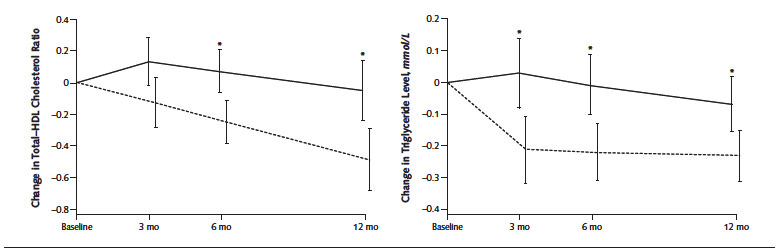
The dashed line is the low-carb group.
This study aimed not to just measure the weight loss aspects of low-carb, but also the health benefits. We saw that those in the low-carb group actually had lower cholesterol and lower risk of heart disease at the end of the 12 month study. In fact, the people in the low-carb group were at a significantly lower risk assessment for heart disease according to the 10-year Framingham risk score.
Total cholesterol levels were reduced by 0.44 mmol/L for the participants in the low-carb group. Triglycerides were also down by 0.16 mmol/L, and HDL (good cholesterol) increased by 0.18 mmol/L.
At the end of the year, the low-carb group saw:
- Lower Total Cholesterol Levels
- Lower LDL Cholesterol Levels
- Higher HDL Cholesterol Levels
- Higher Total-HDL Cholesterol Ratios
- Lower Triglyceride Levels
- Lower Blood Pressure
General Living
Besides measuring the amount of weight loss and cholesterol levels, but they also measured general feelings and averse reactions of the participants.
What they saw in the low-carb group was:
- Less Constipation
- Less Fatigue
- Less Headaches
- Less Diarrhea
- Less Heartburn
- Less Gas
The perception gained from this study is that living on a low-carb diet is significantly better quality of life than those that are going through the low-fat dieting phases.
Participants
Researchers chose 148 obese people who did not report any history of cardiovascular disease in their family. Participants ranged between the age of 22 and 75 with a body mass index of 30 to 45. They were then randomly assigned (by a computer, stratified by sex) to either group A (low-carbohydrate) or group B (low-fat).
During the one full year, participants were allowed to go to counseling sessions and a nutritionist to make sure that they were meeting their macronutrient intake values.
Overall Conclusion
The researchers took in-depth analysis of blood and measurements at 3, 6, and 12 months intervals. The participants on the low-carb diet had lost more weight than those on the low-fat diet. At 12 months in, those in the low-carb group actually lost an average of 7.7 pounds more than those in the low-fat group.
Considering that the majority of participants did not exercise throughout the study, this is quite substantial! The participants were instructed to keep the same levels of activity as they had before, which also shows that exercise was not the reason of this increased weight loss. In fact, the funny thing is, is that the low-fat group tended to have a higher activity level than those in the low-carb group.
Overall, blood levels of fats that show as predictors for cardiovascular disease decreased more in the low-carb group. Researchers wrote that the low-carb diet was more effective for both weight loss and cardiovascular risk factor reduction than those dieting in the low-fat group.
What are your thoughts about this? News to you, or does it just cement what you already believed? Let us know in the comments below!



I definitely agree with the less gas thing – before keto I was incredibly gassy (thanks IBS), now I barely get any at all!
Me too! Glad you’ve been finding good experiences 🙂
This is good news. We need more science to convince the nay-sayers. This is still a pretty divisive topic.
I agree Linda – I think that this study was able to have a decent sample size, it will be one of the big ones that shift the mindset in the low-fat preachers. One can hope 😉
I like the results. But a combo of low carb and low fat worked fantastic for my 100lb. weight lose back in 2012/2013. Maintaining and losing, last 20lbs. slowly but surely.
I don’t doubt it works for some people, Catherine, I just normally see people that do low-fat/low-carb end up losing some extra muscle mass and not in-taking enough calories (resulting in metabolic damage and a good chunk of weight being put back on afterwards). To each their own, I was just summarizing the study that was published 🙂
As someone who has tried both a low fat diet and low carb diet, I agree with this study. For years I did low fat diets on and off and as a result my weight yoyo’d significantly. I find low fat diets extremely hard to maintain and would end up fatigued, irritable, hungry, gassy, even depressed. I wish I’d known about LCHF diet years ago, but it went against everything you would read about by doctors, the media, school education etc. I’ve been overweight since I was a child and now as a 23 year old doing keto, I feel like I’m taking the right step for my health for the first time.
Glad to hear you think you’re making the right decision Kim. It certainly goes against everything we were taught, but I think with the more and more studies that are coming out on the topic, we’ll start to see a big shift in the mindset of doctors and nutritionists in the near future 🙂
Thanks and definitely! I can’t wait for doctors to start acknowledging the benefits. I kind of enjoy the unpopularity of the diet though. I get the feeling that once it becomes mainstream knowledge, our food prices will go up as companies jump on the opportunity. I also don’t want the market flooded with processed crap as they try to compete with one another to make the cheapest alternatives. There’s a few good, healthy brands in Australia to pick from at the moment for things like almond meal and coconut oil.
For sure Kim. It seems that many of the more modern/up to date doctors are starting to support this lifestyle a lot more. Even some are carrying out their own studies which is great to see. That said, I don’t think we’ll have to worry about the processed food companies for a long time since many of their manufacturing processes took them so much money to create in the first place – they will try to live it up until the very last penny, no doubt.
I’m sure the low-fat group was more active because plenty of sugar was flowing through their bodies. I’d like to have seen BG numbers on the two groups–both fasting and pre/post-prandial.
I bet (by LC standards) the low-fat group was a mass of pre-diabetics who didn’t have a clue.
I agree with you Wenchy. I took a look at the study and the BG levels weren’t indicated, but I am guessing what you are. Oh well, ignorance is bliss, right? 😉
Keto diet is working for me. I don’t pass as much as I did before Keto. My bowl movements are fewer and my IBS is gone. My weight has dropped quite a bit and my waist has shrunk two inches. I have more mental clarity and my energy level has improved. The best part is that the girls like my new body. Now I have to overcome my low libido.
Sounds like you’re doing really well Eddie! A bit strange that your libido dropped, though, as many people report increased libido on low-carb diets.
But my husband’s and my own cholesterol went UP after our doc put us on a very low carb diet! She expected it to go down, but it didn’t. I’m just going in for my 9 month check up after being put on the diet, but 6 months after it had gone up 10 points. I refused statins, she has me on cholestyramine, so we won’t know what happens at this checkup. My ratios were much better, however.
Lauren,
It’s sometimes common to see triglycerides go up in the beginning of starting a ketogenic diet, but normally LDL drops quite significantly. You can see rises of HDL (a good thing, and should happen) but usually you see a healthier overall profile of cholesterol. I was just reporting on what the study had reported 🙂
From what I’ve read, low-carb diets cause ketosis which causes trigycerides to dump into the blood when fat is burned. It is recommended that cholesterol levels are not checked until 6 months after losing weight so that numbers aren’t misleading.
That is correct – though not all low carb diets cause ketosis. The participants in this study were not in ketosis (judging by their carb intakes).
I was a kid in the 70s and watched while the USDA decided that low fat high carb was the way to go. I never got obese on that, mainly because I had a good metabolism until my thyroid quit working, and I rarely overate. But I watched as the nation got fatter and fatter. The sheer numbers of overweight kids now days should wake up the most oblivious. I remember when fat kids were made fun of in school- now it’s the norm! The government with their food pyramid and their attempts at dictating what we eat has caused this obesity epidemic. When will they understand that they need to back the low-carb WOE to get people back on track?
I suppose it is much more complicated than that – imagine how the grain industry must be in bed with big government…
Oh, all the processed food companies are in bed with the government. There’s millions being spent on lobbying alone, it’s nuts. But I guess once people start switching to healthier diets like paleo and keto, we’ll start to see a change – and that time is soon coming I think.
I’m new to the Keto style LCHF diet and I feel great, FINALLY losing weight. Ive been on the govt’s low-fat-loaf-of-bread-a-day diet for 12 years and couldn’t lose weight for anything! I started with the Paleo diet (of sorts) and that worked for the first 10, then I plateaued. The Keto diet got me back to losing and i have 10 more to go. People like me with low thyroid DO NOT need to be eating all those carbs–it blows us up like a zepplin. Thanks for the website, books and blog posts.
Thanks for sharing your story MG, it sounds like keto is really doing wonders for you! I am also low thyroid/no thyroid with Hashimoto’s and found that this was a really great way to lose weight. Keep it up! 🙂
I’ve had debilitating migraines as long as I can remember– it got to the point where I was having as many as 3 a week (for reference, 3 a month is considered medically alarming). Drugs weren’t making them less frequent or less severe, just emptying my wallet. I started a ketogenic diet as a last-ditch, desperate attempt at SOMETHING, ANYTHING that might help, after reading the peer-reviewed literature on ketone-fueled brain function in children with epilepsy.
That was last December. In the nine months since, I’ve only had migraines after eating sugar (“it’s your birthday of course I’ll have a slice of your cake”). For me, low carb means no migraines. No hiding under the covers for hours because the slightest photon of light will send me into a dizzying puke-fit. Low carb means I get to have a life again.
Wow, that’s awesome news Evan. I had my dad switch over to keto also because he was having 7+ migraines a month. He was using a pill that costed him $140 per pill which is ridiculous and it had started to lose its effect. He went keto for some time, and it helped, but subsequently went off of keto and the migraines started coming back. I guess for some people they’d rather get the migraines if it means they get their bread – but I am certainly happy that it’s working so well for you!
I’ve been semi-keto for about 6 months (lost 25 lbs) and I recently got lab work showing my total chol is 313 and my trig about 90 and HDL is good but my LDL is high. Due to this the Dr wants me on statins and I have only heard bad news about them. Advice, please? I should probably tell you that, as a result, I gave him a copy of Cholesterol Clarity with a note asking him to read what I’ve been reading… Am I in trouble, or what? Statins!!!
I wouldn’t go for the statins but I’d certainly ask him for a full particle test.
Keto is working well… I think we all have done some sort of LFHC dieting and results were slow and ended up with cravings, health issues, and fast plateaus. The only concern I wondered about with LCHF was could this cause gallstone issues. Many that have these issues state that it actually came from when they were on a high carb diet…
There have been quite a number of cases where gallstones and kidney stones are formed on high fat diets. But eating foods like spinach (to balance pH) and drinking plenty of water will cause this not to happen. In fact, there was a study done on Epileptic children where the percentage was reduced from around a 20% stone rate to around a 0.2% stone rate.
great info… i certainly get my share of water in… hey a cream spinach recipe would be awesome!
I have a couple between the books and the site 😉
I would like to see this type of article dated when written. I have no idea if it’s current.
The study came out late 2014. It’s still a relevant article but it is somewhat dated by today’s standards.
Thank so much for the answer )