


“Won’t I lose all my muscle on keto?” It’s one of the first questions people ask when they consider cutting carbs. And honestly, it’s a fair question. Carbohydrates have been tied to muscle growth in mainstream fitness culture for decades – the idea that you need glycogen to train hard and insulin spikes to grow is deeply embedded.
But the research tells a different story than the gym-floor conventional wisdom. After years of helping people build and maintain strength on keto through ruled.me, I can tell you that the fear of muscle loss is one of the most overstated concerns in the keto conversation. It’s not that there’s zero nuance here – there is. But the blanket claim that “keto eats muscle” doesn’t hold up when you look at the actual data.
This article goes deep on what the research shows about keto and muscle loss: what meta-analyses and RCTs found, why some people do lose muscle on keto (and what they’re doing wrong), how BHB directly protects muscle tissue, and the specific protein and training strategies that make the difference. No bro-science, no fear-mongering – just the evidence.
What we’ll cover:
- Does Keto Cause Muscle Loss?
- What the Research Says: Meta-Analyses and RCTs
- Why Some People Lose Muscle on Keto
- How Keto Protects Muscle: BHB’s Anti-Catabolic Effects
- Protein Targets on Keto for Muscle Preservation
- Training on Keto: Resistance Training Is Non-Negotiable
- Common Mistakes That Cost Muscle on Keto
- Key Takeaways
- FAQ
Does Keto Cause Muscle Loss?

The short answer: no, not when protein and training are handled correctly.
The concern comes from a reasonable-sounding chain of logic. Carbs stimulate insulin. Insulin is anabolic (it helps shuttle amino acids into muscle cells). Therefore, removing carbs must be catabolic. The problem is that this logic skips several important steps – including the fact that protein also stimulates insulin, that ketones themselves have anti-catabolic properties, and that your body doesn’t just start cannibalizing muscle because you stopped eating bread.
The confusion also comes from water weight. When you start keto, you lose glycogen stores and the water bound to them. Glycogen is stored in muscle tissue, so when it depletes, your muscles look and feel slightly smaller. This is not muscle loss – it’s glycogen depletion, and it’s fully reversible. But on a scale or even in the mirror, it can look alarming in the first week or two.
What determines whether you lose muscle on any diet – keto or otherwise – comes down to three variables: adequate protein intake, sufficient total calories, and resistance training stimulus. Get those three right on keto, and muscle loss is not a significant concern. Miss any of them, and you’ll lose muscle on any diet, not just keto.
What the Research Says: Meta-Analyses and RCTs
The strongest evidence on this question comes from a 2025 systematic review and meta-analysis that pulled together 33 controlled studies examining the ketogenic diet’s effects on muscle mass, strength, and performance in adults.A 2025 meta-analysis of 33 studies published in the Journal of Health, Population and Nutrition found no significant differences between ketogenic diets and other dietary interventions for muscle mass, muscle power, or strength in adults. The analysis covered both trained and untrained populations. The conclusion: no significant differences in muscle mass, muscle power, or strength between ketogenic dieters and those on other diets. That’s 33 studies, pooled together, showing that keto does not uniquely destroy muscle tissue.
A 2024 review published in iScience found similar results – significant weight loss on keto that reduced body fat without affecting muscle or bone mass.A 2024 iScience review found that ketogenic diet interventions produced significant weight loss while reducing body fat without affecting muscle or bone mass, and without adverse metabolic changes. The weight came from fat stores, not from lean tissue.
A 2021 meta-analysis specifically examining resistance training combined with ketogenic diets analyzed 13 RCTs and found that while keto significantly decreased fat mass (-2.21 kg) and body weight, the fat-free mass changes were context-dependent.A 2021 meta-analysis of 13 RCTs examining resistance training combined with ketogenic diets found significant reductions in body mass, fat mass, and body fat percentage. Fat-free mass showed small reductions, but the effect was modulated by protein intake and training volume. When protein was adequate and training volume was maintained, lean mass was largely preserved.
Then there’s the Wilson et al. study, which is particularly interesting for people who lift. Twenty-five resistance-trained men followed either a ketogenic diet or a traditional western diet for 10 weeks while doing the same training program.Wilson et al. (2017) studied 25 resistance-trained men on either a ketogenic diet or western diet for 10 weeks with identical resistance training. The KD group gained 2.4% lean mass at week 10. After carbohydrate reintroduction at week 11, lean mass increased to 4.8% above baseline, while fat mass decreased by 2.2 kg in the KD group. Both groups gained lean body mass – the keto group gained 2.4% at week 10. When they reintroduced carbs during week 11, lean mass jumped to 4.8% above baseline. Fat mass dropped by 2.2 kg in the keto group versus 1.5 kg in the western diet group. The keto group also saw a significant increase in testosterone.
That last finding about carb reintroduction is worth noting. Some of the lean mass “gain” after reintroducing carbs likely reflects glycogen and water refilling muscle tissue. But even at week 10 – deep in ketosis – the keto group had still gained lean mass while losing more fat than the control group.
The evidence is fairly clear: when protein intake is adequate and resistance training is in the picture, keto does not cause meaningful muscle loss. It may slightly blunt maximum hypertrophy compared to a higher-carb approach with the same protein, but that’s a different claim than “keto eats muscle.”
Why Some People Lose Muscle on Keto
If the research shows keto preserves muscle, why do some people clearly lose lean mass when they switch? Almost always, it comes down to one or more of three mistakes.
Not Eating Enough Protein
This is the most common problem by far. Early keto advice emphasized keeping protein “moderate” out of fear that excess protein would convert to glucose through gluconeogenesis and “kick you out of ketosis.” That fear is largely unfounded – gluconeogenesis is demand-driven, not supply-driven, meaning your body doesn’t ramp up glucose production just because amino acids are available.Nuttall et al. (2008) demonstrated that the rate of gluconeogenesis remains remarkably stable across widely varying metabolic conditions, supporting the demand-driven model. Protein availability does not proportionally increase hepatic glucose output.
But the damage from that outdated advice persists. People start keto eating 50-60g of protein a day – barely enough to maintain muscle mass for a sedentary 120-pound person, let alone someone active and heavier. At that intake level, muscle loss is not a keto problem. It’s a protein deficiency problem.
Eating Too Few Calories Overall
Keto naturally suppresses appetite – that’s one of its advantages for fat loss. But some people take the appetite suppression too far and end up in a severe calorie deficit without realizing it. When your deficit is too aggressive (more than about 25-30% below maintenance), your body starts pulling energy from everywhere it can, including muscle tissue. This happens on any diet, but keto’s appetite-suppressing effect makes it easier to accidentally under-eat by a large margin.
No Resistance Training
Your muscles need a reason to stick around. Without a training stimulus – specifically resistance training – your body has no strong signal to preserve lean tissue during a calorie deficit. The “use it or lose it” principle applies regardless of your macronutrient ratio. A complete exercise program on keto that includes strength training is the single most reliable way to protect muscle during weight loss.
How Keto Protects Muscle: BHB’s Anti-Catabolic Effects
Here’s the part that doesn’t get enough attention. Not only does keto not inherently cause muscle loss – the metabolic state of ketosis actively provides muscle-protective mechanisms that other diets don’t.
Beta-hydroxybutyrate (BHB), the primary ketone body circulating during ketosis, has direct anti-catabolic effects on skeletal muscle. A 2022 study published in Cell & Bioscience mapped out the mechanisms in detail.This 2022 study in Cell & Bioscience found that D-3-hydroxybutyrate (BHB) maintains anabolism/catabolism balance of muscle protein via the Akt/FoxO3a and mTOR/4E-BP1 pathways. BHB significantly inhibited loss of muscle weights, myofiber sizes, and myofiber diameters in hindlimb unloaded mice. BHB maintains the anabolism/catabolism balance of muscle protein through two key pathways:
- The Akt/FoxO3a pathway – BHB activates Akt signaling, which inhibits FoxO3a. FoxO3a, when active, turns on the ubiquitin-proteasome and autophagy-lysosome systems – the two main cellular programs that break down muscle protein. By suppressing FoxO3a, BHB puts a brake on muscle protein breakdown.
- The mTOR/4E-BP1 pathway – BHB supports mTOR signaling, the primary pathway that drives muscle protein synthesis. This means BHB doesn’t just slow down muscle breakdown – it simultaneously supports the building side of the equation.
In animal models, BHB significantly inhibited loss of muscle weights, myofiber sizes, and myofiber diameters during disuse conditions. It also facilitated positive protein balance and enhanced accumulation of glutamate in wasting muscles – a direct marker of anabolic activity.
There’s another layer to this. Research has shown that BHB actually potentiates leucine-mediated mTOR activation.Research on leucine-enriched nutrients and mTOR signaling has shown that ketone bodies potentiate leucine-mediated mTORC1 activation, resulting in higher rates of leucine-mediated protein synthesis. This suggests that ketosis may enhance the muscle protein synthesis response to dietary protein. Leucine is the amino acid that triggers muscle protein synthesis – it’s the reason protein recommendations for muscle preservation emphasize leucine-rich sources. BHB makes the leucine signal stronger. In practical terms, this means the protein you eat while in ketosis may be more effective at stimulating muscle protein synthesis than the same protein eaten outside of ketosis.
Think about what this means: people worry that keto destroys muscle, but the metabolic state of ketosis – which you reach at 20-30g net carbs per day – is producing a molecule that actively protects it through multiple mechanisms. The fear has it backwards.
Protein Targets on Keto for Muscle Preservation
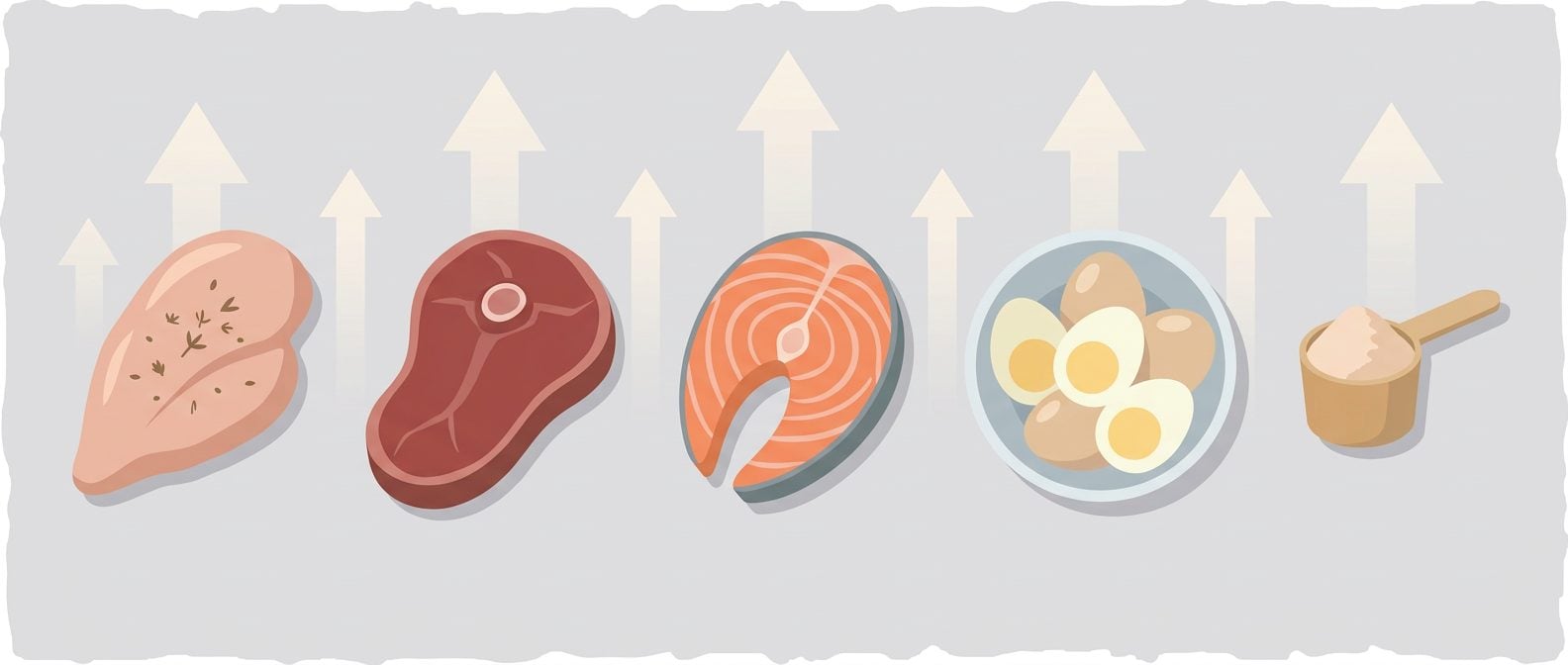
Getting your protein right is the single most important variable for muscle preservation on keto. More important than your carb count, your fat ratio, or your ketone levels. Here’s what the research supports.
Daily Protein Target: 0.7-1.0g Per Pound of Body Weight
This is the range that consistently appears in the literature for preserving lean mass during weight loss.A systematic review and meta-analysis of protein intake and muscle mass found that protein intakes of 0.7-1.0g per pound of body weight (1.6-2.2g/kg) provided the best outcomes for lean mass preservation and muscle function in healthy adults, particularly during calorie restriction. For a 180-pound person, that’s 126-180g of protein daily. On the higher end if you’re actively training and trying to grow muscle, closer to the lower end if you’re primarily focused on fat loss while preserving what you have.
This might seem high if you’ve been following old-school keto advice about keeping protein “moderate.” But research on protein and ketosis has shown that these intakes don’t meaningfully impair ketone production in most people. The gluconeogenesis concern is overstated – as we covered, it’s a demand-driven process. Eating more protein doesn’t force your body to make more glucose.
Per-Meal Protein: 25-30g Minimum
Muscle protein synthesis operates on a threshold system. Research shows that approximately 25-30g of protein per meal is needed to maximally stimulate the mTOR pathway and trigger a meaningful protein synthesis response.Research published in JISSN found that approximately 25-30g of protein per meal maximally stimulates muscle protein synthesis in both young and older adults, with the key trigger being approximately 2.5-3g of leucine per sitting. Below that threshold, you get a weaker anabolic signal. Above it, the returns diminish – though recent evidence suggests they don’t completely plateau the way older studies implied.
The practical takeaway: spread your protein across 3-4 meals, with each meal containing at least 25-30g. Skipping breakfast and then trying to eat 150g of protein in two meals isn’t as effective as distributing it across the day. A common distribution that works well: 35g at breakfast, 40g at lunch, 45g at dinner, 30g as a snack or post-workout. Use the keto calculator to dial in your specific targets based on your stats.
Leucine-Rich Protein Sources
Not all protein is equal for muscle preservation. Leucine content matters because leucine is the specific amino acid that triggers mTOR activation. The threshold for maximal mTOR stimulation is about 2.5-3g of leucine per meal. Good keto-friendly leucine sources include:
- Chicken breast (2.5g leucine per 4 oz)
- Beef (2.4g leucine per 4 oz)
- Eggs (about 0.5g per egg – you need 5-6 eggs to hit the leucine threshold)
- Whey protein (2.5-3g leucine per scoop)
- Salmon and other fatty fish (2.0g leucine per 4 oz)
Training on Keto: Resistance Training Is Non-Negotiable
No dietary strategy – keto or otherwise – replaces the muscle-preserving stimulus of resistance training during weight loss. This is the one variable that, if missing, guarantees some muscle loss regardless of how well you handle your nutrition.
A study on overweight women combining a ketogenic diet with resistance training found that the combination conserved lean body mass while reducing body fat.Jabekk et al. (2010) found that resistance training in overweight women on a ketogenic diet conserved lean body mass while reducing body fat, demonstrating that the combination of keto and strength training is effective for body recomposition. The women didn’t just maintain muscle – they maintained it while losing fat, achieving the body recomposition result that matters more than the number on the scale.
Here’s what to keep in mind about training on keto:
Expect a performance dip in weeks 1-3. Your muscles are still calibrating their fuel systems. Glycogen-dependent performance (high-rep sets, explosive movements) will feel harder initially. This is temporary. After fat adaptation, most people find their strength returns to baseline or close to it.
Strength and power hold up well. A 2024 meta-analysis examining ketogenic diets and strength performance in trained men and women found that keto did not significantly impair strength outcomes in most contexts.A 2024 systematic review and meta-analysis of the effects of ketogenic diets on strength performance in trained men and women found that strength outcomes were not significantly impaired by ketogenic dieting in most study designs. You might lose a rep or two at the top end during adaptation, but your working weights don’t need to crash.
Volume matters more than intensity for muscle preservation. During a calorie deficit on keto, maintaining your training volume (total sets and reps) is more protective of muscle mass than chasing maximum lifts. Three to four sessions per week hitting each muscle group twice is a solid framework. The complete training guide for keto covers programming specifics.
Don’t skip post-workout protein. The window isn’t as narrow as old gym culture suggested, but getting 30-40g of protein within a couple hours of training supports the muscle protein synthesis response. If you’re doing intermittent fasting on keto, plan your training in the feeding window rather than deep in a fast.
Common Mistakes That Cost Muscle on Keto
Based on years of reader questions and troubleshooting, here are the patterns I see most often when someone is losing muscle on keto:
1. Following “high fat, moderate protein” too literally. Some people interpret keto as a fat-first diet and eat 75% of their calories from fat while keeping protein at 15%. That’s a recipe for muscle loss. Protein should be set first (0.7-1.0g per pound), then fat fills in the remaining calories. Fat is a lever, not a goal – especially during weight loss.
2. Aggressive calorie deficits. Eating 1,000 calories a day on keto because you’re “not hungry” will cost you muscle. Keto suppresses appetite effectively, which is a feature – until it leads to a 40-50% calorie deficit. If you’re losing more than about 1-1.5% of your body weight per week, you’re probably losing lean mass along with fat. Slow down.
3. Cardio without resistance training. Running, cycling, and swimming are all fine on keto. But if cardio is your only exercise modality during a calorie deficit, you’re not providing the stimulus your body needs to prioritize muscle preservation. Add resistance training at minimum two to three times per week.
4. Not tracking protein. “I eat enough protein” is what everyone says until they track it for a week. Most people overestimate their protein intake by 20-30%. Track it for at least a week to calibrate your intuition. The macronutrient guide can help with the math.
5. Worrying about ketone numbers instead of protein intake. Chasing higher ketone readings by cutting protein is counterproductive. Moderate ketone levels (0.5-1.5 mmol/L) with adequate protein will preserve more muscle than deep ketosis (3.0+ mmol/L) achieved by starving your muscles of amino acids. The ketone number is not the goal – body composition is.
6. Ignoring the adaptation period. The first two to three weeks of keto feel rough. Energy drops, strength dips, and the scale moves fast (mostly water). Some people interpret this as “keto is eating my muscle” and either quit or make irrational adjustments. Give your body four to six weeks to fully adapt metabolically before judging body composition changes.
Key Takeaways
- A 2025 meta-analysis of 33 studies found no significant difference in muscle mass or strength between ketogenic dieters and those on other diets.
- The three variables that determine muscle preservation on any diet are protein intake, calorie sufficiency, and resistance training – not carbohydrate intake.
- BHB (the primary ketone body) has direct anti-catabolic effects on muscle through the Akt/FoxO3a and mTOR/4E-BP1 pathways, and potentiates leucine-mediated muscle protein synthesis.
- Aim for 0.7-1.0g protein per pound of body weight daily, with 25-30g per meal minimum. Gluconeogenesis is demand-driven, so higher protein intake won’t “kick you out of ketosis.”
- Resistance training 3-4 times per week is the strongest muscle-preservation signal during any weight loss diet, including keto.
- Most muscle loss on keto traces back to inadequate protein, excessive calorie restriction, or absence of resistance training – not the metabolic state of ketosis itself.
FAQ
Does keto cause muscle loss?
Not when done properly. A 2025 meta-analysis of 33 studies found no significant difference in muscle mass between ketogenic dieters and those on other diets. The key variables are protein intake (0.7-1.0g per pound of body weight), resistance training, and total calorie intake. When protein is adequate and you’re lifting, keto preserves lean mass while preferentially burning fat. The people who lose muscle on keto are almost always under-eating protein, under-eating calories overall, or not doing any resistance training. Learn more about how protein works on keto.
How much protein should I eat on keto to preserve muscle?
Aim for 0.7-1.0 grams per pound of body weight daily, distributed across 3-4 meals with at least 25-30g per sitting. This range consistently shows up in the research as sufficient for lean mass preservation during weight loss. The concern that high protein intake “kicks you out of ketosis” is overstated – gluconeogenesis is demand-driven, not supply-driven, meaning your body won’t convert extra protein into glucose just because it’s available. Use the keto calculator to dial in your specific protein target.
Can you build muscle on a keto diet?
Yes, though keto may not be optimal for maximum hypertrophy compared to a higher-carb approach with similar protein. Wilson et al. found that resistance-trained men on a ketogenic diet gained lean mass (2.4% at week 10), and after reintroducing carbs at week 11, lean mass jumped further to 4.8%. The data suggests keto supports muscle maintenance and moderate growth effectively, but if your primary goal is maximum muscle gain, a targeted or cyclical ketogenic approach with carbs around training may give a slight edge. For more on training approaches, see the complete guide to exercise on keto.
Does ketosis break down muscle for glucose?
This is one of the most common misconceptions about keto. Gluconeogenesis – the process of making glucose from non-carb sources – is demand-driven, not supply-driven. Your body produces only the glucose it needs, and that rate stays remarkably stable regardless of protein availability. In ketosis, your brain and muscles shift to using ketones and fatty acids for the majority of their energy needs, which dramatically reduces glucose demand in the first place. The net effect is less reliance on gluconeogenesis, not more. Understanding how gluconeogenesis works clears up this concern quickly.
What are BHB’s muscle-sparing effects?
Beta-hydroxybutyrate (BHB), the primary ketone body in circulation during ketosis, has direct anti-catabolic properties. Research published in Cell & Bioscience found that BHB maintains the anabolism/catabolism balance of muscle protein through the Akt/FoxO3a and mTOR/4E-BP1 pathways. In animal models, BHB significantly inhibited muscle weight loss, preserved myofiber size, and enhanced protein balance. BHB also potentiates leucine-mediated mTOR activation, meaning it may enhance the muscle protein synthesis response to dietary protein. Learn more about what BHB is and why it matters.
The information in this article is not medical advice and is not a substitute for professional medical guidance. Always consult your doctor before making notable dietary changes, especially if you have a pre-existing health condition or take medication.
Sources
- Effects of ketogenic diet on muscle mass, strength, aerobic metabolic capacity, and endurance in adults: a systematic review and meta-analysis (2025) – Journal of Health, Population and Nutrition / PubMed
- The impact of a ketogenic diet on weight loss, metabolism, body composition and quality of life (2024) – iScience
- Effects of resistance training combined with a ketogenic diet on body composition: a systematic review and meta-analysis (2021) – PubMed
- Effects of Ketogenic Dieting on Body Composition, Strength, Power, and Hormonal Profiles in Resistance Training Men – Wilson et al. (2017) – PubMed
- Mechanism of reduced muscle atrophy via ketone body (D)-3-hydroxybutyrate (2022) – Cell & Bioscience / PubMed
- Leucine-Enriched Nutrients and the Regulation of mTOR Signalling and Human Skeletal Muscle Protein Synthesis (2016) – PMC
- Regulation of hepatic glucose production and the role of gluconeogenesis in humans – Nuttall et al. (2008) – PubMed
- Systematic review and meta-analysis of protein intake to support muscle mass and function in healthy adults (2022) – PMC
- How much protein can the body use in a single meal for muscle-building? (2018) – PMC
- Resistance training in overweight women on a ketogenic diet conserved lean body mass while reducing body fat – Jabekk et al. (2010) – PubMed
- Effects of the Ketogenic Diet on Strength Performance in Trained Men and Women: A Systematic Review and Meta-Analysis (2024) – PubMed